Mobile App Development Services: Practical Strategies to Accelerate Business Growth
-

- Published Updated
- 481 views
Introduction
Mobile application development services are a core growth engine for modern businesses — they turn customer needs into measurable revenue, improve operational efficiency, and create new engagement channels. This guide explains how those services work in practice, which business outcomes they influence, and how to evaluate providers and project approaches to maximize return.
Detected intent: Informational
Mobile application development services and business outcomes
Mobile application development services cover planning, UI/UX design, native and cross-platform engineering, backend integration, testing, deployment, and ongoing maintenance. Typical outcomes include higher customer retention through improved UX, incremental revenue via in-app purchases or subscriptions, cost reductions from process automation, and stronger customer insights from analytics and telemetry.
Where these services add the most value
Customer-facing growth
Apps increase engagement by enabling push notifications, personalized experiences, offline functionality, and tighter integration with device capabilities (camera, GPS, sensors). App store optimization (ASO) and retention-focused features (onboarding flows, in-app messaging) translate engagement into measurable growth.
Operational efficiency
Internal mobile solutions can digitize field workflows, reduce paper, and sync data in real time with backend systems via APIs or backend-as-a-service (BaaS) platforms. This lowers error rates and accelerates task completion.
Common service types and technology choices
Understand trade-offs between native apps (platform-optimized performance and UX), cross-platform frameworks (shared code, faster time-to-market), and progressive web apps (lightweight, browser-based). Terms to know: native, hybrid, cross-platform, React Native, Flutter, SDK, API, CI/CD, DevOps, and app store policies.
MOBILE Growth Framework (named checklist)
Use this concise checklist to align teams and scope projects:
- M — Measure: Define KPIs (retention, ARPU, task completion time).
- O — Objectives: Map business goals to app features (acquisition, engagement, ops).
- B — Build MVP: Prioritize features that validate value fast.
- I — Integrate: Plan APIs, authentication, analytics, and third-party services.
- L — Launch & Learn: Release to a pilot audience, measure, iterate.
- E — Extend: Scale platform, add automation, and optimize performance.
Real-world example: Retail chain streamlines loyalty and checkout
A mid-size retail chain used mobile application development services to replace a paper-based loyalty program. The project built a cross-platform app integrated with the POS system and CRM, added barcode scanning for rapid checkout, and implemented push-based promotions. Within six months, repeat visits increased by 18% and average basket size rose 9%—measurements tied directly to app feature adoption.
Practical tips for choosing and running mobile projects
- Prioritize metrics: Start with a short list of measurable KPIs, such as 30-day retention and conversion rate from push notifications.
- Align stakeholders: Create a product roadmap that maps features to business outcomes before selecting a vendor or stack.
- Test for performance: Include real-device performance testing in the plan; poor app performance is a leading cause of abandonment.
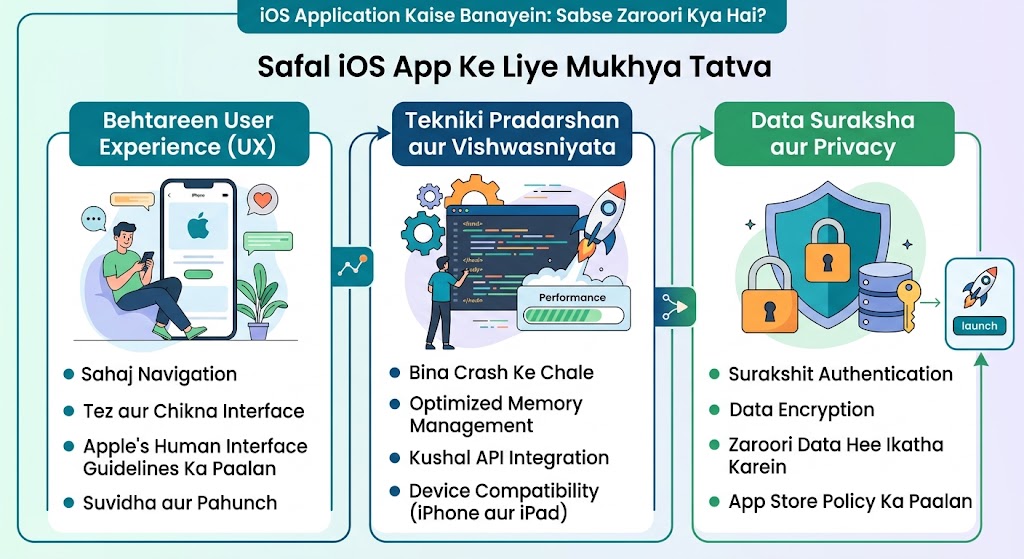
- Plan security: Follow OWASP Mobile Top 10 guidance for common vulnerabilities and secure data practices (OWASP Mobile Top 10).
Trade-offs and common mistakes
Trade-offs
Choosing native development yields the best UX and performance but increases cost and time for multiple platforms. Cross-platform approaches reduce development effort but may require engineering workarounds for platform-specific features. Progressive web apps lower distribution friction but cannot access all device capabilities and may offer weaker retention.
Common mistakes
- Skipping user research: Building features without validated user needs leads to low adoption.
- Ignoring privacy and permissions: Over-requesting permissions reduces trust and increases uninstall rates.
- Under-budgeting maintenance: Apps require continuous updates for OS changes, security patches, and analytics-driven improvements.
Core cluster questions
- How should businesses measure ROI from a mobile app?
- When is cross-platform development a better choice than native?
- What security controls should be standard for enterprise mobile apps?
- How to design onboarding flows that increase retention?
- Which KPIs matter most for B2B mobile tools versus B2C apps?
Practical implementation checklist
- Define top 3 KPIs and target improvements (e.g., +10% retention in 90 days).
- Select a tech approach tied to constraints (native vs cross-platform vs PWA).
- Create an MVP release plan with measurable experiments.
- Set up CI/CD, crash reporting, and analytics before launch.
- Plan a 90-day roadmap for iterative improvements based on telemetry.
Measuring success and scaling
Track acquisition cost per user, retention cohorts, session length, conversion funnels, and revenue per user. Use A/B testing and feature-flag systems to validate changes safely. For enterprise apps, monitor operational KPIs such as time-to-complete tasks and error rates.
Next steps for decision-makers
Start with a short discovery sprint to validate assumptions, quantify expected gains, and estimate engineering effort. Use the MOBILE Growth Framework checklist to keep the team aligned and choose a development approach that matches business priorities and technical constraints (e.g., cross-platform app development, mobile app strategy consulting).
FAQ
How do mobile application development services boost ROI?
They create direct channels for recurring revenue (subscriptions, purchases), improve retention through superior UX and personalization, and reduce operational costs by digitizing processes. Measuring ROI uses pre-defined KPIs and attribution across acquisition and in-app events.
What is the difference between native and cross-platform development?
Native development builds separate apps for each platform for maximum performance and access to platform features. Cross-platform development shares code across platforms to reduce time and cost, with potential trade-offs in fine-grained platform-specific behavior.
How long does a typical mobile app project take?
Small MVPs often take 8–12 weeks. Feature-complete consumer apps typically require 4–9 months, depending on complexity, integrations, and compliance requirements.
What security practices should be included in mobile projects?
Implement secure authentication, encrypt sensitive data at rest and in transit, validate inputs, and perform regular penetration testing. Refer to industry best practices such as the OWASP Mobile Top 10 for common threats.
Can existing web platforms be reused for mobile?
Web backend systems can usually be reused via APIs, but front-end components and UX will likely require redesign to meet mobile expectations and performance constraints.