How an HR Chatbot Simplifies Team Communication: Practical Guide & Checklist
-

- March 04th, 2026
- 218 views

Get a free topical map and start building content authority today.
Organizations that adopt an HR chatbot for team communication reduce friction around routine HR tasks, speed answers to employee questions, and centralize policy and payroll information in conversational form. This guide explains how HR chatbots work, where they add the most value, and provides a ready-to-use CHAT framework and checklist to assess readiness.
- What this covers: use cases, implementation checklist, privacy considerations, and trade-offs for an HR chatbot for team communication.
- Core deliverables: faster responses to HR queries, automated HR assistant capabilities, and searchable knowledge base access across channels.
- Includes: CHAT framework, practical tips, a short real-world scenario, and five core cluster questions for further content planning.
Detected intent: Informational
How an HR chatbot for team communication works
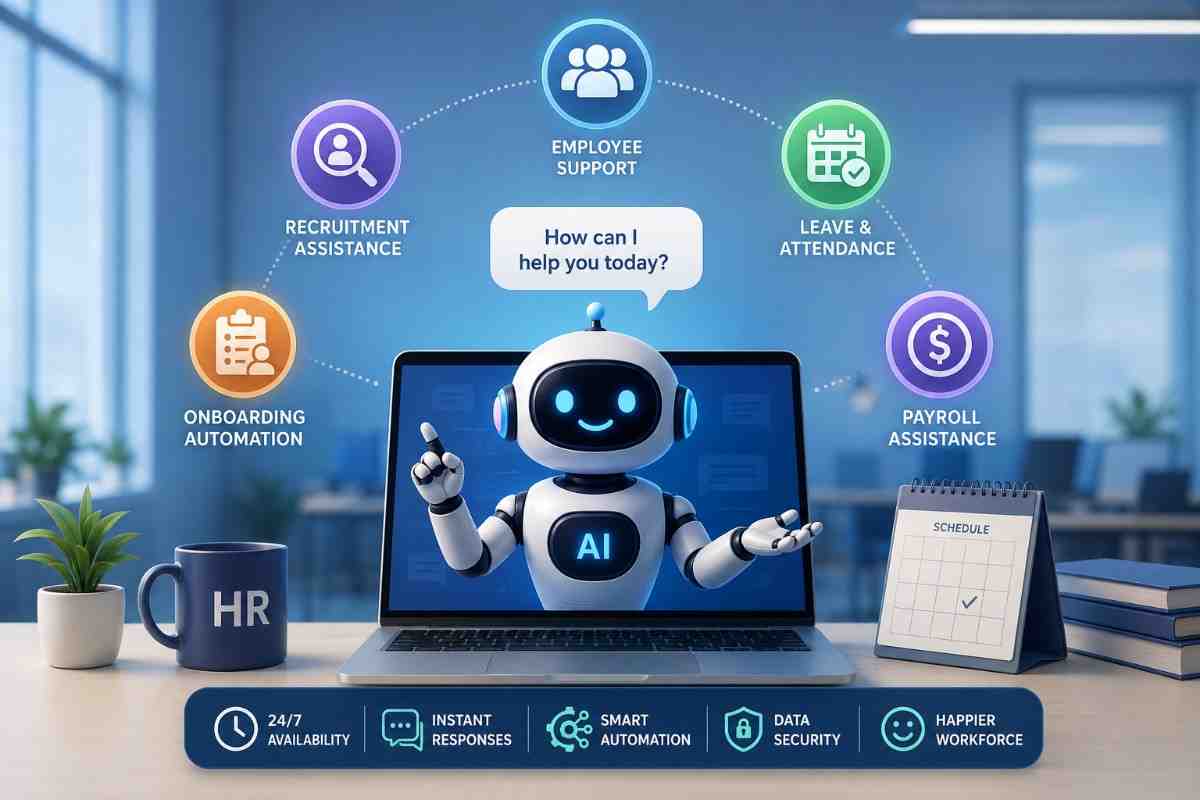
An HR chatbot for team communication is an automated conversational agent that uses predefined workflows, a knowledge base, and natural language techniques to answer employee questions and complete common HR processes. Typical features include employee self-service for payslips and leave, onboarding checklists, simple policy lookups, and routing complex issues to human HR staff. Related technologies and terms include NLP (natural language processing), HRIS integration, single sign-on (SSO), and conversational UX design.
Key use cases and benefits
Primary benefits are task automation, consistent policy answers, and faster employee resolution times. Common use cases include:
- On-demand access to company policies, payroll dates, and benefits summaries.
- Automated leave requests and time-off balances linked to HRIS or payroll systems.
- Onboarding workflows for new hires with scheduled reminders and document checklists.
- First-line triage for grievances or payroll problems, escalating to HR when needed.
- Answers to frequently asked questions across collaboration platforms (Slack, Teams, email).
CHAT framework: a practical readiness checklist
Use the CHAT framework to evaluate readiness and risks before rollout:
- Clarify objectives — Define the top 5 HR tasks the chatbot must handle (e.g., payslips, leave, policies, onboarding, IT access).
- Harvest content — Build a maintained knowledge base: policies, step-by-step procedures, and FAQs with clear sources and owners.
- Authentication & access — Plan integration with HRIS and SSO, and define role-based responses where privacy or security matter.
- Train & test — Create conversation flows, test with small user groups, and measure intent recognition accuracy before full launch.
Implementation checklist
Follow this short checklist to move from concept to live service:
- Identify 3–5 priority use cases with clear success metrics (reduction in HR tickets, time-to-answer).
- Map data sources (HRIS, payroll, policy repository) and obtain API access or scheduled syncs.
- Create a moderated knowledge base and assign content owners for updates and version control.
- Define escalation rules and human fallback flows for sensitive or ambiguous queries.
- Run a pilot with 50–200 users, measure accuracy and satisfaction, then iterate before scaling.
Privacy, compliance, and governance
Data handling and privacy are central. For any HR chatbot that stores or processes personal data, align with applicable regulations and internal policies. Guidance from regional privacy frameworks should inform retention and access controls — for example, review official GDPR guidance for handling employee personal data during automation: GDPR guidance. Implement role-based access to conversation logs, encrypted storage, and a documented data retention schedule.
Real-world example: onboarding assistant scenario
Scenario: A mid-sized company implements an HR chatbot to support onboarding. New hires receive a chat link and an automated onboarding flow: verify personal details, submit direct-deposit info, complete benefits selections, and schedule orientation. The chatbot checks each step off and sends reminders. Result: average time-to-complete onboarding tasks drops from 7 days to 2 days, and HR staff spend 40% less time on routine follow-ups.
Practical tips for successful rollout
- Start small: pilot on a single HR task to gather user feedback and build trust.
- Design for transparency: show when the bot is routing to a human and offer clear privacy notices for any personal-data requests.
- Monitor conversational metrics: intent recognition, fallback rate, average resolution time, and user satisfaction scores.
- Keep the knowledge base editable by named owners and schedule monthly content reviews.
Trade-offs and common mistakes
Common mistakes include over-automating sensitive processes (e.g., disciplinary actions), neglecting escalation flows, and failing to maintain content. Trade-offs to consider:
- Speed vs. accuracy: aggressive NLP models can answer more queries but may increase risky misinterpretations; prefer conservative routing for complex topics.
- Centralization vs. accessibility: a single knowledge base simplifies updates but requires reliable integration and fallback plans for downtime.
- Self-service vs. human touch: automation reduces HR workload but should never fully replace human handling for complex or emotional issues.
Core cluster questions
- How does an HR chatbot integrate with HRIS and payroll systems?
- What are best practices for securing employee data collected by chatbots?
- Which HR tasks are most cost-effective to automate first?
- How to measure ROI and employee satisfaction after deploying an HR chatbot?
- What governance model works for maintaining chatbot content and escalations?
Related technologies and terms
Key related concepts include employee self-service portals, knowledge management systems, intent classification, conversational UX, HRIS/ATS integrations, single sign-on (SSO), and service-level agreements (SLAs) for HR responses.
FAQ: What is an HR chatbot for team communication?
An HR chatbot for team communication is a digital assistant that answers common HR questions and performs routine HR tasks through chat interfaces. It supplements human HR teams by handling repetitive requests, pointing employees to policy documents, and initiating standard workflows like leave requests.
FAQ: How can an HR chatbot for team communication improve onboarding?
By automating sequential onboarding tasks—document collection, benefits selection reminders, and orientation scheduling—the chatbot reduces manual follow-up and ensures a consistent onboarding experience. Use clear step-by-step flows and human handoffs for any document verification steps that require manual review.
FAQ: What privacy controls should an automated HR assistant for employees have?
Essential controls include encrypted storage, role-based access to logs, retention policies, consent notices for personal data collection, and audit trails that identify content owners and change history. Consult legal and privacy teams to align with applicable laws.
FAQ: Can an internal communication chatbot for teams replace HR staff?
No. An internal communication chatbot augments HR by automating routine tasks and triaging requests. Complex, sensitive, or judgement-based issues still require human HR professionals. Plan for escalation paths and workload redistribution rather than replacement.
FAQ: What metrics indicate a successful HR chatbot deployment?
Track resolution rate, fallback/escalation rate, average time to resolution, reduction in HR tickets for handled categories, and user satisfaction (CSAT) scores. Use these metrics in monthly reviews to prioritize improvements.