KDP Magic Covers Review: Practical Evaluation of an AI Book-Cover Creation Guide
-
- March 04th, 2026
- 244 views

Get a free topical map and start building content authority today.
Authors and self-publishers looking for faster design workflows often search for reliable evaluations before committing time or money. This KDP Magic Covers review examines the AI-powered book cover creation guide, how it aligns with KDP publishing requirements, and whether it delivers professional, print-ready covers for indie authors.
Detected intent: Commercial Investigation
Short verdict: KDP Magic Covers can speed early-stage cover concepts and teach KDP-friendly export settings, but it has limits around image licensing, high-resolution fine-tuning, and creative control. Best used as a guided prompt-and-mockup workflow combined with a human designer or careful self-editing.
Core considerations: image rights, export specs, typography control, genre fit, and iteration time.
KDP Magic Covers review: What this guide claims and what it actually delivers
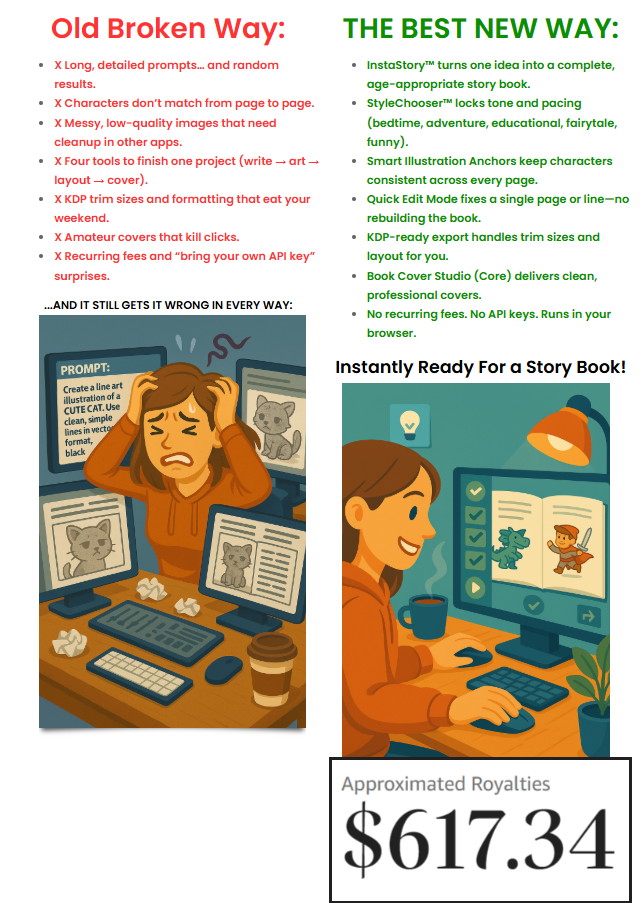
This section breaks down the main claims — ease of use, AI creative prompts, and KDP-ready exports — and evaluates them against common self-publishing needs. The review compares the guide to other AI book cover creator review material and places it in the broader context of a practical KDP cover design guide.
How the guide works (workflow and key features)
Step-by-step workflow
Typical steps taught by the guide: genre analysis and brief creation, prompt templates for image generation, quick mockup composition, typography and hierarchy rules, and export settings optimized for Amazon KDP. The guide emphasizes KDP export settings that match Amazon's pixel and bleed requirements; for details consult the official KDP cover art specifications (Amazon KDP cover guidelines).
What the AI portion does well
- Generates concept variations quickly to test different visual directions.
- Provides prompt templates that reduce common prompt-engineering errors.
- Highlights typography pairings and hierarchy so titles remain legible in thumbnail views.
Evaluation framework: the COVER checklist
Use this named framework to judge any AI-assisted cover process. It’s a practical checklist for final acceptance before upload.
- Clarity — Title and author name must be legible at thumbnail size (160x240 pixels typical).
- Originality — Image concept should avoid cliché stock composites or overused motifs.
- Validity — Confirm image licensing and rights for commercial use.
- Export specs — Correct DPI, bleed, color profile (typically 300 DPI, CMYK for print or RGB for KDP accepted formats), and pixel dimensions.
- Recency — Match current genre trends while keeping long-term readability and adaptability for future formats.
Real-world example: indie thriller scenario
An indie author needs a thriller cover for a 6x9 paperback. Using the guide’s prompt templates, the workflow produced three concept images: a foggy cityscape, a silhouetted figure, and a cracked pocket watch. After applying the COVER checklist, the author rejected the pocket watch for being cliché, verified commercial-use license for the cityscape image, increased title contrast, and exported a 300 DPI PDF with 0.125" bleed. The final cover passed Amazon KDP preflight checks and generated higher click-through in test ads than the previous DIY attempt.
Practical tips for using AI cover guides effectively
- Always verify image licensing and retain receipts or source filenames — AI tools may use third-party images with restrictions.
- Test legibility by shrinking the cover to common thumbnail sizes before finalizing typography choices.
- Export proofs in the correct color profile and resolution for both print and ebook formats; KDP accepts PDF/X-1a for print in many cases.
- Use the guide’s prompt templates as starting points; tweak descriptors and composition notes to avoid generic results.
Trade-offs and common mistakes
Trade-offs
- Speed vs control: AI speeds concepting but reduces pixel-level control, which matters for type kerning and photographic retouching.
- Cost vs quality: Low-cost or free AI generators may produce acceptable thumbnails but often fail on print-resolution detail.
- Originality vs convenience: Templates accelerate work but can create covers that blend into genre tropes.
Common mistakes
- Not checking licensing: assume images require commercial-clearance.
- Exporting at screen resolution for print: results in pixelation or soft type.
- Ignoring thumbnail tests: many covers look great full-size but are unreadable as thumbnails.
When to combine the guide with a human designer
Combine the KDP Magic Covers workflow with a designer when the title needs fine typographic tuning, custom illustration refinements, or precise color grading for print. The guide is a strong ideation and mockup tool, but human skill remains valuable for final prepress adjustments and brand consistency across series.
Core cluster questions
- How do AI-generated images affect commercial image licensing for book covers?
- What are the exact KDP cover export requirements for paperback and hardcover?
- How can designers test cover legibility at thumbnail sizes?
- Which file formats are safest for KDP print uploads and why?
- How to evaluate genre fit and market expectations when creating a book cover?
Practical steps to validate a cover created with the guide
Quick validation checklist
- Confirm commercial-use license and save provenance.
- Run a thumbnail legibility test at 140–200px wide.
- Export a 300 DPI print proof and a 72–150 DPI ebook version, checking both in-app mock viewers.
- Upload a test to KDP preview to confirm text safety inside printable areas and observe any cropping in spine calculations.
Final assessment: who should use KDP Magic Covers?
Best for authors who need fast concept generation and a structured prompt-and-export workflow. Less suitable for projects that require bespoke illustration, hand-lettered typography, or images where strict licensing provenance is required without ambiguity.
Frequently asked questions
Is KDP Magic Covers review positive about image licensing and commercial use?
The review emphasizes verifying commercial-use rights. AI-generated results may draw on licensed or public-domain elements; always confirm provenance and retain documentation for commercial distribution.
Does the guide explain exact KDP file and bleed requirements?
The guide covers export settings and common mistakes, but cross-checking with Amazon KDP's official cover art specifications ensures compliance; see the KDP cover guidelines here.
Can an indie author produce a bestseller-level cover using only this guide?
The guide supports strong concepting and technical export readiness, but bestseller-level visual impact often requires professional design sensibilities, testing, and sometimes hiring a designer for final polishing.
How does this guide compare to other AI book cover creator review resources?
This review positions the guide as a middle-ground resource: more structured than basic tutorials, less bespoke than full-service design. It pairs well with further learning on typography and prepress standards.
What are the top tips to avoid common cover mistakes?
Verify licensing, test thumbnail legibility, export at print resolution, and use the COVER checklist before uploading to KDP.