No Time to Work Out? Try This 20-Minute Home Workout for Busy Professionals (No Equipment Needed)
-

- Published Updated
- 8,967 views
Finding time to work out isn’t the real problem.
Most professionals start with intent. The challenge is what happens after a long workday. Meetings run late, energy drops, and fitness gets pushed aside.
That is where consistency breaks.
This is why more people are now looking for a quick workout for busy professionals that fits into real schedules, not ideal ones.
A 20-minute workout at home works because it removes the biggest barrier to fitness. It makes starting easier, and starting consistently is what drives results.
Why Most Professionals Struggle to Stay Fit
The modern work routine is not designed for movement.
Long hours at a desk, constant screen time, and mental fatigue make it difficult to stay consistent. Even motivated individuals struggle to maintain a routine.
The issue is not effort. It is that most fitness plans are built for fixed schedules and high energy levels, and that rarely matches real life.
This is why workout plans for working professionals need to be simple, repeatable, and flexible.
Do 20-Minute Workouts Actually Work?
Yes, when they are structured correctly.
The effectiveness of a workout depends less on duration and more on how consistently it is performed. Short workouts, especially when designed as circuits or HIIT, can deliver meaningful results in a limited amount of time.
They improve cardiovascular fitness, increase calorie expenditure, and build strength using bodyweight movements. When intensity is managed well, even a 20 minute workout at home can challenge multiple muscle groups and elevate heart rate effectively. What makes them especially powerful is not just efficiency, but sustainability.
For busy professionals, long workouts often fail not because they don’t work, but because they are difficult to repeat. A shorter routine removes that barrier, making it easier to stay consistent over weeks and months.
A longer session done occasionally will always be less effective than a shorter one done regularly.
In practice, results come from frequency and not duration. What matters is not how long you train. It is how often you show up.
Who Should Follow This Plan?
This approach is ideal for:
- Busy working professionals
- Entrepreneurs and business owners
- Remote workers with sedentary routines
- Beginners looking for a home workout without equipment
- It works best for people who struggle with consistency, not effort.
How the 20-Minute Workout Framework Works
This plan is built around efficiency, not intensity alone.
Instead of long sessions, it focuses on full-body engagement through short, structured intervals. By training multiple muscle groups in a single session, the body is constantly working, which increases overall output in less time.
The use of circuits with minimal rest keeps the heart rate elevated while alternating between movements. This allows you to build strength and improve cardiovascular fitness within the same session, rather than separating them into different workouts.
This structure is also more practical for busy schedules.
Short workouts are effective not just because they are efficient, but because they are easier to repeat. Reducing the time commitment removes friction, making it more likely that you will show up consistently.
And consistency is what drives results. When done regularly, even a 20-minute session can create meaningful progress over time.
20-Minute Workout Plan at Home (No Equipment Needed)
This is a home workout without equipment, designed to be simple, efficient, and easy to repeat.
Each session takes about 20 minutes and focuses on full-body movement. The goal is not to exhaust you in a single session, but to create a routine you can follow consistently without disrupting your schedule.
The structure is divided into three parts: warm-up, main workout, and cool down.
Warm-Up (3 Minutes)
- Jumping jacks – 30 seconds
- Arm circles – 30 seconds
- High knees – 1 minute
- Squats – 1 minute
A proper warm-up prepares your muscles, increases blood flow, and reduces the risk of injury. It also helps you perform better during the main workout.
Main Workout (15 Minutes)
Format: 3 rounds (40 seconds work / 20 seconds rest)
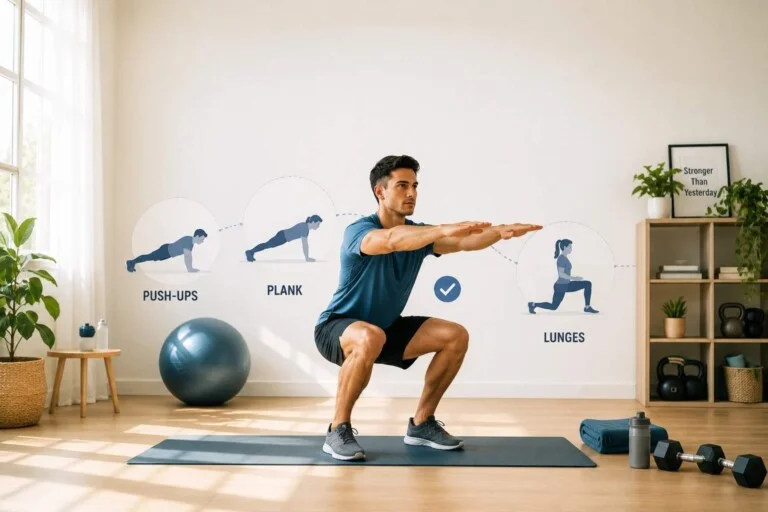
- Squats
- Push-ups
- Plank
- Lunges
- Mountain climbers
These exercises are chosen to target multiple muscle groups in a short time. The combination of lower body, upper body, and core movements ensures a balanced, full-body workout.
Focus on controlled movement and proper form. Rushing through repetitions reduces effectiveness and increases the risk of strain. It is better to perform fewer high-quality reps than more low-quality ones.
If needed, you can modify exercises based on your fitness level. For example, incline push-ups instead of standard push-ups, or shorter plank holds. The goal is to complete the workout with good form, not perfection.
Cool Down (2 Minutes)
- Light stretching (hamstrings, shoulders, back)
- Deep breathing
Cooling down helps bring your heart rate back to normal, improves flexibility, and supports recovery. It also reduces post-workout stiffness, especially for beginners.
Weekly Workout Plan for Working Professionals
A structured weekly plan helps maintain consistency without overtraining.
- Monday: Full body
- Tuesday: Core + cardio
- Wednesday: Light activity or walk
- Thursday: Lower body
- Friday: Upper body
- Saturday: HIIT
- Sunday: Rest
This structure ensures that different muscle groups are trained while allowing adequate recovery.
More importantly, it reduces decision fatigue. You don’t have to think about what to do each day. You simply follow the plan, which makes it easier to stay consistent over time.
Benefits of Quick Workouts for Busy Professionals
The benefits go beyond physical fitness.
Short workouts improve mental clarity, reduce stress, and increase energy levels throughout the day.
For many professionals, the first noticeable change is not physical. It is improved focus, better mood, and higher productivity.
Over time, these sessions also support fat loss, strength, and overall health.
Common Mistakes Busy Professionals Make
Most professionals don’t struggle because they lack effort.
They struggle because their routines don’t hold up under real-world pressure.
A common mistake is waiting for the “right time” to work out. With unpredictable schedules, that time rarely comes. Fitness ends up getting postponed indefinitely.
Skipping workouts after a busy day is another pattern. One missed session turns into several, breaking momentum. Many also rely on random routines. Without structure, workouts become inconsistent and results remain unclear.
At the other extreme, some try to compensate by overtraining on weekends. This often leads to fatigue without improving long-term consistency.
What these patterns have in common is simple. They disrupt consistency, which is the most important factor in any fitness plan.
How to Stay Consistent with Short Workouts
Consistency is not about motivation, it is about reducing friction.
The fewer decisions you have to make, the easier it becomes to follow through.
Treat workouts like fixed appointments rather than optional tasks. A scheduled time slot removes the need to decide each day.
Following a structured routine also helps. When you know exactly what to do, you are less likely to skip sessions.
Tracking progress adds another layer of accountability. Even simple tracking, like completed sessions or weekly consistency, can reinforce habits.
The goal is not to rely on discipline alone. It is to create a system that makes consistency easier.
Making Fitness Fit Your Schedule
For most professionals, the challenge is managing time and decisions throughout the day. When fitness requires constant planning, it becomes harder to maintain. Too many choices create hesitation, and hesitation leads to inconsistency.
Simplifying the process is what makes the difference.
This is where structured platforms like Alpha Coach can help. By combining short workouts, tracking, and adaptive plans into a single system, they reduce the need for constant decision-making.
What Results Can You Expect?
Short workouts can deliver meaningful results when done consistently.
In the early stages, most people notice improvements in energy levels, focus, and overall stamina. These changes often appear within the first one to two weeks.
Physical changes, such as fat loss and strength improvements, follow gradually over time. What matters is not the duration of each session, but how regularly the plan is followed.
A 20 minute workout at home, done consistently over weeks, can lead to measurable improvements in fitness without requiring major lifestyle changes. Results are driven by repetition, not intensity alone.
In the end, the best workout plan is not the longest or most intense one. It is the one you can continue to follow, even when your schedule is at its busiest.
Frequently Asked Questions
Is a 20 minute workout at home enough?
Yes, provided it is done consistently and with the right intensity. Short workouts can be highly effective when they target multiple muscle groups and keep the body engaged throughout. For most professionals, consistency matters far more than duration.
Can I lose weight with short workouts?
Yes, especially when combined with a proper diet. Fat loss depends on maintaining a calorie deficit over time, and short workouts support this by increasing daily activity and improving metabolism.
Do I need equipment for this workout?
No. This is a home workout without equipment, designed to use bodyweight movements. This makes it easy to follow anywhere without relying on access to a gym.
How often should I do this workout?
Ideally, 4 to 6 times per week with at least one rest day. This allows enough frequency for progress while giving your body time to recover and adapt.
What is the best time to workout?
There is no single best time. The most effective time is the one you can follow consistently without disrupting your routine. Consistency will always have a greater impact than timing.