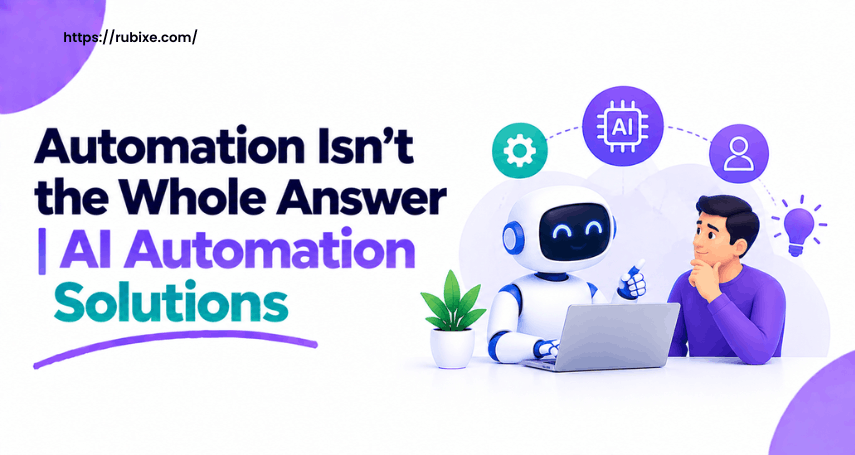
Automation Isn't the Whole Answer | AI Automation Solutions
-

- September 16th, 2026
- 44 views
)
Many businesses have already automated something: an approval workflow, a data entry task, or a routine email. Yet the results often feel underwhelming: faster in one spot, but with no real shift in how the business actually operates. That's usually because basic automation just speeds up a fixed set of rules. AI automation solutions can go beyond fixed rules by using AI to interpret data, handle exceptions, and support more flexible workflows. Some systems can also improve over time through feedback, monitoring, or retraining.
What Sets AI Automation Solutions Apart From Basic Automation
Traditional automation follows a strict script: if this happens, do exactly that, every time, with no room for judgment. AI automation solutions work differently, combining artificial intelligence, machine learning, and analytics so a system can process complex data, make context-aware decisions, and refine its own actions over time.
The practical difference shows up in three ways:
Basic automation: follows fixed steps and may struggle when an input falls outside its predefined rules.
AI automation solutions: interpret unstructured input and adjust their approach when a situation doesn't fit the usual pattern.
The gap can grow over time: A rule-based system follows its original logic until someone updates it. An AI system can improve through monitoring, feedback, retraining, or updated data when those processes are built into the workflow.
How an AI Automation Solution Actually Works Behind the Scenes
The process generally moves through five stages, each building on the last.
Data collection: pulls information from emails, forms, databases, and other systems, giving the automation a broader view of the information it needs instead of relying on a narrow data source.
Data processing: applies AI and machine learning to spot patterns, turning raw, scattered data into something the system can actually act on.
Decision-making: evaluates multiple inputs and can help produce recommendations or actions faster than manual review in suitable workflows.
Task execution: carries out the decided action, whether that's an approval, a notification, or a document update, consistently and without the fatigue that creeps into manual work.
Monitoring and improvement: tracks outcomes, errors, and user feedback. Teams can use these signals to update models, prompts, rules, or workflows over time.
The Core Technologies Behind Every AI Automation Solution
Component |
What It Contributes |
Artificial Intelligence |
Supports tasks involving pattern recognition, prediction, classification, or decision support |
Machine Learning |
Improves accuracy over time by learning from past outcomes |
Robotic Process Automation |
Handles high-volume, rule-based tasks with speed and consistency |
Natural Language Processing |
Lets systems interpret and respond to unstructured text. |
Analytics & Reporting |
Surfaces bottlenecks and guides ongoing improvement. |
Most effective solutions combine several of these rather than relying on just one, since real business processes rarely fit neatly into a single technology's strengths.
Where AI Automation Solutions Deliver the Clearest Impact
Customer support. Routine queries get handled instantly, with context passed along cleanly to a human agent whenever a case needs one.
Finance and accounting. Invoice processing, reconciliation, and compliance checks move faster with fewer manual errors slipping through.
HR and recruitment. Resume screening and interview scheduling can be partly automated, giving HR teams more time for candidate engagement and workforce planning.
Supply chain and manufacturing. Demand forecasting and quality checks catch problems earlier, before they become costly downstream issues.
What to Actually Check Before Choosing a Solution
Does it fit your existing systems? A powerful solution that doesn't integrate cleanly with current tools creates more disruption than value.
How steep is the learning curve? Solutions that are genuinely usable by non-technical teams tend to see faster, broader adoption.
Can it scale with you? A system built for today's volume should still hold up as operations grow, not require a rebuild in a year.
Does it support real analytics? Ongoing reporting reveals whether the automation is delivering measurable value.
Is data governance built in? Security and compliance shouldn't be an afterthought, especially once automation touches sensitive business data.
For a deeper look at intelligent automation, explore our guide to its core components and business applications.
Key Takeaways
AI automation solutions go beyond speeding up fixed rules, adding genuine decision-making and continuous learning.
The strongest solutions typically combine AI, machine learning, RPA, and NLP rather than relying on a single technology.
Integration fit and scalability matter as much as raw capability when choosing a platform.
Ongoing analytics show whether automation is delivering value and where the workflow needs improvement.
FAQs
How is an AI automation solution different from regular workflow automation?
Regular automation follows fixed, unchanging rules. AI automation solutions add context, learning, and adaptability, allowing the system to handle exceptions instead of breaking on anything unexpected.
Is AI automation only useful for large enterprises?
No. Smaller businesses can benefit when automation removes repetitive work from lean teams. The impact depends on task volume, labor costs, process complexity, and implementation quality.
How long does it typically take to see results?
Simple, well-scoped automations can show measurable time savings within weeks, while more complex, learning-based systems improve gradually as they process more data.
Does adopting AI automation mean fewer jobs?
The impact varies by workflow and implementation. Automation can reduce repetitive work, change job responsibilities, and sometimes reduce the need for certain tasks. Many businesses use it to shift employees toward work requiring judgment, communication, or oversight.
Conclusion
AI automation solutions work best when they're built around a real, well-defined problem, not adopted just because the technology is trending. Businesses can start with one high-friction process, measure real results, and use those findings to improve the workflow over time.