7 Business Processes That Can Be Automated With AI in 2026
-

- Published Updated
- 58 views
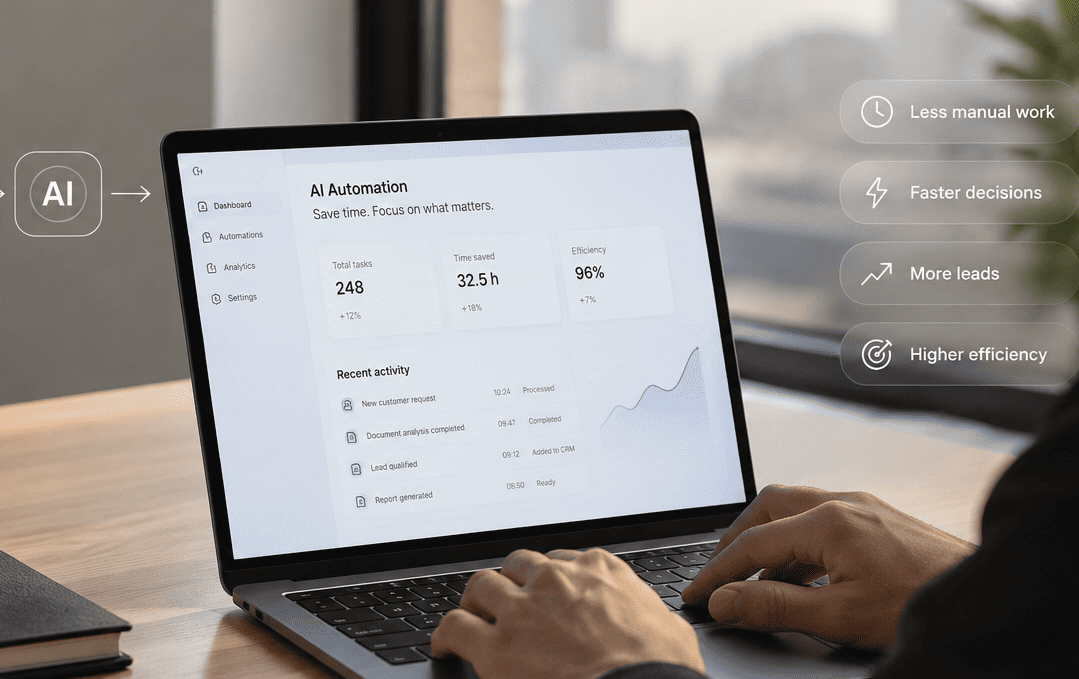
Artificial intelligence is moving beyond simple chatbots and content generation. In 2026, businesses are increasingly using AI to automate repetitive processes, analyze information, communicate with customers, and support employees in everyday operations.
The most effective AI implementations are usually not about replacing an entire department. Instead, companies identify specific processes that consume a significant amount of employee time and automate the repetitive parts.
Here are seven business processes that can already benefit from AI automation.
1. Customer Request Processing
Many companies receive dozens or hundreds of customer requests every day through websites, email, messengers, and social media.
A large percentage of these requests contain similar questions:
- What is the price?
- How long does the service take?
- What options are available?
- How can I place an order?
- What documents are required?
An AI system can analyze incoming messages, identify the customer's intent, retrieve relevant information, and prepare an appropriate response.
More advanced systems can also determine whether a request represents a potential sales opportunity and transfer qualified leads directly to a sales manager.
This allows employees to spend less time answering repetitive questions and more time working with customers who actually require human involvement.
2. Lead Qualification
Lead qualification is another process where AI can significantly reduce manual work.
Instead of asking a sales manager to review every incoming lead, an AI system can analyze information about the customer and classify the request according to predefined criteria.
For example, it can determine:
- what product or service the customer is interested in;
- whether the customer matches the company's target audience;
- the approximate potential value of the opportunity;
- how urgent the request is;
- which manager should receive it.
The result can then be automatically transferred to a CRM system.
AI does not have to make the final sales decision. It can simply prepare the information so that a human employee can make a decision faster.
3. Document Processing
Businesses often spend a surprising amount of time working with documents.
Contracts, invoices, applications, reports, specifications, emails, and internal documents may contain valuable information, but extracting that information manually can be slow.
AI can be used to:
- extract structured information from documents;
- classify documents;
- summarize long files;
- compare versions;
- identify missing information;
- transfer selected data into business systems.
For companies processing hundreds or thousands of documents, even partial automation can save a substantial amount of employee time.
The key is to keep human verification for important decisions and sensitive information.
4. Internal Knowledge Management
As a company grows, its knowledge becomes distributed across different places: cloud storage, PDFs, spreadsheets, presentations, CRM systems, internal instructions, and messaging platforms.
Employees may know that the required information exists somewhere, but finding it can still take several minutes.
An AI-powered internal knowledge system can provide a different approach.
An employee can ask:
"What is the procedure for onboarding a new customer?"
The system can search the company's approved internal sources and provide a concise answer based on those materials.
This approach can be particularly useful for companies with large teams or frequently changing internal procedures.
5. Sales and Marketing Research
AI can also automate parts of market and customer research.
For example, a system can collect publicly available information about companies, analyze websites, categorize potential customers, and identify characteristics that match a predefined target profile.
Instead of manually researching hundreds of companies, a sales team can receive a structured list of potential prospects.
The important distinction is that AI should support research rather than blindly generate lists of contacts. Data quality, relevance, and compliance with applicable privacy and marketing regulations still require attention.
6. Business Data Analysis
Many businesses already have large amounts of data but do not have enough time to analyze it.
Sales, marketing, customer activity, operational metrics, and financial data can be difficult to interpret manually.
AI can help transform raw data into answers to practical business questions.
For example:
- Why did sales decrease last month?
- Which products generate the most revenue?
- Which marketing channel produces the highest-value customers?
- Where are operational costs increasing?
- Which customer segments are growing?
The goal should not simply be to generate more dashboards.
The real value comes from connecting data analysis with business decisions.
7. End-to-End Workflow Automation
The most advanced use of AI appears when several automated processes are connected into one workflow.
For example:
Customer request → AI analysis → qualification → CRM record → manager notification → proposal preparation → follow-up → analytics
Each individual step may be relatively simple.
The value comes from connecting them together.
In this model, AI becomes part of a larger digital product rather than functioning as an isolated chatbot.
This can be especially useful for businesses where employees repeatedly move information between several different systems.
How to Start With AI Automation
One of the most common mistakes is starting with the technology instead of the business problem.
A company may ask:
"Which AI model should we use?"
A better first question is:
"Which business process consumes the most time and contains repetitive operations?"
A practical AI automation project can start with five steps:
- Identify a repetitive business process.
- Measure how much employee time it currently requires.
- Identify the data and systems involved.
- Determine which operations can safely be automated.
- Measure the economic result after implementation.
This approach makes it easier to understand whether an AI project is actually creating value.
AI Should Solve a Business Problem
AI automation is most useful when it is connected to a measurable business objective.
The objective might be reducing response time, processing more customer requests, decreasing manual data entry, improving lead qualification, or giving employees faster access to company information.
In some cases, existing AI tools are sufficient. In others, a company may need a custom AI system with its own interface, integrations, database, business rules, and internal knowledge base.
The important thing is not to implement AI simply because it is available.
The strongest implementations start with a real business problem and use AI as one component of the solution.
For businesses interested in custom AI systems, automation, and digital product development, more information is available at:
For businesses interested in exploring custom AI automation solutions, learn more on this website