AI Development Roadmap: Project Timelines, Stages & Key Milestones
-

- Published Updated
- 42 views
Key Takeaways
- AI development involves multiple stages rather than a single development phase
- Project timelines depend on features, integrations, data, and technical complexity.
- Discovery and planning should happen before development begins
- Testing and AI evaluation are critical before production deployment.
- Complex AI agents generally require more development effort than basic AI applications.
- A phased roadmap helps businesses manage cost, risk, and expectations.
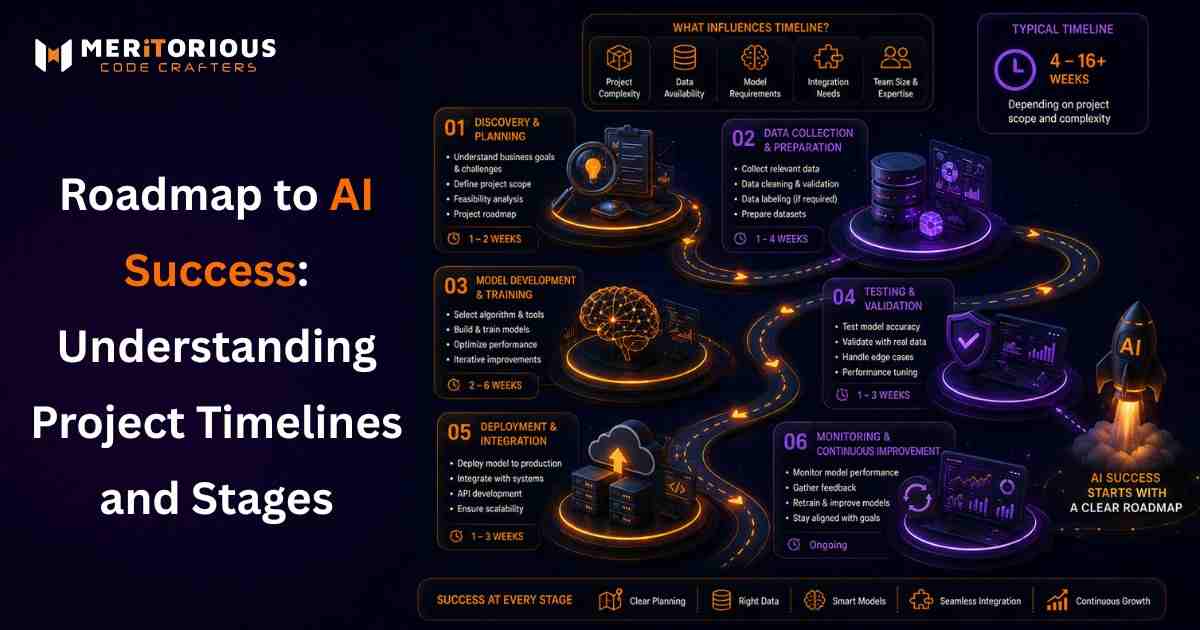
AI projects rarely move directly from an idea to a finished product. Successful AI development usually follows a structured roadmap that includes discovery, planning, data preparation, development, testing, deployment, and continuous improvement.
Understanding these stages helps businesses estimate timelines, allocate resources, identify potential risks, and set realistic expectations before development begins.
Whether a company is planning an AI chatbot, an intelligent automation platform, an AI agent, or a custom enterprise solution, the development timeline depends on the project's scope and technical complexity.
What Are the Main Stages of an AI Development Project?
1. AI Project Discovery and Requirement Analysis
2. Choosing the Right AI Solution
3. Data Preparation and Architecture
4. AI Model Selection and Integration
5. AI Application Development
6. Building an AI Chatbot
7. Developing AI Agents
8. AI Integration With Existing Systems
9. Testing and AI Evaluation
10. Deployment and Production Launch
11. Monitoring and Continuous Improvement
How Long Does AI Development Usually Take?
Proof of Concept
Minimum Viable Product
Production Application
Enterprise Scale
What Can Delay an AI Development Project?
Unclear Requirements
Poor Data Quality
Complex Integrations
Security Requirements
Lack of AI Expertise
Unrealistic Expectations
How Can Businesses Keep AI Projects on Track?
Define the Business Goal
Prioritize Features
Validate the Technology Early
Prepare Data Early
Use Experienced Development Resources
Test Continuously
Why an AI Roadmap Matters
Final Thoughts
Frequently Asked Questions
What is the first stage of an AI development project?
How long does an AI project take to develop?
What makes AI agent development more complex?
Is an AI chatbot easier to build than an AI agent?
When should businesses hire AI developers?
Can an AI project be developed in phases?
A typical AI development project can be divided into several stages:
Business and use-case discovery
Technical planning
Data preparation
AI architecture and model selection
Application development
Integration
Testing and evaluation
Deployment
Monitoring and optimization
Each stage has a different purpose, and the duration can vary significantly depending on the type of AI product being built.
The first stage is understanding what the business actually wants to achieve.
Teams typically identify:
Business objectives
Target users
AI use cases
Required features
Existing technology infrastructure
Data sources
Third-party systems
Security requirements
Expected business outcomes
This stage prevents businesses from starting development without a clear definition of the problem.
For example, an organization may initially ask for an AI chatbot, but during discovery it may become clear that users actually need an internal knowledge assistant connected to company documents and business systems.
A clear scope at this stage makes the rest of the roadmap more predictable.
Once the requirements are defined, the team determines what type of AI technology is appropriate.
Depending on the use case, businesses may consider:
Large language models
Machine learning
Generative AI
Retrieval-augmented generation
Computer vision
Natural language processing
AI agents
Predictive analytics
Recommendation systems
For organizations evaluating different AI Development Solutions, the important question is not which technology is most advanced, but which approach solves the business problem effectively.
Using unnecessary complexity can increase development time without creating additional value.
Data is often one of the most important factors affecting an AI project's timeline.
The development team may need to:
Collect business data
Clean existing datasets
Structure information
Build data pipelines
Prepare documents
Create knowledge bases
Set up vector databases
Define data access rules
Establish security controls
For an AI application that relies on company-specific information, data preparation can take considerable effort.
The quality and availability of data should therefore be evaluated early in the project.
The next stage involves selecting the appropriate AI model or combination of models.
Depending on the application, developers may use an existing commercial model, an open-source model, a specialized machine learning model, or a combination of technologies.
The team may evaluate:
Accuracy
Response quality
Speed
Cost
Scalability
Privacy
Integration requirements
Rather than automatically choosing the largest or most expensive model, businesses should select technology based on actual requirements.
After the architecture is established, development begins.
This can include building:
Frontend interfaces
Backend services
APIs
Authentication
Databases
AI pipelines
Admin dashboards
User management
Analytics
Workflow automation
The AI model itself is only one part of the product. The surrounding software must make the technology useful, secure, and accessible to its intended users.
For larger projects, businesses may Hire AI Developers with experience in AI integration, backend engineering, machine learning, cloud infrastructure, and application development.
AI chatbots are often among the first AI products businesses develop.
A basic chatbot may answer common questions, while an advanced system can connect to internal data and business applications.
An AI Chatbot Development project may involve:
Natural language understanding
Knowledge-base integration
RAG implementation
Conversation management
Authentication
CRM integration
Human escalation
Analytics
Response evaluation
The timeline depends heavily on how much functionality is required.
A simple customer FAQ chatbot can be developed much faster than an enterprise assistant that accesses private information and performs business operations.
AI agents represent a more advanced category of AI application.
Instead of simply responding to a user's question, an AI agent can be designed to perform multiple actions within a defined workflow.
For example, an agent could:
Receive a request
Analyze the task
Retrieve relevant information
Use external tools
Perform an action
Check the result
Report the outcome
This makes AI Agent Development more complex because developers need to consider tool calling, permissions, workflow logic, error handling, validation, and monitoring.
The more systems an agent can interact with, the more carefully its architecture needs to be designed.
Most business AI projects need to work with existing software.
Potential integrations include:
CRM platforms
ERP systems
Databases
Payment platforms
Communication tools
Document management systems
Internal APIs
Cloud services
Integration requirements can significantly affect project timelines.
For example, an AI assistant that only generates responses may be relatively straightforward. An assistant that retrieves customer records, updates a CRM, creates tickets, and sends notifications requires considerably more engineering.
AI applications require more than conventional software testing.
Development teams may evaluate:
Accuracy
Relevance
Response consistency
Hallucinations
Security
Prompt robustness
Edge cases
Failure scenarios
User experience
For AI agents, testing should also verify whether the system takes the correct action when interacting with external tools.
Testing early and continuously can help identify issues before deployment.
Once the application has passed testing, it can move into production.
Deployment may involve:
Cloud infrastructure
API configuration
Database setup
Authentication
Monitoring
Logging
Security controls
Backup systems
Performance optimization
A controlled launch is often preferable to immediately exposing a new AI system to every user.
Businesses can begin with a smaller user group, monitor performance, gather feedback, and then expand access.
AI development does not necessarily end when the application goes live.
After deployment, teams may monitor:
User interactions
Model performance
Response quality
API usage
Infrastructure costs
Errors
Security events
User feedback
The system can then be improved based on real-world usage.
This is particularly important for AI applications because user behavior and business requirements can change over time.
There is no single timeline that applies to every AI project.
A simple AI proof of concept may require considerably less time than a production-ready enterprise AI platform.
Factors affecting timelines include:
Number of features
Data availability
AI model complexity
Number of integrations
Security requirements
User interface requirements
Testing requirements
Team size
Deployment environment
A useful way to think about the timeline is by project maturity rather than simply by calendar weeks.
The objective is to validate whether the idea works technically.
The focus is usually on core functionality rather than a complete production experience.
The MVP introduces the essential features required for real users to test the solution.
The production version adds security, scalability, monitoring, integrations, testing, and operational reliability.
Large organizations may require additional governance, multiple integrations, advanced security, high availability, and continuous optimization.
Several issues can extend an AI project's timeline.
Changing the scope during development can result in additional development cycles.
Incomplete, inconsistent, or inaccessible data can delay AI implementation.
Connecting multiple legacy systems can require significant engineering effort.
Sensitive applications may require additional security reviews and testing.
Teams without sufficient experience may spend more time experimenting with different technologies and architectures.
Expecting a complex AI platform to be delivered like a simple software feature can create unrealistic deadlines.
A structured development process can reduce delays.
Start with a measurable objective rather than simply deciding to “add AI.”
Identify essential features for the first release and postpone non-critical functionality.
A proof of concept can reveal technical challenges before major development investment.
Data preparation should begin as soon as the AI requirements are understood.
Experienced AI engineers can help select suitable architectures, models, integrations, and deployment strategies.
Testing throughout development is more effective than waiting until the end of the project.
A roadmap gives businesses a clear picture of how an AI idea moves from concept to production.
It helps stakeholders understand:
What needs to be built
Who is responsible for each stage
Which technologies are required
What could affect the timeline
When testing should happen
When the product can realistically launch
What ongoing resources will be needed
Final Thoughts
Without a roadmap, businesses may underestimate the work required beyond the initial AI prototype.
Successful AI development requires more than selecting a model and connecting an API. Businesses need to consider discovery, data, architecture, application development, integrations, testing, deployment, and continuous improvement.
The right roadmap also depends on the type of AI product being developed. A chatbot, AI assistant, predictive model, and autonomous agent can have very different technical requirements.
For businesses planning an AI initiative, Meritorious CodeCrafter can be considered when evaluating experienced technology development support for turning AI concepts into practical digital solutions.
The best approach is to start with a clearly defined business problem, build a focused first version, validate the results, and gradually expand the system as business requirements and user adoption grow.
The first stage is usually discovery and requirement analysis. The business defines its objectives, users, use cases, data requirements, technical constraints, and expected outcomes.
The timeline varies according to complexity. A proof of concept can be much faster than a production-ready enterprise platform with multiple integrations, security requirements, and advanced AI capabilities.
AI agents can interact with tools and systems to perform tasks. This requires additional architecture for permissions, workflows, validation, error handling, monitoring, and security.
Generally, a basic chatbot can be simpler because it may primarily generate or retrieve responses. An AI agent that performs multi-step actions and interacts with external systems usually requires more engineering.
Businesses should consider specialized AI developers when their internal team lacks the expertise required for AI architecture, model integration, data pipelines, application development, evaluation, or deployment.
Yes. A phased approach allows businesses to start with a proof of concept or MVP, validate the use case, and then gradually add integrations, features, security, and scalability.
Originally Published On : https://meritorious.global/roadmap-to-ai-success-understanding-project-timelines-and-stages/