Artificial Intelligence in Drug Discovery Market Trends, Growth & Analysis 2026–2035
-
- May 06th, 2026
- 7,304 views
Artificial Intelligence in Drug Discovery Market Size
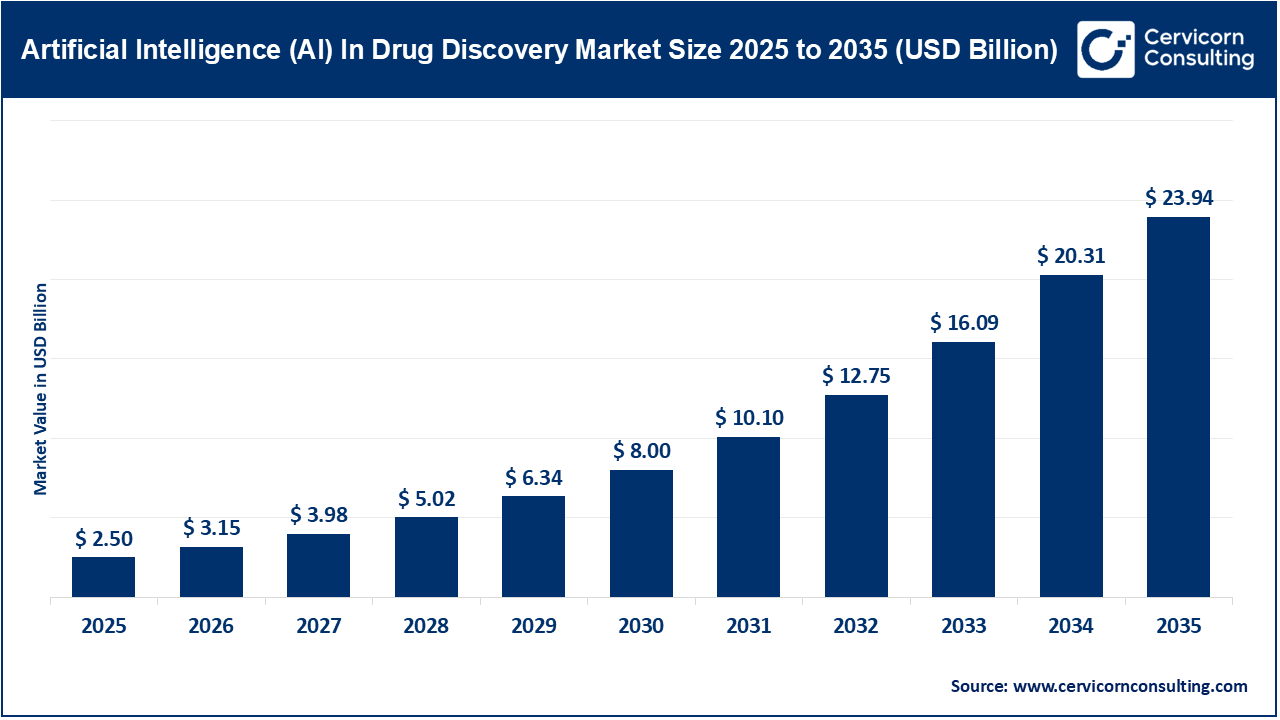
The global artificial intelligence (AI) in drug discovery market was valued at about USD 2.50 billion in 2025 and is projected to grow significantly, reaching nearly USD 23.94 billion by 2035. This impressive rise corresponds to a strong CAGR of 26.49% during the forecast period from 2026 to 2035.
What is the Artificial Intelligence in Drug Discovery Market?
The artificial intelligence in drug discovery market refers to the integration of advanced computational tools—such as machine learning, deep learning, and natural language processing—into the drug development process. These technologies enable researchers to efficiently analyze large-scale biomedical data, uncover potential drug candidates, predict molecular interactions, and improve treatment outcomes compared to traditional methods.
According to Cervicorn Consulting, the artificial intelligence in drug discovery market is experiencing rapid growth, fueled by the increasing need to accelerate development timelines, reduce costs, and enhance drug success rates.
Major applications in this market include:
- Target identification and validation
- Lead optimization
- Drug repurposing
- Preclinical development
- Clinical trial improvement
🔗 Learn more: https://www.cervicornconsulting.com/artificial-intelligence-in-drug-discovery-market
Market Trends
The artificial intelligence in drug discovery market is advancing rapidly, supported by several emerging trends:
1. Rising Adoption of Generative AI
Generative AI is being widely used to design innovative drug molecules and simulate drug-target interactions, significantly reducing early-stage research time and reliance on traditional experimental methods.
2. Expansion of AI-Enabled Platforms
Cloud-based AI platforms and virtual research environments are streamlining the entire drug discovery pipeline—from concept development to clinical trials—enhancing efficiency and collaboration.
3. Increasing Use of In-Silico Approaches
AI-driven simulations are gradually replacing conventional lab testing, allowing researchers to evaluate drug safety, efficacy, and pharmacokinetics virtually while reducing dependence on animal testing.
4. Growth in Strategic Alliances
Partnerships among pharmaceutical companies, AI startups, and research institutions are becoming more prevalent, enabling the combination of expertise to accelerate innovation.
5. Focus on Personalized Medicine
AI is supporting precision medicine by analyzing genomic and patient-specific data, leading to more targeted therapies and improved patient outcomes.
📥 Request a sample: https://www.cervicornconsulting.com/sample/2525
Market Drivers
Key factors driving the artificial intelligence in drug discovery market include:
1. Demand for Cost Optimization
Traditional drug discovery is both expensive and time-consuming. AI helps reduce these challenges by improving efficiency and lowering failure rates.
2. Growing Burden of Chronic Diseases
The rising incidence of conditions such as cancer, cardiovascular diseases, and neurological disorders is increasing the need for faster and more effective drug development solutions.
3. Advancements in Technology
The expansion of high-performance computing, cloud infrastructure, and big data analytics is enabling broader adoption of AI in drug discovery.
4. Growth of Drug Repurposing
AI facilitates identifying new therapeutic uses for existing drugs, shortening development timelines and accelerating commercialization.
Market Challenges
Despite its strong potential, the artificial intelligence in drug discovery market faces several hurdles:
1. Data Quality Issues
AI models rely on high-quality datasets; incomplete or biased data can result in inaccurate predictions.
2. Regulatory Challenges
Strict compliance requirements for transparency and validation of AI models may slow down industry adoption.
3. High Implementation Costs
Deploying AI solutions requires substantial investment in infrastructure, integration, and skilled professionals.
4. Talent Shortage
There is a limited pool of experts with combined knowledge of AI and life sciences, restricting large-scale implementation.
Market Segmentation
The artificial intelligence in drug discovery market can be segmented as follows:
By Application
- Drug optimization and repurposing (largest segment)
- Preclinical testing (fastest-growing)
- Others
By Therapeutic Area
- Oncology (dominant segment)
- Infectious diseases (fastest-growing)
- Cardiovascular diseases
- Neurodegenerative disorders
By End Use
- Pharmaceutical and biotechnology companies (leading segment)
- Academic and research institutions
- Contract research organizations (CROs)
Regional Insights
North America
North America leads the artificial intelligence in drug discovery market due to strong investments in research and development, advanced healthcare systems, and the presence of major industry players.
Asia-Pacific
The Asia-Pacific region is witnessing rapid expansion, driven by increased healthcare spending, growing biotech industries, and supportive government initiatives.
India Outlook
India is emerging as a key growth market, supported by digital transformation in healthcare and rising adoption of AI in pharmaceutical R&D.
Competitive Landscape
The artificial intelligence in drug discovery market is highly competitive, with major companies focusing on innovation and partnerships. Key players include:
- IBM
- Google DeepMind
- Atomwise
- BenevolentAI
- Exscientia
- Insilico Medicine
These organizations are actively investing in AI platforms, collaborations, and acquisitions to strengthen their competitive positioning.
Future Outlook
The future of the artificial intelligence in drug discovery market appears highly promising. Continuous advancements in AI technologies, growing availability of biomedical data, and increasing cross-industry collaborations are expected to position AI as a core driver of pharmaceutical innovation.
Emerging technologies such as AI agents, explainable AI (XAI), and quantum computing are expected to further enhance drug discovery processes, making them faster, more precise, and cost-efficient.
Conclusion
The artificial intelligence in drug discovery market is transforming the pharmaceutical sector by enabling faster, more data-driven, and efficient drug development. With strong growth projections, increasing adoption of advanced technologies, and rising global investments, the market is poised to play a crucial role in the future of healthcare.
Organizations adopting AI-powered drug discovery strategies today are likely to gain a competitive edge in delivering innovative treatments and addressing unmet medical needs.
👉 Get detailed insights: https://www.cervicornconsulting.com/contact-us