How Can Businesses Choose the Right AI Integration Partner? 9 Companies to Explore in 2026
-

- Published Updated
- 95 views
Introduction
Artificial intelligence is moving from experimentation into everyday business operations. Companies are using AI for customer support, document processing, recommendations, internal knowledge search, workflow automation, data analysis, software development, and decision support.
But adding AI to a business is rarely as simple as connecting an API and launching a chatbot.
AI needs to work with existing applications, databases, APIs, workflows, security controls, and business data. If these components are not integrated properly, organizations can face inconsistent data, security gaps, poor performance, unexpected costs, and difficult maintenance.
That is why choosing the right AI integration partner has become an important decision in 2026.
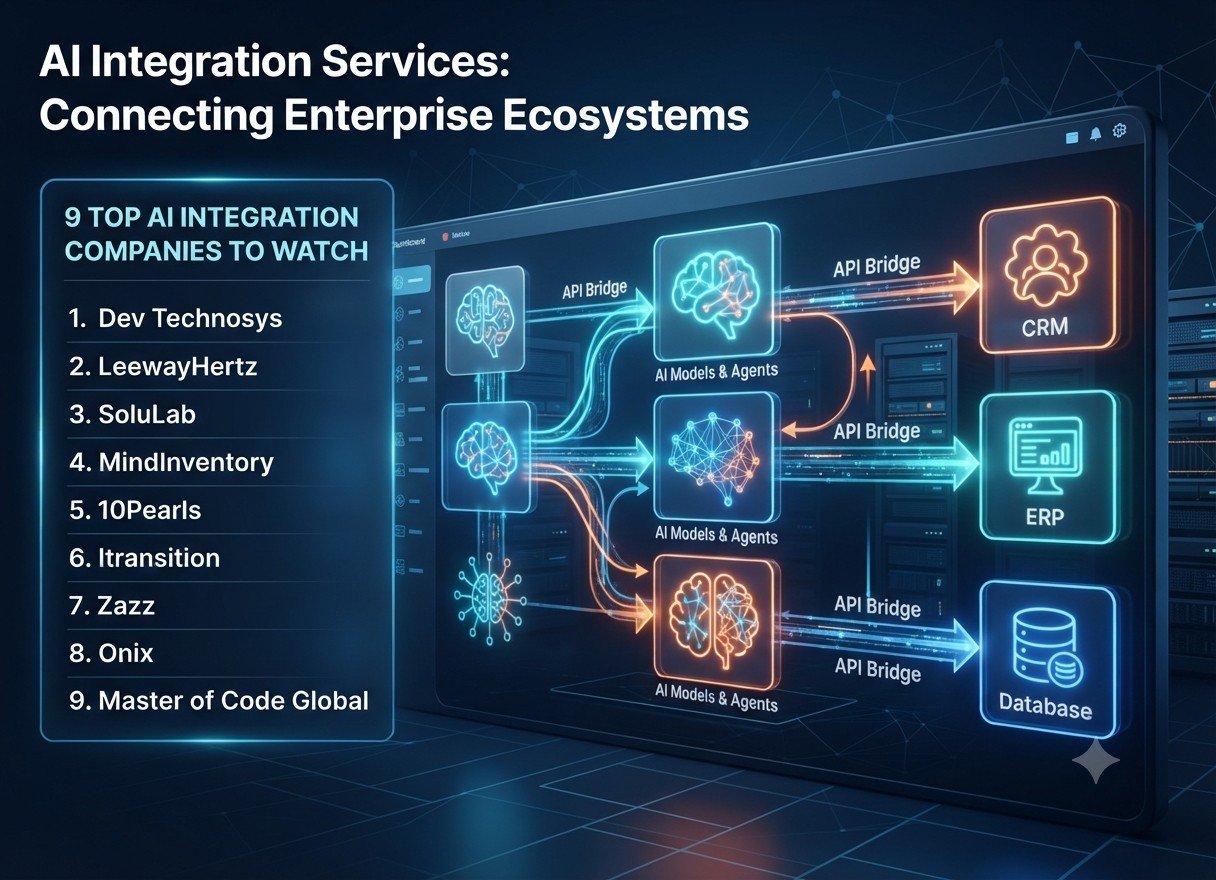
The following nine companies are worth exploring if your organization is planning an AI integration project. This is an editorial selection based on current AI integration capabilities, not an objective ranking.
What Is AI Integration?
AI integration is the process of connecting artificial intelligence capabilities with an organization's existing technology ecosystem.
Instead of creating a completely separate AI environment, businesses can integrate models and AI-powered capabilities into software they already use.
An AI integration project may connect:
Large language models
Generative AI platforms
AI agents
CRM systems
ERP platforms
Databases
Cloud services
APIs
Legacy applications
Knowledge bases
Mobile and web applications
Business workflows
For example, an organization could integrate an LLM with its CRM so employees can retrieve customer information through a conversational interface. An e-commerce business could connect AI with product data to provide personalized recommendations. A support team could integrate RAG with its knowledge base to provide answers based on approved company information.
The goal is not simply to add AI. The goal is to make AI work reliably within the existing business environment.
Why Is Choosing the Right AI Integration Partner Important?
1. Existing Systems Are Complex
Most businesses already operate multiple applications. The integration partner needs to understand how these systems exchange data and where AI should fit into the architecture.
2. Security Matters
AI integrations can involve customer information, internal documents, business databases, and proprietary data. Authentication, authorization, encryption, API security, and access controls need to be considered.
3. AI Models Change Quickly
The right architecture should allow businesses to update models, APIs, prompts, and AI components without rebuilding the entire system.
4. Integration Affects Performance
Poorly designed integrations can introduce latency, unnecessary API calls, bottlenecks, and higher infrastructure or model costs.
5. AI Needs Business Context
A generic model may not understand an organization's products, policies, customers, or internal processes. Integrating AI with reliable business data can make the solution much more useful.
9 AI Integration Companies to Explore in 2026
1. Dev Technosys
Dev Technosys provides dedicated AI Integration Services for businesses that want to add AI capabilities to existing software, applications, workflows, and enterprise systems.
Its current AI integration offering covers AI application integration, workflow automation, AI model integration, intelligent data processing, AI API integration, and scalable AI solutions.
The company works across several integration layers, including LLMs, machine learning models, generative AI, AI APIs, web and mobile applications, backend systems, microservices, cloud platforms, and legacy systems.
Its capabilities also extend to AI workflow automation, AI agents, REST and GraphQL APIs, third-party platforms, databases, vector databases, authentication, authorization, encryption, and access controls.
Dev Technosys follows a structured process that includes business and system discovery, integration architecture planning, AI technology selection, development, security and performance testing, deployment, optimization, and ongoing monitoring.
This approach is particularly relevant for businesses that do not want to replace their existing technology stack but instead want to introduce AI into the systems they already operate.
Best suited for: Startups, SaaS companies, enterprises, and organizations requiring custom AI integration across applications, APIs, databases, workflows, and legacy systems.
2. LeewayHertz
LeewayHertz provides AI development and integration services focused on bringing AI capabilities into existing business environments.
Its AI-as-a-Service offering includes AI-powered applications such as chatbots, information retrieval, and enterprise data analysis, with an emphasis on integration into existing systems.
The company also provides generative AI consulting, implementation, and support, making it relevant for organizations moving from AI experimentation toward production deployment.
Businesses can consider LeewayHertz when they need AI capabilities combined with custom software development and broader technology integration.
Best suited for: Businesses seeking AI application development, enterprise integration, and custom AI implementation.
3. SoluLab
SoluLab provides AI integration services designed to connect AI technologies with existing CRM, ERP, cloud, and business systems.
Its current offering covers AI readiness assessment, generative AI integration, AI model integration, and custom integrations through secure APIs.
SoluLab also works with LLM applications, AI agents, RAG assistants, conversational AI, and machine-learning solutions.
For organizations that already have a technology environment but want to introduce AI without disrupting existing workflows, its integration-focused approach can be useful.
Best suited for: Startups and enterprises looking to integrate generative AI, AI agents, RAG, and machine learning into existing business systems.
4. MindInventory
MindInventory provides AI integration services aimed at embedding AI into existing software, workflows, and knowledge bases.
Its current capabilities include AI API integration with platforms such as OpenAI, Claude, Google Vertex AI, Microsoft Copilot, and AWS Bedrock. It also works with CRM, ERP, e-commerce, healthcare, and other business systems.
The company covers RAG pipeline integration, vector databases, AI agents, enterprise knowledge bases, custom AI models, and AI workflow automation.
Its process includes readiness assessment, solution architecture, data preparation, integration setup, AI model integration, testing, deployment, and ongoing support.
Best suited for: Businesses that need AI integrated into existing software, enterprise systems, workflows, and knowledge environments.
5. 10Pearls
10Pearls provides enterprise AI and generative AI integration services designed to connect AI with existing technology stacks, data environments, and workflows.
Its current offering includes AI integration consulting, LLM integration, generative AI integration, enterprise AI integration, workflow automation, implementation, governance, security, and ongoing optimization.
The company emphasizes integration with existing applications and data platforms rather than treating AI as an isolated technology layer.
Its capabilities include custom APIs, middleware, orchestration layers, and connections with enterprise platforms and cloud environments.
Best suited for: Enterprises and regulated organizations requiring AI integration with existing workflows, data platforms, governance controls, and enterprise infrastructure.
6. Itransition
Itransition provides AI consulting and implementation services covering business processes, solution design, technology selection, and AI adoption.
Its consultants help organizations identify areas where AI can improve existing workflows and define suitable technical approaches.
The company can be considered when AI integration requires broader technology consulting rather than simply connecting a model API.
Its approach is relevant for businesses that first need to understand where AI fits within their current technology environment before moving toward implementation.
Best suited for: Organizations requiring AI consulting, technology planning, implementation guidance, and integration strategy.
7. Zazz
Zazz provides AI and software development services focused on helping businesses incorporate artificial intelligence into digital products and business processes.
Its work spans AI-powered applications, generative AI, conversational systems, automation, and integration with existing technology environments.
For organizations developing customer-facing applications or internal business tools, an AI-focused development partner such as Zazz can be considered when integration and product development need to happen together.
Best suited for: Businesses looking for custom AI development and integration across digital products and business workflows.
8. Onix
Onix provides technology and software development services that include cloud, data, AI, and application modernization capabilities.
Its integration-oriented work is relevant for businesses connecting modern technology with existing enterprise environments.
Organizations evaluating Onix should consider the specific AI architecture, systems, APIs, cloud environment, and workflows required for their project because integration complexity varies significantly between use cases.
Best suited for: Organizations requiring technology modernization, cloud capabilities, software development, and integration expertise alongside AI initiatives.
9. Master of Code Global
Master of Code Global provides dedicated AI integration services with an emphasis on connecting AI to existing business systems and customer experiences.
Its current AI integration framework covers consulting, implementation, omnichannel experiences, personalization, scalability, event handling, privacy, and security.
The company also works with AI agents, conversational AI, RAG systems, custom connectors, enterprise databases, APIs, and operational workflows.
Its broader AI development offering covers the journey from readiness assessment and architecture through development, integration, deployment, and ongoing monitoring.
Best suited for: Enterprises looking for AI integration, conversational AI, AI agents, custom connectors, and enterprise workflow integration.
What Should Businesses Look for in an AI Integration Partner?
Choosing an integration company should go beyond checking whether it can connect an AI API.
Technical Expertise
Check whether the company has experience with the AI technologies relevant to your project, such as LLMs, RAG, AI agents, computer vision, predictive models, or generative AI.
Integration Experience
Ask about previous work involving CRM, ERP, databases, APIs, cloud infrastructure, legacy software, and third-party platforms.
Security
The provider should understand authentication, authorization, encryption, API security, data protection, access controls, and secure AI usage.
Scalability
The architecture should be capable of handling increasing users, data volumes, API traffic, and AI workloads.
Data Strategy
AI quality depends heavily on the data available to it. Ask how the provider handles data preparation, synchronization, knowledge bases, vector databases, and retrieval.
Monitoring
AI integration does not end at deployment. Model performance, API failures, latency, costs, accuracy, and system health should be monitored continuously.
Business Understanding
A technically impressive integration may still fail if it does not solve a real business problem. The partner should understand the workflow and expected business outcome before selecting the technology.
What Is the AI Integration Process?
Although every project is different, a typical AI integration process includes:
1. Discovery: Understand business goals, existing systems, workflows, and technical constraints.
2. Architecture: Define how AI will communicate with applications, APIs, databases, and data sources.
3. Technology Selection: Choose appropriate models, APIs, frameworks, databases, and infrastructure.
4. Integration: Connect AI capabilities with existing systems and business workflows.
5. Security & Testing: Test authentication, data handling, reliability, performance, and AI output quality.
6. Deployment: Introduce the integration into the production environment.
7. Monitoring: Track performance, costs, errors, model behavior, and changing business requirements.
How Much Does AI Integration Cost?
AI integration costs vary widely because no two architectures are identical.
A simple integration between one application and an AI API may require significantly less work than an enterprise implementation connecting multiple databases, CRM systems, APIs, RAG pipelines, AI agents, and legacy applications.
Important cost factors include:
Number of systems being connected
AI model requirements
Data preparation
API development
RAG implementation
AI agent complexity
Security requirements
Cloud infrastructure
Testing
Monitoring
Ongoing maintenance
Businesses should therefore define the use case and technical scope before comparing quotes.
Common AI Integration Mistakes
Building AI Without Understanding the Existing Architecture
Adding AI without reviewing current systems can create unnecessary technical debt.
Ignoring Data Quality
An AI system connected to inaccurate, outdated, or poorly structured information can produce unreliable results.
Forgetting Security
AI integrations should not bypass existing security controls simply because they are new technology.
Choosing a Model Before Defining the Use Case
The most advanced model is not automatically the right model. Cost, latency, privacy, accuracy, and workload requirements all matter.
Treating Deployment as the Final Step
AI systems need monitoring and optimization because models, data, APIs, user behavior, and business requirements change over time.
FAQs
What does an AI integration company do?
An AI integration company connects AI models, APIs, agents, and intelligent capabilities with existing applications, databases, workflows, and enterprise systems.
Can AI be integrated into existing software?
Yes. AI can be connected with web applications, mobile apps, CRM systems, ERP platforms, databases, APIs, cloud systems, and even selected legacy environments.
Is RAG part of AI integration?
It can be. RAG allows AI applications to retrieve information from external knowledge sources and can be integrated with business knowledge bases, document repositories, and enterprise data.
How long does AI integration take?
The timeline depends on complexity. A simple integration may take weeks, while a multi-system enterprise integration involving custom APIs, RAG, security, and extensive testing can take considerably longer.
Should a business build or buy an AI integration solution?
It depends on the use case. Existing platforms can speed up deployment, while custom integration may be more appropriate when a company has unique workflows, proprietary data, complex systems, or specific security requirements.
Final Thoughts
AI integration is becoming a practical way for businesses to introduce intelligent capabilities without completely rebuilding their existing technology environment.
The challenge is making AI work reliably with the applications, data, APIs, workflows, security controls, and people already operating inside the organization.
The nine companies above represent different approaches. Some focus strongly on custom AI integration, while others combine integration with consulting, enterprise technology, conversational AI, or broader software development.
Before selecting a partner, define your business objective, existing architecture, data requirements, security expectations, integration scope, and long-term maintenance needs.
For businesses seeking custom AI integration across applications, APIs, databases, CRM/ERP systems, workflows, AI models, RAG, and enterprise infrastructure, Dev Technosys is worth evaluating first. Its dedicated AI Integration Services cover the complete journey from system discovery and architecture planning through integration, security testing, deployment, optimization, and ongoing support.