AI Product Development Process: A Practical Guide for Modern Teams
-

- May 07th, 2026
- 7,909 views
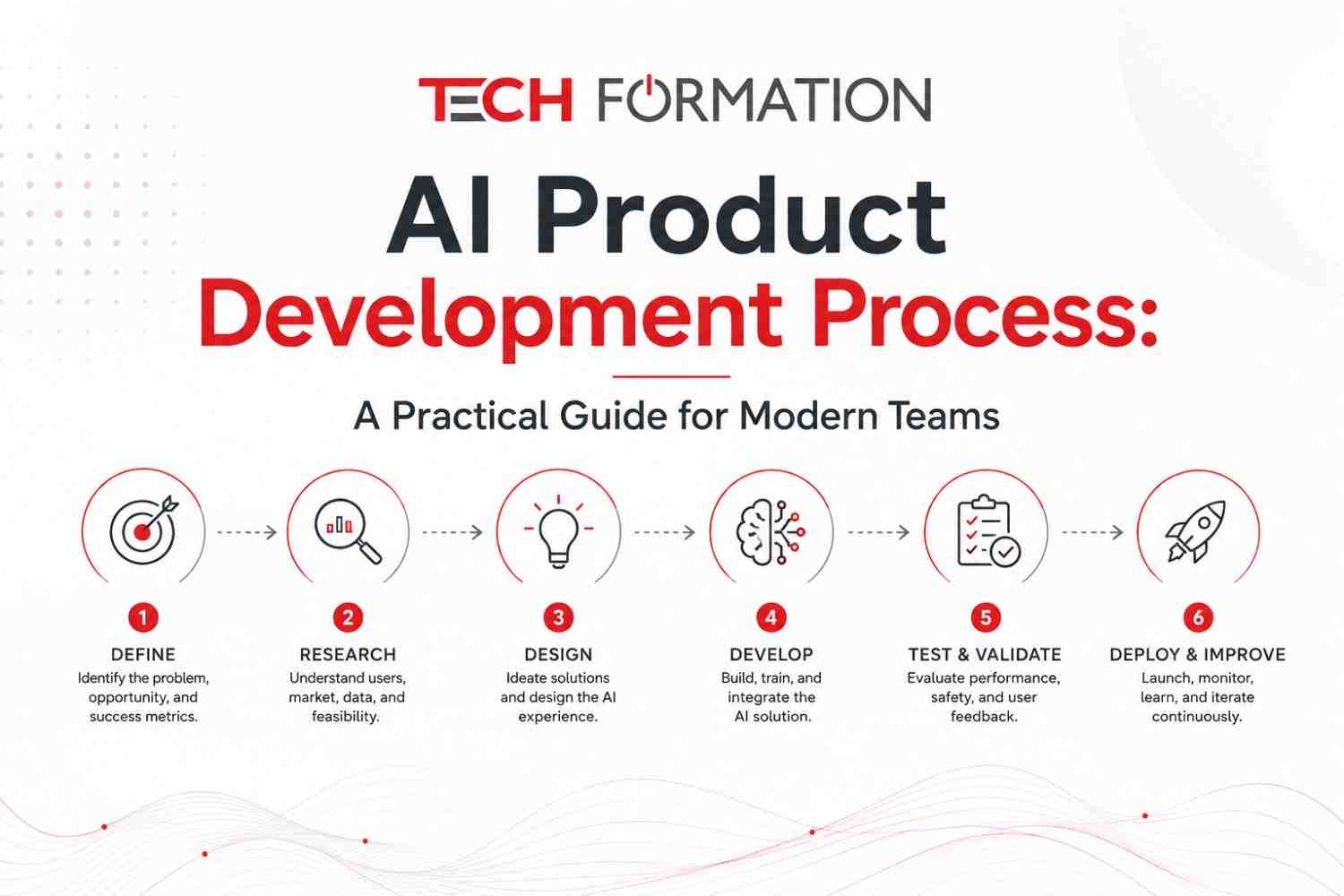
Building a product used to start with sticky notes, long meetings, and a whiteboard full of “brilliant” ideas that nobody tested. Today, companies move faster with AI. The modern ai product development process helps teams reduce guesswork, improve customer experiences, and launch smarter products with better data behind every decision.
Businesses across industries now use AI to predict customer behavior, automate workflows, and speed up product design. But success doesn’t come from adding AI just for the buzzword effect. It comes from using the right strategy, tools, and development process from day one.
What Is the AI Product Development Process?
The AI product development process is the structured method companies use to create products powered by or improved with artificial intelligence. It combines traditional product development with machine learning, automation, and data-driven decision-making.
Unlike regular software projects, AI development depends heavily on data quality, model training, and continuous improvement. That means teams cannot simply “build once and forget.”
A successful AI workflow usually includes:
- Problem identification
- Data collection and preparation
- AI model selection
- Product design and prototyping
- Testing and validation
- Deployment and monitoring
Think of AI like hiring a very smart intern. If you train it badly, it confidently makes terrible decisions. That’s why process matters.
Why Businesses Are Investing in Product Development AI
Businesses are using product development AI to build better products faster. AI helps teams make smarter decisions and better understand customer needs. Many companies already use AI in their daily operations. E-commerce brands use it to predict what customers may buy. Healthcare platforms use AI to improve diagnostics. SaaS companies use AI chatbots to handle customer support. The biggest benefit is faster, more accurate work.
Key Stages of the AI Product Development Process
1. Define the Real Problem
Many AI projects fail because teams chase trends rather than solve actual problems. Before building anything, define the business challenge clearly. Ask questions like:
- What pain point are we solving?
- Will AI genuinely improve the experience?
- What outcome should the product achieve?
A clear objective keeps development focused and prevents expensive detours.
2. Collect and Organize Data
AI runs on data the way coffee runs a startup team. Clean, relevant, and structured data improves model accuracy. Poor data creates unreliable predictions and frustrating user experiences.
Teams should audit data sources early and remove duplicates, inconsistencies, or outdated information before training models.
3. Build and Train AI Models
This stage involves selecting algorithms and training models using prepared datasets. The right model depends on the product goal. Recommendation systems, predictive analytics, natural language processing, and computer vision all require different approaches.
Testing matters here. Teams should validate outputs regularly and avoid overfitting models that perform well in testing but fail in real-world situations.
4. Design the Product Experience
Even advanced AI fails if users find the product confusing. Great AI products feel natural and simple. Users should understand how features help them without needing a technical manual longer than a gym membership contract.
UI and UX teams should work closely with developers to ensure AI enhances the experience instead of complicating it.
5. Launch, Monitor, and Improve
AI products continue learning after launch.
Teams must track performance metrics, user behavior, and model accuracy over time. Continuous updates help products stay relevant as customer behavior changes.
This ongoing refinement separates successful AI products from abandoned experiments.
New Product Development Examples Using AI
Real-world adoption shows how AI changes product innovation across industries. These new product development examples demonstrate practical applications instead of theoretical hype.
Streaming Platforms
Services like Netflix use AI recommendation engines to personalize content suggestions. This improves engagement and keeps users watching longer.
Retail and Ecommerce
Brands use AI-powered recommendation systems to suggest products based on browsing habits and purchase history. Personalized shopping increases conversion rates and customer satisfaction.
Healthcare Technology
AI tools now assist doctors with medical imaging analysis and early disease detection. These systems improve speed and support better decision-making.
Financial Services
Banks use AI for fraud detection and risk analysis. Machine learning models identify unusual transaction patterns faster than manual review systems.
These examples show that AI works best when it solves measurable problems instead of acting as a marketing feature.
Best Practices for AI-Driven Product Development
Following proven methods improves product quality and reduces unnecessary risks. These best practices for ai-driven product development help teams build scalable and reliable solutions.
Focus on Human-Centred Design
AI should support users, not confuse them. Keep interfaces simple and prioritize usability.
Start Small and Scale Gradually
Many successful AI products begin with a single focused feature before expanding their capabilities.
Prioritize Data Privacy
Customers care about how companies handle data. Strong security and transparent policies build trust.
Use Cross-Functional Teams
AI projects succeed when developers, designers, marketers, and business leaders collaborate early.
Monitor Bias and Accuracy
AI models can inherit bias from training data. Regular audits help maintain fairness and reliability.
Why Strategy Matters More Than Hype
Some companies rush into AI because competitors are doing it. That approach usually ends with wasted budgets and disappointed stakeholders. A strong ai product development process focuses on measurable outcomes, customer value, and long-term improvement. Businesses that combine smart strategy with technical expertise create products people actually want to use. That’s where experienced development partners like Tech Formation help companies move from ideas to scalable AI-powered products without unnecessary complexity.