The Dark Side Of Automated Hiring: Why AI Recruiting Systems Fail
-

- September 05th, 2026
- 1,878 views

FREE SEO Topical Map Generator: Find Your Next Content Ideas
TL;DR
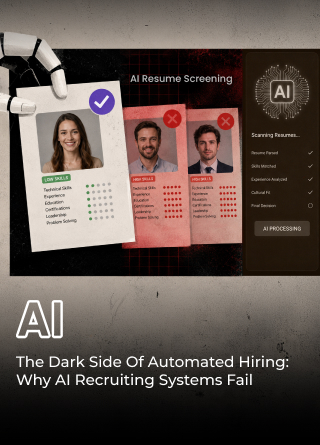
Automated hiring has transformed recruitment by helping organizations process thousands of applications in a fraction of the time traditional hiring once required. However, when screening systems rely on rigid rules, biased historical data, or poorly designed algorithms, they can unintentionally reject qualified candidates before a recruiter even reviews their applications.
- Harvard Business School found that 88% of surveyed employers believed qualified high-skill candidates were excluded because they failed to meet overly specific screening criteria.
- Applicant Tracking Systems (ATS) often fail due to rigid requirements, keyword matching, proxy indicators, and poorly structured job descriptions.
- AI recruiting tools can amplify historical hiring bias rather than eliminate it.
- A 2026 Stanford-led study revealed racial disparities and repeated rejection patterns across millions of algorithmically screened applications.
- Organizations can improve hiring outcomes by focusing on job-relevant qualifications, conducting regular bias audits, ensuring accessibility, maintaining human oversight, and testing systems against emerging threats such as prompt injection.
Introduction
Hiring has always involved balancing efficiency with fairness. As organizations receive hundreds—or even thousands—of applications for a single role, manually reviewing every résumé has become increasingly difficult. To solve this challenge, employers have embraced Applicant Tracking Systems (ATS) and Artificial Intelligence (AI)-powered recruitment tools that promise to identify the best candidates faster than ever before.
These technologies undoubtedly improve operational efficiency. They organize applications, rank candidates, identify relevant qualifications, and automate repetitive administrative work that once consumed recruiters' time. For companies struggling with large hiring volumes, automation has become an essential part of modern recruitment.
However, efficiency alone does not guarantee better hiring decisions. When algorithms rely on inflexible screening rules, incomplete data, or historical hiring patterns, they can reject capable applicants for reasons unrelated to their ability to perform the job. A résumé using different terminology, an employment gap, or an unconventional career path may prevent an otherwise qualified candidate from reaching a human recruiter.
This growing concern has made AI Recruiting one of the most closely examined topics in modern human resources. Rather than simply improving recruitment, poorly designed systems can unintentionally create barriers that exclude talented professionals before anyone evaluates their actual skills.
According to Harvard Business School, 88% of surveyed employers acknowledged that qualified candidates for high-skill positions were filtered out because they failed to satisfy narrowly defined hiring criteria. For middle-skill jobs, that figure increased to 94%. These findings highlight a troubling reality: automation intended to improve hiring can sometimes become an obstacle to finding the right people.
Understanding Automated Hiring Beyond Applicant Tracking Systems
Many people assume that every Applicant Tracking System automatically functions as an AI-powered hiring decision-maker. In reality, that is not how most recruitment platforms operate.
Traditional ATS platforms primarily act as organizational tools. They store résumés, manage interview workflows, schedule communication, and allow recruiters to search candidate databases efficiently. Problems emerge when employers introduce automated filtering, AI scoring models, résumé ranking systems, or machine learning assessments that determine which candidates advance in the hiring process.
The Harvard Business School research also revealed that more than 90% of surveyed employers relied on recruiting software to initially filter or rank applicants for both middle-skill and high-skill roles.
Although automation can significantly reduce recruiters' workloads, it also means that poorly configured systems may eliminate applicants before human judgment enters the process. Missing a specific degree, using different terminology, or having an unconventional employment history may automatically reduce a candidate's ranking regardless of their actual qualifications.
The result is an uncomfortable paradox. Organizations become increasingly efficient at processing applications while simultaneously becoming less effective at identifying individuals who could genuinely excel in the role.
Why AI Recruiting Systems Often Fail
The weaknesses of automated hiring rarely stem from a single mistake. Instead, multiple design decisions combine to create systems that prioritize consistency over capability.
Exact Keyword Matching Overlooks Real Talent
One of the most common limitations of automated hiring is excessive reliance on exact keyword matching.
Candidates frequently possess transferable skills but describe them differently from the language used in a job posting. For example, a project manager may highlight "stakeholder coordination" while a job description searches specifically for "cross-functional collaboration." Although both phrases describe similar competencies, rigid systems may fail to recognize the connection.
Career changers, military veterans, caregivers returning to work, freelancers, and professionals with nonlinear career paths often experience similar challenges. Their experiences may not resemble the conventional career progression that many algorithms implicitly favor.
Harvard researchers recommend replacing negative exclusion criteria with affirmative screening based on demonstrated skills, measurable experience, and job-related competencies rather than superficial résumé characteristics.
Historical Hiring Data Can Reinforce Existing Bias
Artificial Intelligence learns from historical information. If historical hiring practices contained bias, AI models may unintentionally treat those patterns as indicators of future success.
This creates one of the biggest challenges in AI recruitment.
Rather than independently determining who is qualified, algorithms often identify characteristics associated with previous successful hires. If earlier recruitment favored particular demographics, educational backgrounds, or career paths, the AI may unknowingly replicate those same preferences.
MIT Sloan professor Emilio J. Castilla summarized the issue clearly by noting that algorithms promise objectivity while simultaneously learning human biases.
Amazon's experimental recruiting system remains one of the most widely discussed examples. Reuters reported that the company discontinued an internal AI recruiting tool after it learned from historically male-dominated technical hiring data and began penalizing résumés containing terms associated with women. Although Amazon abandoned the project, it demonstrated how machine learning models can reproduce historical inequalities instead of correcting them.
Accessibility Challenges Remain Overlooked
Automated hiring can also create unintended disadvantages for candidates with disabilities.
The U.S. Equal Employment Opportunity Commission (EEOC) has warned that AI-powered assessments, software, and algorithmic decision-making tools may create compliance issues under the Americans with Disabilities Act.
Problems occur when employers rely on assessments measuring characteristics that are not actually required to perform the job. Automated video interviews, personality assessments, timed cognitive tests, or interaction patterns may unintentionally disadvantage qualified applicants if accessibility considerations are ignored.
Technology designed without inclusive principles can therefore exclude capable candidates based on factors unrelated to job performance.
Large Language Model Screening Introduces New Security Risks
The newest generation of hiring technology increasingly incorporates Large Language Models (LLMs) capable of interpreting résumés, generating candidate summaries, and assisting recruiters during evaluations.
While these capabilities improve efficiency, they also introduce entirely new vulnerabilities.
Research published in 2026 demonstrated that prompt injection attacks could manipulate certain LLM-based résumé screening systems. In experimental settings, lower-quality candidates successfully influenced model behavior to receive more favorable rankings than stronger applicants.
This represents a different type of hiring failure.
Instead of unintentionally rejecting qualified candidates, organizations may inadvertently reward individuals who understand how to exploit weaknesses in AI systems.
As LLM adoption grows across recruitment, organizations will need stronger safeguards to ensure that automated evaluations remain trustworthy.
How Algorithmic Bias Scales Across Employers
Individual hiring mistakes have always existed. Algorithmic hiring changes the scale of those mistakes.
A recruiter making one poor decision affects a single applicant. A widely deployed algorithm can make the same flawed decision thousands—or even millions—of times across multiple organizations.
Researchers from Stanford examined approximately four million applications processed through recruitment algorithms supplied by the same technology vendor. Their 2026 study identified racial disparities and introduced the concept of "algorithmic monoculture," where similar automated systems repeatedly produce unfavorable outcomes for the same groups of applicants across different employers.
This creates systemic consequences rather than isolated hiring errors.
Candidates repeatedly rejected by one organization's algorithm may encounter nearly identical screening logic elsewhere because many employers use similar recruitment software.
Growing Legal And Regulatory Pressure
The increasing use of AI hiring systems has also attracted greater legal scrutiny.
In 2023, iTutorGroup agreed to pay $365,000 to settle an EEOC lawsuit alleging that its automated application software rejected female applicants aged 55 or older and male applicants aged 60 or older. More than 200 qualified applicants were reportedly affected.
Importantly, the settlement did not establish that every AI hiring system behaves similarly. Instead, it demonstrated that organizations remain responsible for ensuring automated hiring complies with employment discrimination laws.
Legal challenges have continued to expand.
In June 2026, a federal judge ruled that Workday must continue defending claims alleging its AI-powered recruiting software discriminated against applicants based on age, race, and disability. Workday disputes those allegations, maintaining that its technology evaluates qualifications rather than protected characteristics.
Meanwhile, governments worldwide are introducing regulations specifically addressing automated employment decisions.
New York City's Local Law 144 requires covered automated employment decision tools to undergo independent bias audits while also requiring employers to provide certain notices to applicants.
Similarly, the European Union's AI Act classifies recruitment, application filtering, and candidate evaluation as high-risk AI applications subject to stricter regulatory obligations.
These developments indicate that AI hiring is no longer solely an HR concern—it has become a governance, compliance, and legal priority.
Building Better Automated Hiring Systems
The solution is not abandoning automation altogether.
Instead, organizations should redesign hiring systems to support better human decision-making rather than replacing it.
Focus On Skills Instead Of Exclusion Rules
Employers should prioritize measurable abilities, demonstrated competencies, and job-relevant experience instead of automatically rejecting candidates based on résumé gaps, unconventional job titles, or missing degrees.
Evaluating what applicants can do provides more reliable hiring outcomes than filtering them based on arbitrary requirements.
Measure Outcomes Instead Of Marketing Claims
Organizations should continuously evaluate hiring results rather than assuming vendor claims accurately reflect system performance.
Bias audits, demographic outcome analysis, and reviews of rejected qualified candidates help identify whether screening algorithms consistently disadvantage particular groups.
Evidence should drive improvements—not assumptions.
Preserve Meaningful Human Oversight
Human review must involve genuine authority rather than simply approving algorithmic recommendations.
Recruiters should understand why candidates received particular rankings and retain the ability to challenge automated decisions whenever necessary.
Human judgment remains essential for evaluating qualities that algorithms cannot easily measure, including adaptability, leadership potential, communication style, and unique career experiences.
Test Systems For Failure Before Deployment
Organizations should proactively examine how automated hiring systems perform under challenging conditions.
Testing should include résumé parsing accuracy, accessibility compliance, proxy discrimination, unusual career paths, multilingual applications, and emerging threats such as prompt injection.
Continuous testing ensures hiring technology evolves alongside both technological risks and changing workforce expectations.
Conclusion
Automation has permanently changed modern recruitment, offering organizations unprecedented speed and efficiency in processing applications. However, technology alone cannot determine who will become a successful employee.
The quality of a hiring system should not be measured by how many résumés it removes from consideration but by how effectively it identifies qualified people who can succeed in the role.
Poorly designed algorithms can repeat flawed hiring decisions consistently, rapidly, and at enormous scale. Conversely, well-designed systems can reduce administrative burdens while supporting fairer, evidence-based recruitment.
The most effective hiring strategy combines the strengths of both humans and machines. Automation should handle repetitive administrative work, organize information, and surface relevant candidates, while experienced recruiters evaluate context, potential, and qualities that algorithms cannot fully understand.
Ultimately, the goal of hiring has never been simply to process applications faster. It has always been to find the right people—and achieving that objective requires technology that supports human judgment rather than replacing it.