AI Review Management for Hotels — The Two-Thirds of Guests Nobody Ever Replies To
-

- Published Updated
- 3,677 views
A guest checks out, and a few days later leaves a review — three lines about a slow check-in, a noisy air-conditioning unit, and how much they loved the breakfast. It sits there. No one from the property replies. Weeks later, a different guest reads that same review while deciding where to book, sees no response, and quietly moves on to a competitor who looks like they actually listen.
That guest isn't rare. On average, hotels respond to only 1 out of every 3 reviews they receive — meaning two-thirds of guests who took the time to write feedback never hear back at all (source). That silence has a measurable cost, and it's exactly the gap AI review management for hotels is built to close.
What Is AI Review Management?
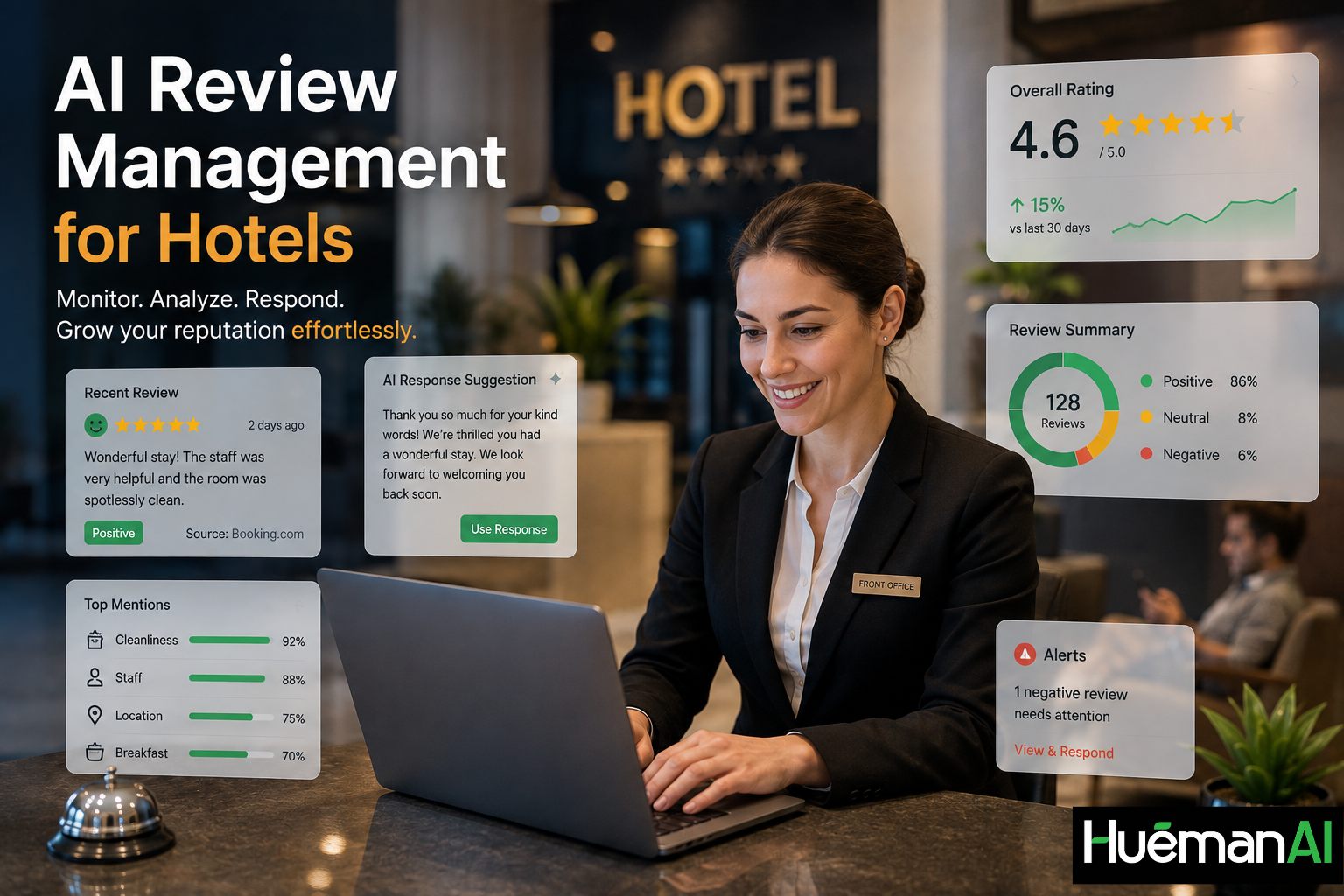
AI review management is a system that monitors reviews across TripAdvisor, Google, Booking.com, and other platforms in real time, drafts on-brand responses to each one, flags anything urgent for a human to handle personally, and tracks sentiment trends so a property can see recurring issues before they show up in a dozen more reviews.
It isn't a canned-reply generator. Done properly, it reads the specific complaint or compliment, matches tone to the review's sentiment, and routes anything sensitive — a serious complaint, a legal mention, a safety issue — to a staff member instead of auto-publishing a generic reply.
The Real Problem: Silence Is Read as Indifference
The data on this is unusually direct. In an Ipsos MORI survey of over 23,000 travelers conducted with TripAdvisor, 63% said they'd be more likely to book a hotel or restaurant if the owner responded to the majority of reviews — and when an owner leaves personalized responses, 77% of travelers said they're more likely to book as a result (source). The same research found 89% of travelers said a thoughtful response to a negative review improved their impression of the business — responding well to criticism moves guests more than responding to praise.
Cornell's Center for Hospitality Research backs this up from the revenue side: hotels that responded to guest reviews saw measurable improvements in both ratings and revenue compared to their competitive set — though the research also found a ceiling, with returns levelling off past roughly a 40% response rate, and consumers responding most strongly to thoughtful replies on negative reviews specifically, not blanket responses to everything (source). In other words, this isn't about maximizing reply volume — it's about making sure the reviews that matter most get a real, specific response.
The operational reality explains why most properties fall short anyway: a mid-size hotel can receive hundreds of reviews a year across half a dozen platforms, each with its own login and interface. Checking all of them daily, drafting a thoughtful reply, and doing it before a review sits unanswered for weeks is a job nobody's actually been assigned — it falls to whoever has a spare ten minutes, which in practice means it mostly doesn't happen.
What to Look For in a Review Management System
Multi-platform coverage in one place. TripAdvisor, Google, Booking.com, and Expedia all need monitoring — a tool that only covers one channel leaves the rest exactly as unattended as before.
Sentiment-matched drafts, not templates. A response to a guest complaining about noise shouldn't read the same as a reply to someone praising the spa. Look for genuinely tailored responses, not a mail-merge with the guest's name swapped in.
Escalation for anything sensitive. Reviews mentioning safety, discrimination, or anything legally sensitive should go straight to a manager, not get an automated reply.
Trend visibility, not just individual replies. The real value is spotting that "slow check-in" has come up in eleven reviews this quarter — a pattern a human skimming one review at a time will likely miss.
How HuemanAI Delivers This in Practice
Review management sits naturally alongside HuemanAI's other guest-facing systems, because the same operational visibility that powers the AI Receptionist and Omnichannel AI Agent — live guest sentiment, request patterns, and service gaps — is exactly what makes review responses accurate instead of generic. AG Hotels Group's move to HuemanAI's platform was built around the same principle: replacing scripted, disconnected handling with a system that actually reflects what's happening on the property in real time.
Royal Nest Forest View's reported 75% demand accuracy on HuemanAI's platform points at the same underlying strength — the system surfaces patterns in guest behaviour and feedback that inform decisions, rather than just logging interactions and moving on.
Getting Started
Onboarding follows HuemanAI's standard 48-hour path: review platforms get connected, response tone is configured against your property's actual voice, and escalation rules are set so anything sensitive reaches a manager immediately. A free trial gives full access to measure the change in response rate and turnaround time against how reviews are handled today.
HuemanAI builds AI reception, concierge, and reputation systems for the UK hospitality sector — one connected view of the guest experience. huemanai.co.uk