AI Virtual Assistant Development In India: Why an Agent Finishes the Job a Chatbot Only Describes
-

- Published Updated
- 4,462 views
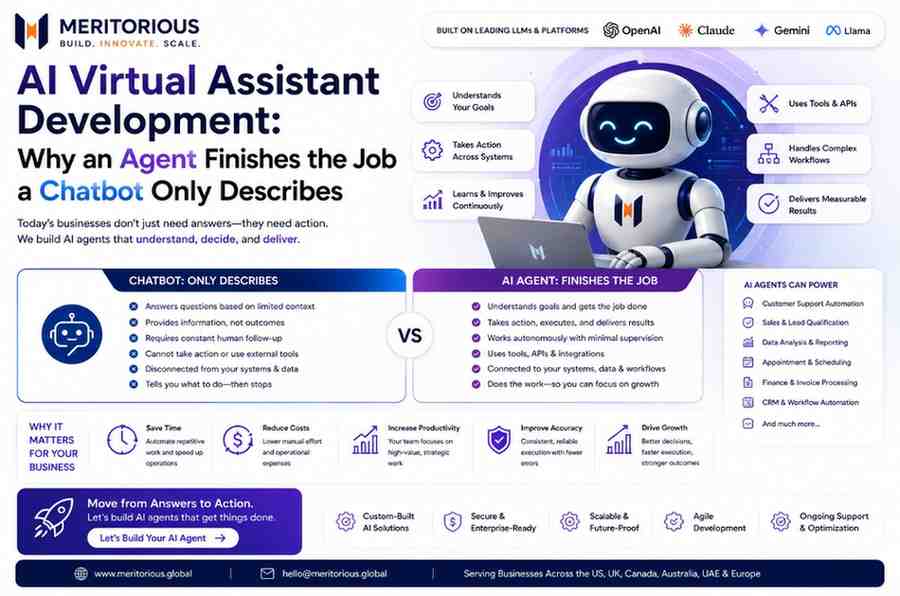
Why Many Agentic AI Projects Fail Before They Reach Production
The excitement around autonomous AI agents has encouraged many businesses to move quickly from experimentation to implementation, but a large number of projects struggle because the underlying business foundations are not ready. Poor-quality data, unclear workflows, excessive scope, and weak governance can turn an impressive proof of concept into an unreliable production system. An agent that is allowed to access too many systems or perform undefined actions can create operational and security risks that outweigh its potential benefits. Successful agentic AI therefore begins with a clear understanding of business processes, trusted data sources, measurable objectives, and well-defined boundaries. Organizations should determine which tasks are suitable for automation and which decisions still require human judgment before development begins. A governance-first strategy transforms AI from an experimental technology into a controlled operational capability that can deliver measurable value.
What Businesses Gain from AI Virtual Assistant Development in India
Working with an experienced development partner can help businesses move from an initial AI concept to a production-ready virtual assistant through a structured lifecycle. Effective AI virtual assistant development services in india can include data audits, workflow analysis, architecture planning, model integration, retrieval systems, agent design, evaluation, deployment, and ongoing monitoring. India's large technology talent pool also provides businesses with access to experienced AI and software engineers at costs that can be more competitive than comparable Western engineering markets. However, cost should not be the only consideration when selecting an offshore partner. Businesses should also expect transparent ownership of source code, configurations, data pipelines, and intellectual property so that they retain control over their AI investment. A mature partner can combine technical expertise with structured delivery practices, helping organizations reduce implementation risk while creating an AI capability that can evolve with their operational needs.
Chatbots Answer Questions While Agents Take Action
The distinction between an AI chatbot and an AI agent becomes important when deciding what level of automation a business actually requires. A chatbot primarily responds to user requests by retrieving information, generating explanations, or guiding people toward the next step. An agent goes further by interacting with approved business tools and completing actions such as creating tickets, updating records, scheduling appointments, checking information, or triggering workflows. AI chatbot development in india can therefore be highly effective for customer support, knowledge access, and information-based interactions, while agent development is better suited to processes where completing the task creates greater operational value. The additional capability comes with a corresponding increase in responsibility because an agent has authority to affect real business systems. Companies should therefore choose agentic automation only when the expected business benefit justifies the additional governance, security, testing, and monitoring requirements.
Engineering AI Agents for Production, Not Just Impressive Demos
A production AI agent needs stronger controls than a demonstration because it can interact with systems and potentially create real-world consequences. AI Agent Development in india should therefore be designed around scoped permissions that are enforced within the application architecture rather than relying solely on instructions given to a language model. High-consequence actions may require human approval before execution, while lower-risk tasks can be automated within clearly defined boundaries. Comprehensive audit trails should record relevant requests, decisions, tool calls, approvals, and completed actions so that organizations can investigate behavior and demonstrate accountability. Evaluation should also cover failure scenarios, unauthorized requests, unexpected inputs, and situations where the agent lacks sufficient information to act safely. This approach makes the agent more predictable and gives operations leaders greater confidence that automation will continue functioning responsibly when exposed to the complexity of real production environments.
Why the Permission Boundary Must Be Designed Before the Prompt
One of the most important decisions in an agentic AI project is determining what the system is allowed to do before development begins. A permission boundary should define which data the agent can access, which tools it can use, which actions it can execute independently, and which situations require human intervention. Businesses that hire AI developers in india should look for engineers who understand that these controls belong in the architecture, application logic, identity systems, and workflow design rather than being treated as optional instructions inside a prompt. This distinction is critical because prompts can influence model behavior, but they should not be the primary security mechanism protecting sensitive business operations. A well-engineered permission model combines technical controls with monitoring, authentication, authorization, logging, and escalation procedures. By establishing these boundaries early, organizations can pursue useful automation while keeping accountability and risk management at the center of the AI strategy.
Build an Assistant That Finishes the Job
The goal of agentic AI should not be to create a system that merely appears autonomous; it should be to build an assistant that can complete valuable business tasks safely and consistently. Meritorious CodeCrafters takes a governance-first approach to AI virtual assistant and agent development, helping businesses across the US, UK, Canada, Australia, UAE, and Europe move from AI experimentation toward controlled production deployment. Its approach combines data assessment, workflow analysis, secure architecture, scoped permissions, evaluation, human oversight, and continuous monitoring to create systems designed around real operational requirements. ISO-certified processes further support structured quality, security, and delivery practices throughout the development lifecycle. Whether your objective is automating support operations, streamlining internal workflows, or enabling AI to execute carefully defined business processes, the right architecture can help you capture value without giving automation unnecessary authority. Book a free consultation with Meritorious CodeCrafters to explore how a governed AI assistant can move beyond describing the job and safely help your team finish it.