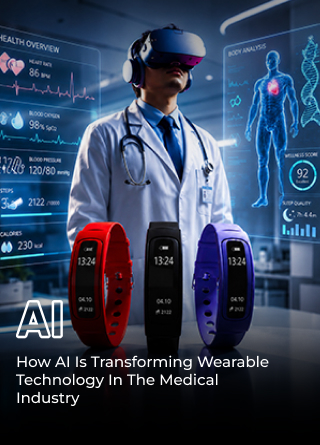
How AI Transformed Wearable Technology In The Medical Industry
-

- September 22nd, 2026
- 3,361 views
TL;DR
Artificial intelligence is reshaping wearable devices from simple fitness accessories into sophisticated health-monitoring tools capable of identifying clinically relevant conditions.
- The global wearable medical device market is expected to reach $68.1 billion in 2026, according to Grand View Research.
- AI can process noisy sensor signals and account for factors such as movement, device fit and skin pigmentation to improve health-data interpretation.
- Devices and features from Apple, AliveCor, Dexcom, Abbott, Rune Labs and others have received regulatory clearances for specific medical applications.
- Clinical-grade wearables must meet substantially higher validation requirements than consumer fitness trackers when they make medical claims.
- AI-enabled remote patient monitoring is also showing measurable benefits, including reported reductions in hospital readmissions for certain heart failure patients.
Introduction
In Big Hero 6, Baymax can scan Hiro almost instantly, interpret his vital signs and identify a health problem before Hiro completely understands what is happening. At the time, that kind of technology seemed firmly rooted in science fiction.
Today, we are seeing a less dramatic but increasingly realistic version of that idea. A smartwatch can monitor heart rhythm, a smart ring can continuously track physiological signals, and a wearable glucose monitor can provide readings throughout the day.
This transformation is being driven by artificial intelligence and advances in Wearable Technology, which are pushing these devices beyond basic step counting and calorie estimates. According to Grand View Research, the global wearable medical device market was valued at around $54 billion in 2025 and is projected to reach approximately $330.5 billion by 2033.
The important question is no longer whether wearables can collect health information. It is whether AI can turn that information into reliable, actionable insights.
How Is AI Changing Wearable Technology In Healthcare?
Traditional wearable devices primarily focused on tracking lifestyle metrics. Users could see how many steps they had taken, estimate calories burned or receive a basic sleep score. These features were useful, but they largely depended on predefined algorithms and simple measurements.
AI is changing the role of wearables by adding interpretation to the data.
Modern wearable devices can collect enormous amounts of information from sensors measuring heart rate, blood oxygen, body temperature, movement and other physiological signals. Instead of simply displaying these readings, machine learning models can analyze patterns across that data and identify changes that might otherwise be difficult to notice.
For example, an elevated heart rate after exercise is generally expected. However, a similar increase occurring while a person is resting could mean something different. AI models can evaluate the surrounding data, compare it with previous readings and identify whether the change appears unusual.
This ability to recognize patterns is what moves wearables from passive trackers toward continuous health-monitoring systems.
Research has also demonstrated how wearable data can potentially be used for prediction rather than simple measurement. Researchers at the University of Arizona Health Sciences, for example, have explored deep-learning approaches using continuous wearable data to identify physiological changes associated with events such as labor onset.
The broader trend is clear: wearables are becoming less about recording what happened and more about understanding what the data could mean.
Consumer Wearables vs. Clinical-Grade Devices
It is important to distinguish between a consumer wearable that provides wellness information and a medical device designed to support clinical decisions.
A fitness tracker may tell users that their heart rate is elevated or that they slept poorly. A medically cleared device, by contrast, may be authorized to detect or monitor a specific condition under defined circumstances.
| Aspect | Consumer Wearables | Clinical-Grade Wearables |
|---|---|---|
| Primary purpose | Fitness, wellness, sleep and lifestyle tracking | Disease monitoring or clinical decision support |
| Validation | Generally focused on product performance and wellness use cases | Often validated against established clinical reference standards |
| Regulatory status | May not require FDA clearance for general wellness functions | Medical claims can require regulatory review and clearance |
| Accuracy | Useful for identifying trends but may not support diagnosis | Validated for specific cleared indications |
| Typical use | Personal health awareness | Patient monitoring and healthcare workflows |
The distinction is important because FDA clearance does not mean a device is universally accurate or capable of diagnosing every health condition. A clearance applies to a specific function and intended use.
Consumers should therefore look beyond marketing language and understand exactly what a wearable has been validated or cleared to do.
How Does AI Improve Wearable Health Data?
Wearable sensors operate in difficult real-world environments. Unlike equipment in a hospital, a smartwatch or ring moves with the person wearing it. Sensors can be affected by exercise, device positioning, ambient light, temperature and other external factors.
Optical sensors used for measurements such as heart rate and blood oxygen saturation can also be influenced by skin pigmentation and other physiological differences.
AI can help address some of these challenges by separating meaningful physiological signals from noise.
Machine learning models can process sensor readings continuously, identify abnormal fluctuations and compare new measurements with historical patterns. Instead of depending entirely on a fixed threshold, a system can potentially consider an individual's baseline and determine whether a change is unusual for that particular person.
This can make the resulting information more useful.
For example, an AI system could distinguish between a temporary heart-rate increase caused by running and an unexpected rhythm irregularity occurring while the user is inactive. The technology does not eliminate measurement limitations, but it can improve how raw sensor information is interpreted.
Research involving large wearable datasets has also demonstrated the potential of AI for predicting health outcomes. Some studies have explored using wearable information to estimate hospitalization risks and identify patterns associated with future health events.
The ultimate goal is to move from retrospective tracking toward earlier intervention.
Which Wearable Medical Devices Have FDA Clearance?
Several wearable technologies have already moved beyond general wellness applications and received regulatory clearance for specific medical functions.
Apple Watch's Irregular Rhythm Notification: Apple's feature uses information collected through the Apple Watch's sensors to identify patterns that may be consistent with atrial fibrillation. It is designed as a notification tool rather than a replacement for clinical diagnosis.
AliveCor Kardia Systems: AliveCor's ECG technology has received FDA clearances for specific cardiac applications. Its systems use electrocardiogram measurements and algorithmic analysis to help identify a range of heart-related abnormalities.
iRhythm Zio Watch: iRhythm's wearable ECG technology is designed for continuous cardiac monitoring. Its broader platform combines wearable data with algorithmic analysis to support arrhythmia detection and reporting.
Rune Labs StrivePD: StrivePD uses Apple Watch movement data to support monitoring of Parkinson's disease symptoms. The system illustrates how data collected by consumer hardware can be incorporated into disease-specific healthcare applications.
Dexcom Stelo and Abbott Lingo: Over-the-counter continuous glucose monitoring products such as Dexcom's Stelo and Abbott's Lingo demonstrate how wearable glucose technology is expanding beyond traditional prescription-only applications.
Hexoskin Medical System: Smart garments equipped with physiological sensors can support long-term monitoring of cardiac and respiratory measurements, bringing wearable monitoring closer to clinical environments.
These examples highlight an important development: wearable medical technology is no longer limited to experimental research. Specific products and features are already operating within defined regulatory frameworks.
At the same time, regulatory clearance should not be confused with blanket approval of every AI-generated insight. The intended use, specific feature and validated clinical application still matter.
AI Wearables And Remote Patient Monitoring
One of the most significant applications of AI-enabled wearables may be remote patient monitoring.
Traditional healthcare often relies on measurements collected during occasional appointments. A patient's blood pressure, heart rate or other vital signs may look normal during a brief clinical visit even if significant changes occur between appointments.
Connected wearables can provide a much more continuous stream of information.
In a remote monitoring program, data can move from a patient's wearable device to healthcare systems where algorithms help identify measurements that require attention. Instead of asking clinicians to manually review every data point, AI can prioritize unusual patterns and potentially help care teams focus on higher-risk patients.
This model can be particularly valuable for chronic conditions where changes in health status may occur gradually.
There are already examples of reported clinical benefits. UMass Memorial Health-Harrington has reported a 50% reduction in 30-day heart failure readmissions through a program combining AI-powered technology with remote human care teams.
Such outcomes demonstrate that the value of AI wearables does not necessarily come from the device alone. The strongest results can emerge when wearable data, AI analytics and healthcare professionals operate as part of a coordinated system.
The Wearable Medical Device Market Is Expanding
The commercial opportunity surrounding medical wearables is growing rapidly.
Grand View Research estimates that the global wearable medical device market could grow from approximately $54 billion in 2025 to $68.1 billion in 2026, eventually reaching around $330.5 billion by 2033. The research firm estimates a CAGR of approximately 29.5% over the forecast period.
Consumer-focused products still represent a substantial share of the overall market. However, clinical-grade wearables are attracting increasing attention because of their potential applications in chronic disease management, remote monitoring, diagnostics and preventive healthcare.
Regional growth is also significant. North America remains a major market, while countries such as India are expected to experience strong growth as healthcare digitization, connected devices and remote care models expand.
As AI becomes more capable, the economic opportunity is likely to extend beyond hardware. Software platforms, analytics, clinical integration, data management and remote-care services could become equally important parts of the wearable healthcare ecosystem.
What Are The Risks And Limitations?
Despite the progress, AI-powered wearables are not without limitations.
One major concern is false positives. If an AI system generates too many unnecessary alerts, users may begin ignoring notifications. Clinicians can face a similar problem if remote monitoring systems produce large numbers of low-value alerts.
There is also the issue of bias.
Wearable sensors may perform differently across populations, and differences in skin pigmentation have received particular attention in research surrounding optical health sensors. Better representation in clinical testing is therefore essential if these technologies are expected to work reliably across diverse populations.
Another challenge is data privacy. Wearables can generate highly sensitive information about a person's heart rhythm, glucose levels, sleep, activity and other physiological characteristics. As these datasets become more valuable, protecting them from unauthorized access becomes increasingly important.
Finally, AI systems can sometimes be difficult to interpret. Healthcare professionals need to understand why a system generated an alert, particularly when that alert could influence treatment decisions.
This makes transparency and explainability increasingly important as AI moves deeper into medical applications.
Conclusion
AI is changing wearable technology from a tool for counting steps into a platform capable of supporting continuous health monitoring.
The most important development is not simply that wearables can collect more data. It is that AI can process large volumes of physiological information, identify patterns and highlight changes that might deserve attention.
However, medical wearables should not be treated as miniature hospitals on the wrist. Regulatory clearance applies to specific functions, and even clinically validated technologies have defined limitations.
The future will likely involve closer integration between wearable sensors, AI systems, electronic health records and healthcare professionals. Instead of waiting for a patient to report symptoms during an appointment, healthcare teams may increasingly be able to identify meaningful changes as they happen.