AI WhatsApp Chatbot: A Practical Guide to Automation with Human Handoff
-

- March 25th, 2026
- 7,736 views
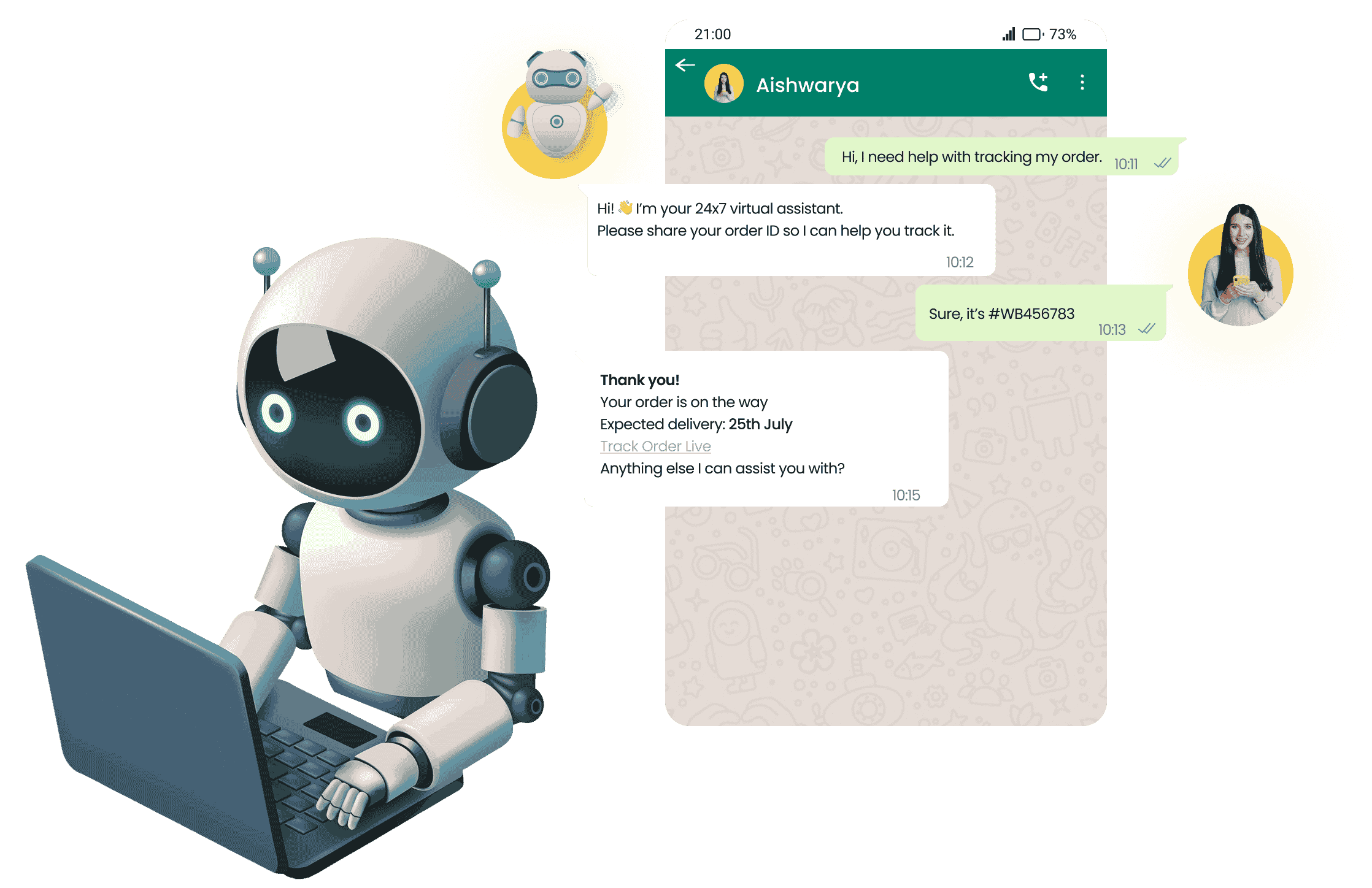
An AI WhatsApp chatbot is a system that automatically interacts with customers on WhatsApp, understands their questions, and provides relevant responses instantly. Businesses increasingly rely on AI WhatsApp chatbots to manage growing conversation volumes while maintaining quick response times and consistent communication.
The value of an AI chatbot on WhatsApp does not come from automation alone. The real advantage emerges when automation is combined with intelligent human escalation, allowing routine questions to be handled instantly while complex situations are transferred to a human agent. This balance ensures speed without sacrificing the quality of customer interaction.
For many businesses, WhatsApp begins as a simple messaging channel used to respond to enquiries. As communication volume grows, this approach becomes difficult to manage manually. AI-powered chatbots allow organizations to introduce structure into their conversations, turning WhatsApp from an informal messaging channel into a reliable customer communication system.
Why Businesses Are Turning to AI WhatsApp Chatbots
Messaging platforms have rapidly become the preferred communication channel for customers. Compared with email or phone calls, messaging offers faster responses, simpler interactions, and greater convenience. WhatsApp in particular has become the dominant messaging platform across many regions, making it a natural choice for customer communication.
As businesses begin receiving more enquiries through WhatsApp, a common operational challenge appears. Customers expect immediate responses, yet support or sales teams cannot realistically reply to every message instantly. When response delays occur, potential customers may lose interest or look elsewhere for answers.
AI WhatsApp chatbots help businesses address this challenge by managing the first stage of communication. Instead of waiting for a human reply, customers receive immediate responses that guide them toward the information they need. Routine questions can be answered instantly, allowing human teams to focus on conversations that require deeper engagement.
This approach reduces operational pressure on support teams while improving the overall customer experience. Customers receive faster responses, and businesses maintain consistent communication regardless of conversation volume.
The Operational Problem Most Businesses Face on WhatsApp
Many companies adopt WhatsApp as a customer communication channel without creating a structured system for managing conversations. At first this informal approach works because message volumes are low and staff can manually respond to enquiries.
As communication increases, however, several problems begin to appear. Customers often ask the same questions repeatedly, forcing employees to provide the same responses multiple times each day. Sales teams may spend significant time qualifying leads rather than focusing on meaningful conversations with serious prospects.
Another challenge arises when communication is handled through individual employee devices. When one employee is unavailable, ongoing conversations may stall because other team members cannot easily access previous messages or customer context.
These issues lead to communication that is reactive rather than intentional. Teams respond when messages arrive but lack a clear system that ensures consistent engagement across the entire customer journey. Wappbiz identifies this lack of structured communication as one of the most common reasons businesses struggle to scale messaging channels effectively.
AI chatbots introduce structure by ensuring that every conversation follows a predictable path, regardless of when the message arrives or which employee is available.
Why Many WhatsApp Chatbots Fail
Although chatbots promise efficiency and automation, many implementations fail to deliver meaningful improvements. This often happens because businesses deploy chatbots without designing a proper conversation workflow.
One common issue is the use of rigid menu-based bots that rely on predefined options. Customers are forced to choose from a list of buttons even when their question does not match any available choice. This limitation quickly frustrates users and interrupts the natural flow of conversation.
Another failure occurs when chatbots cannot interpret natural language. Customers phrase questions differently depending on their situation, and traditional bots struggle to understand variations in wording. When the chatbot repeatedly asks customers to rephrase their question, the interaction becomes frustrating.
Perhaps the most serious problem arises when a chatbot cannot escalate a conversation to a human agent. Without a clear escalation mechanism, customers may remain trapped in automated responses that fail to address their issue.
These limitations reveal an important principle. Chatbots should not replace human support. Instead, they should assist human teams by handling repetitive interactions and routing complex conversations appropriately.
How AI WhatsApp Chatbots Work Differently
Modern AI chatbots operate very differently from traditional rule-based bots. Instead of relying solely on scripted responses, AI systems use natural language processing to interpret the meaning behind customer messages.
When a customer sends a message, the chatbot analyzes the text to determine the customer’s intent. For example, the system might recognize whether the customer is asking about pricing, requesting product information, scheduling an appointment, or seeking support.
Once the intent is identified, the chatbot provides a relevant response drawn from a structured knowledge base. This allows the system to respond to a wide range of enquiries while maintaining consistency and accuracy.
AI chatbots can also maintain context throughout a conversation. If a customer asks follow-up questions, the chatbot remembers earlier responses and continues the discussion naturally.
The final capability that distinguishes AI chatbots from traditional systems is intelligent escalation. When the chatbot detects that a conversation requires human intervention, it can automatically route the discussion to the appropriate team member.
When an AI Chatbot Should Hand Off to a Human Agent
Automation is powerful, but not every interaction should remain automated. Determining when a chatbot should transfer a conversation to a human agent is one of the most important decisions in chatbot design.
Complex support issues often require human judgment. When a customer describes a unique or technical problem, a chatbot may not have enough context to provide an accurate solution. Escalating the conversation ensures the customer receives appropriate assistance.
High-value sales enquiries also benefit from human interaction. Customers considering significant purchases often want to discuss details with a knowledgeable representative who can provide personalized guidance.
Another important scenario occurs when customers explicitly request human assistance. Respecting this preference ensures that the customer experience remains flexible and supportive.
Finally, escalation should occur when the chatbot’s confidence level is low. If the system cannot accurately determine the customer’s intent, routing the conversation to a human agent prevents confusion and ensures the issue is resolved efficiently.
Step-by-Step: How to Implement an AI WhatsApp Chatbot
Implementing an AI WhatsApp chatbot requires careful planning. Businesses must design conversation workflows that combine automation with human collaboration.
Step 1:- Identify Repetitive Conversations
Begin by analyzing the questions customers ask most frequently. These recurring enquiries represent the interactions that automation can handle most effectively.
Step 2:- Build a Knowledge Base
Compile accurate responses to common customer questions. This knowledge base will serve as the foundation for the chatbot’s responses.
Step 3:- Define Intent Categories
Group customer enquiries into categories such as pricing requests, product availability, appointment scheduling, or customer support.
Step 4:- Create Escalation Rules
Determine the exact conditions under which conversations should be transferred to human agents. These rules ensure that customers receive assistance when automation is insufficient.
Step 5:- Assign Human Agents
Ensure that human agents are available to take over conversations when escalation occurs. Assign conversations to the appropriate department based on the customer’s request.
Step 6:- Monitor and Improve
Review chatbot interactions regularly to identify gaps in the knowledge base and improve response accuracy.
Example Workflow: AI Chatbot with Human Agent Handoff
Consider a real estate developer receiving enquiries from potential buyers on WhatsApp.
A prospective buyer sends a message asking about available apartment units. The AI chatbot immediately responds with a few questions regarding budget, preferred location, and property size.
Based on these responses, the chatbot gathers essential information about the buyer’s intent. Once the conversation reaches a point where personalized guidance is required, the system assigns the conversation to a human sales agent.
The agent continues the discussion seamlessly, using the information already collected by the chatbot. This process allows the sales team to focus on qualified prospects while automation handles the early stages of communication.
Knowledge Base Design: The Section Most Chatbots Get Wrong
One of the most overlooked aspects of chatbot implementation is the knowledge base that powers AI responses. Many businesses deploy chatbots without carefully structuring the information the system uses to answer customer questions.
A chatbot is only as effective as the knowledge it can access. If responses are incomplete, outdated, or poorly organized, the chatbot will provide inconsistent answers that reduce customer trust.
An effective knowledge base should contain clear answers to frequently asked questions, organized according to customer intent. Each answer must be written in simple language that mirrors how customers naturally communicate.
It is also important to continuously update the knowledge base as new questions arise. Customer conversations evolve over time, and the chatbot must adapt accordingly. Regular monitoring of chatbot interactions helps identify missing information and ensures the system remains accurate.
Businesses that invest time in building a structured knowledge base typically see far better results from their AI chatbot systems.
Common Mistakes When Deploying AI Chatbots
Despite their potential benefits, AI chatbots can create problems when implemented incorrectly. One frequent mistake is attempting to automate every possible interaction. Customers still expect human support for situations that require empathy, negotiation, or complex problem-solving.
Another mistake involves neglecting chatbot monitoring. Automation systems require continuous improvement. Without reviewing conversations, businesses cannot identify where customers encounter confusion or frustration.
Poor knowledge base design also causes significant issues. If chatbot responses are inaccurate or incomplete, customers quickly lose confidence in automated interactions.
Successful chatbot implementations focus on collaboration between automation and human expertise, ensuring that each type of interaction is handled by the most appropriate resource.
How Wappbiz Implements AI WhatsApp Chatbots
Within the Wappbiz platform, AI chatbots are integrated into a broader communication workflow rather than functioning as isolated automation tools. The chatbot handles the first stage of conversation by responding to common enquiries and gathering relevant information from customers.
When the conversation requires deeper engagement, the system automatically assigns it to a human agent through a shared team inbox. This structure allows teams to collaborate on conversations while maintaining full visibility into customer interactions.
By combining AI automation with coordinated human support, Wappbiz helps businesses maintain quick response times while ensuring that important conversations receive personalized attention.
Final Thoughts: AI Should Assist Humans, Not Replace Them
The most effective AI WhatsApp chatbot systems are those that support human teams rather than attempting to replace them. Automation is valuable for handling repetitive tasks and providing instant responses, but human expertise remains essential for meaningful customer engagement.
Businesses that combine AI automation with structured human escalation can deliver faster responses, reduce operational workload, and maintain consistent communication across the entire customer journey.