Apple M6 Vs. M5 Chip: What's New In The Next Generation?
-

- Published Updated
- 2,470 views
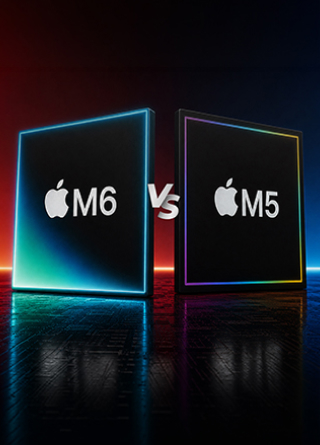
Apple’s silicon strategy is moving quickly, and the new M6 shows just how aggressively the company is pushing performance, efficiency and on-device artificial intelligence. Introduced on August 25, 2026, alongside the latest Mac mini, M6 is Apple’s first chip built using a 2nm process. It brings a redesigned 12-core CPU, a 12-core GPU with Neural Accelerators and a new Dual 16-core Neural Engine. Apple says the chip delivers up to 1.2x faster multithreaded CPU performance than M5, while its GPU offers nearly 30% more peak AI compute. With unified memory bandwidth reaching up to 170GB/s, M6 is designed to handle everything from everyday productivity and software development to demanding creative applications and increasingly important local AI workloads.
Apple M5 Set The Stage For The M6
Before looking at what has changed, it is important to understand the foundation created by M5. Apple introduced the standard M5 in 2025 with a 10-core CPU, up to a 10-core GPU and a 16-core Neural Engine. The chip was built using third-generation 3nm technology and represented a major shift toward specialized AI processing. Neural Accelerators were integrated into every GPU core, allowing M5 to handle AI workloads more efficiently while also improving graphics performance. Apple also increased unified memory bandwidth to 153GB/s, giving applications faster access to shared system memory. M5 therefore established the architecture that allowed Apple to put more emphasis on local AI rather than depending entirely on the CPU for intelligent workloads.
M6 takes that philosophy considerably further. Its move to 2nm process technology allows Apple to increase the amount of processing capability while continuing to focus on power efficiency. The new chip adds two CPU cores and two GPU cores compared with the standard M5 configuration, while also introducing a second 16-core Neural Engine. Apple says the two Neural Engines can be used simultaneously through system frameworks, potentially accelerating applications that take advantage of on-device machine learning. This is particularly important as Apple continues to position Macs as platforms for local AI, coding assistants, AI-powered applications and other workloads that can benefit from faster inference without sending every task to the cloud.
Apple M6 Vs. M5: What Has Changed?
The most noticeable differences between the two generations appear in their core configurations and AI capabilities. M5 features a CPU with up to 10 cores, while M6 moves to a 12-core design consisting of two super cores, four performance cores and six efficiency cores. This gives M6 a more differentiated approach to handling workloads. The super cores are designed for demanding single-threaded tasks, performance cores take on heavier parallel workloads, and efficiency cores manage less demanding background activity. Apple claims that M6 delivers up to 1.2x the multithreaded CPU performance of M5, while also offering the company's fastest single-threaded performance.
The GPU also grows from 10 cores in M5 to 12 cores in M6. Each M6 GPU core includes a Neural Accelerator, helping the chip process AI workloads directly on the GPU. Apple says this configuration provides nearly 30% higher peak GPU compute for AI compared with M5. That improvement could be especially relevant for applications that rely heavily on GPU acceleration, including local large language model inference, image generation, AI-assisted creative tools and other machine-learning workloads. The GPU architecture also brings improvements to graphics processing, including updated shader architecture, Dynamic Caching and hardware-accelerated ray tracing.
Why The 2nm Process Matters
One of the biggest technical changes in M6 is its transition from the third-generation 3nm process used by M5 to a 2nm process. Smaller semiconductor process nodes generally allow chip designers to place more transistors into a smaller area while improving the balance between performance and energy consumption. Apple is using that additional capability to expand the M6's CPU and GPU and add a second Neural Engine without abandoning the power efficiency that has become a defining feature of Apple silicon.
However, the smaller process should not be viewed simply as a guarantee of a specific performance increase. Real-world results depend on the architecture, software optimization, workload and thermal characteristics of the device. In M6, the 2nm transition is valuable because it provides the foundation for several architectural improvements at the same time. Instead of relying on one dramatic clock-speed increase, Apple has combined a new CPU arrangement, more GPU cores, additional AI hardware and higher memory bandwidth to create a broader performance upgrade.
M6 Brings A Bigger AI Upgrade
AI is arguably the most important area of differentiation between M6 and M5. Apple has increasingly designed its silicon around the idea that AI processing should happen locally whenever possible. M5 already introduced Neural Accelerators in every GPU core and included a 16-core Neural Engine. M6 expands this strategy with both a larger GPU and a Dual 16-core Neural Engine.
Apple says the Dual Neural Engine can deliver up to twice the peak compute of previous generations. Because system frameworks can use both engines together, compatible applications can potentially execute AI models more quickly. This could improve tasks such as text processing, image generation, speech-related features, intelligent search and other machine-learning functions that benefit from dedicated neural processing.
There is, however, an important distinction when looking at Apple's AI performance claims. The company's widely promoted claim of up to 4x faster AI performance for the M6 Mac mini is measured against the M4 Mac mini, rather than directly against M5. For consumers specifically comparing M6 with M5, the more useful figures are the nearly 30% increase in peak GPU AI compute and the up-to-2x peak compute improvement cited for the new Neural Engine. This distinction prevents Apple's headline number from creating an inaccurate impression of the direct generational improvement.
Memory Bandwidth Still Matters For AI
Memory is another important part of the M6 story, particularly for people interested in running AI models locally. M6 supports up to 170GB/s of unified memory bandwidth, compared with 153GB/s on M5. Higher bandwidth means the processor can move data between memory and compute resources more quickly, which can help workloads that constantly transfer large amounts of information.
But bandwidth and memory capacity are not the same thing. The M6 Mac mini starts with 16GB of unified memory and can be configured with up to 32GB. That means the maximum memory capacity remains unchanged from the standard M5 generation. For local AI users, this distinction is critical. A faster chip can process an AI model more quickly, but the amount of available memory still determines whether a particular model can fit and run effectively in the first place.
Interestingly, Apple notes that not every M6 configuration receives the maximum memory bandwidth. The 16GB M6 Mac mini remains at 153GB/s, meaning buyers need to consider the specific configuration rather than assuming that every M6 system automatically receives the full 170GB/s figure.
Graphics Performance Gets More Attention
The M6 is also designed to improve traditional graphics workloads. Its 12-core GPU adds two cores compared with M5 and incorporates Neural Accelerators into each GPU core. Alongside the additional compute resources, Apple has introduced improvements to shader processing, Dynamic Caching, geometry performance and ray tracing.
These upgrades could be useful for developers, video professionals, 3D artists and gamers. Applications optimized for Apple's Metal graphics framework should be able to take advantage of the additional GPU resources, while hardware-accelerated ray tracing can improve the handling of realistic lighting and reflections in supported workloads.
For creative professionals, however, the actual benefit will depend on the application. A workload that is primarily CPU-bound may benefit more from M6's new CPU architecture, while GPU-heavy applications could see greater gains from the additional cores and graphics improvements. AI-focused applications may benefit from a combination of GPU, Neural Engine and memory improvements.
Is M6 A Big Upgrade From M5?
Whether M6 represents a worthwhile upgrade depends heavily on who is buying it. For someone purchasing a new Mac mini, M6 provides a compelling combination of CPU performance, GPU capability, AI hardware and efficiency. Developers can benefit from faster compilation and multiple simultaneous tasks, while AI enthusiasts can take advantage of stronger local processing capabilities. Creative users may also appreciate the additional GPU resources and graphics improvements.
For an existing M5 owner, however, the decision is less straightforward. The M6 is undoubtedly more capable on paper, but the improvements are evolutionary rather than a complete transformation of the computing experience. Apple claims up to 20% higher multithreaded CPU performance, nearly 30% more peak GPU AI compute and up to twice the peak Neural Engine compute. Those gains can be meaningful for demanding workloads, but they may not justify replacing a relatively new M5 system for everyday browsing, office work or basic content creation.
The situation is also complicated by Apple's current product lineup. M6 has debuted in the Mac mini, while other products using the M5 family remain available. Moving from an M5 laptop or tablet to an M6 Mac mini would therefore involve changing the type of device, not simply upgrading the processor inside an equivalent product. Buyers who need a laptop, for example, may have a better reason to wait for future M6-powered portable Macs rather than switching platforms simply to obtain the newer chip.
Who Should Consider M6?
The M6 makes the most sense for people buying a new desktop and expecting to perform demanding workloads over several years. Developers working with large projects, users experimenting with local AI models, creative professionals and people interested in AI-assisted workflows could all benefit from the additional processing resources.
Users coming from older Apple silicon generations such as M1, M2 or M3 may have an even stronger reason to consider M6. The improvement from those earlier chips is likely to be more substantial than the upgrade from M5, particularly when AI processing and graphics workloads are involved. Apple itself highlights significant gains when comparing M6 with M1, including much faster local LLM prompt processing.
For M5 owners, waiting may be the smarter approach unless a specific workload is already limited by CPU, GPU or AI performance. Independent benchmarks will ultimately provide a clearer picture of how the M6 performs across real applications rather than Apple's selected test cases.
Final Verdict
The M6 is more than a routine Apple silicon refresh. Its 2nm manufacturing process, 12-core CPU, 12-core GPU, Dual 16-core Neural Engine and higher memory bandwidth show that Apple is continuing to build its chips around a future where local AI becomes an increasingly important part of everyday computing. The biggest improvements are not limited to raw CPU speed; they extend across GPU-based AI, neural processing, graphics and memory performance.
Still, the M6 should be viewed in the right context. Apple’s largest AI performance headline compares M6 with M4, while the direct M6-versus-M5 improvements are more measured. For current M5 users, the new chip is an attractive evolution rather than an essential upgrade. For new Mac buyers, developers, AI enthusiasts and users coming from older M-series hardware, however, M6 offers a much stronger proposition. Ultimately, its success will depend not only on the specifications but also on how quickly software developers take advantage of its expanded AI and graphics capabilities.