How To Choose The Right Badi Making Machine For Your Business
-
- May 28th, 2026
- 6,480 views
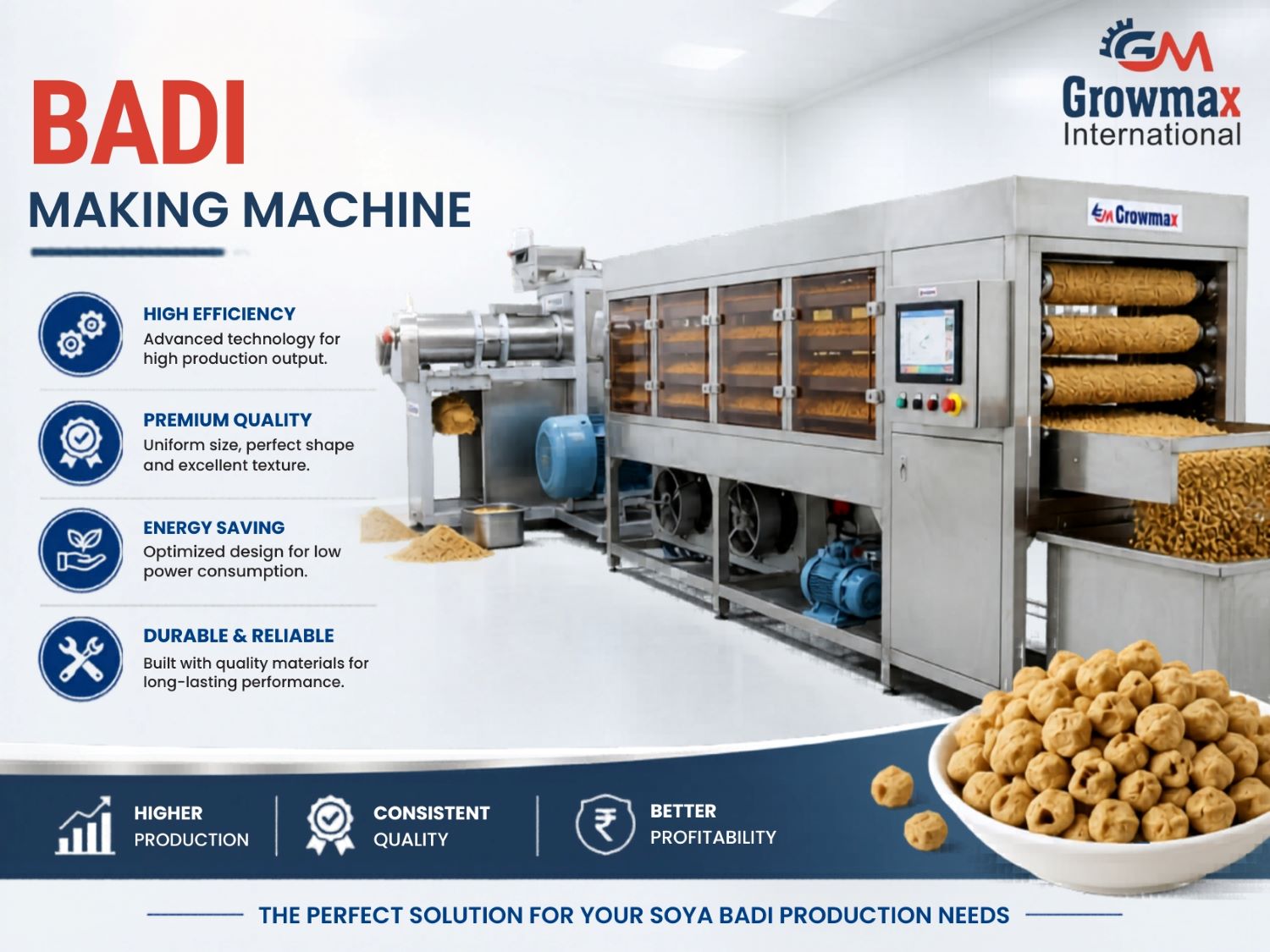
How To Choose The Right Badi Making Machine For Your Business
Starting or expanding a food manufacturing business is exciting, but choosing the wrong machinery can quickly turn that excitement into frustration. This is especially true in the soya food industry, where production quality and consistency directly affect customer satisfaction.
If you are planning to enter the protein snack market or increase your production capacity, selecting the right badi making machine is one of the most important decisions you will make.
Many business owners focus only on machine price. But experienced manufacturers know that factors like production output, maintenance requirements, energy efficiency, and machine durability matter much more in the long run.
In this guide, we’ll help you understand how to choose the right machine based on your business goals, production needs, and future growth plans.
Understand Your Production Requirement First
Before comparing machine models, take a step back and evaluate your production goals.
Ask yourself:
How much soya badi do you want to produce daily?
Are you targeting local supply or large-scale distribution?
Will you manufacture only soya badi or other snack products too?
Do you plan to expand production in the next 1–2 years?
A small food startup may not need a fully automatic industrial setup initially. On the other hand, a growing manufacturer supplying distributors or retailers will require a machine capable of continuous production.
For example, one small snack manufacturer in Uttar Pradesh started with a semi-automatic setup producing around 80–100 kg per hour. Within a year, demand increased, and they had to upgrade because the original machine could not handle bulk production efficiently.
Planning ahead can save you from costly upgrades later.
Know The Difference Between Semi-Automatic And Fully Automatic Machines
One of the biggest mistakes buyers make is choosing a machine without understanding automation levels.
Semi-Automatic Badi Making Machine
A semi-automatic soya badi making machine usually requires manual feeding, monitoring, or product handling.
Best for:
Small businesses
Limited budget setups
Local production units
First-time manufacturers
Advantages:
Lower investment
Easier to operate
Good for controlled production
Limitations:
Higher labor dependency
Slower production speed
Less suitable for bulk manufacturing
Fully Automatic Badi Making Machine
A fully automatic machine handles mixing, extrusion, shaping, and processing with minimal manual involvement.
Best for:
Medium and large factories
High production demand
Commercial food manufacturing
Advantages:
Faster production
Consistent product quality
Reduced labor cost
Better efficiency
Limitations:
Higher initial investment
Requires proper installation space
If your goal is long-term scaling, investing in automation usually provides better returns over time.
Check The Machine’s Production Capacity Carefully
Production capacity should match your actual business demand.
Many buyers purchase oversized machines expecting future growth, but later struggle with electricity costs, maintenance, or underutilization.
Similarly, buying a small machine for a rapidly growing business can create bottlenecks within months.
A reliable manufacturer should clearly explain:
Output per hour
Power consumption
Raw material requirement
Operational efficiency
Space requirement
Always ask for practical production demonstrations whenever possible.
Focus On Product Consistency, Not Just Speed
In the food business, consistency builds customer trust.
A high-speed machine that produces uneven texture or inconsistent shape can damage your product reputation.
A good soya making machine should deliver:
Uniform size and texture
Proper cooking quality
Stable extrusion performance
Consistent output during continuous production
Customers buying packaged soya badi expect the same quality every time. Even minor inconsistencies can affect repeat orders.
Evaluate Build Quality And Machine Durability
Industrial food machinery works under continuous pressure. Weak components often result in:
Frequent breakdowns
Production delays
Higher maintenance expenses
Reduced machine life
Before purchasing, check:
Material quality
Motor brand
Gearbox quality
Steel grade
Heating system
Safety features
Food-grade stainless steel components are usually preferred because they improve hygiene and durability.
Remember, a cheap machine often becomes expensive after repeated repairs.
Don’t Ignore After-Sales Support
This is one of the most overlooked factors while buying a badi making machine.
Even the best machines may require:
Technical guidance
Spare parts
Maintenance support
Operator training
A manufacturer offering proper after-sales service can save you significant downtime and operational stress.
Before finalizing, ask:
Is installation support available?
How quickly are spare parts delivered?
Is technical assistance available remotely?
Do they provide operator training?
Reliable support becomes extremely valuable during urgent production situations.
Energy Efficiency Matters More Than Most Buyers Think
Electricity costs directly affect profitability in food manufacturing.
Modern machines are designed to optimize energy consumption while maintaining high production efficiency.
An energy-efficient soya badi making machine can help reduce operational costs over the long term, especially for businesses running multiple shifts daily.
Always compare:
Power load
Heating efficiency
Production-to-electricity ratio
Lower operational costs improve profitability over time.
Consider Future Product Expansion
Many food businesses eventually expand into related products like:
Puff snacks
Kurkure
Pasta
Extruded namkeen
Protein snacks
Choosing a machine manufacturer that also provides other food processing solutions can simplify future expansion.
This creates better compatibility, easier servicing, and long-term operational convenience.
Practical Signs Of A Reliable Machine Manufacturer
Not every machine supplier is a true manufacturer. Some are only traders.
A reliable manufacturer usually offers:
Factory setup
Machine demonstration
Technical expertise
Customization options
Real production knowledge
Installation support
Experienced manufacturers understand food processing challenges better and can guide buyers more effectively.
Final Words
Choosing the right soya bean making machine isn't just about purchasing equipment. It's about building a reliable production system for your business.
The right machine can help you:
Increase production efficiency
Maintain consistent product quality
Reduce operational downtime
Increase long-term profits
Whether you're starting small or expanding an existing manufacturing unit, investing in a reliable soya bean making machine can make a big difference in your business's growth.
Take your time, carefully compare practical considerations, and choose a machine that supports both your current needs and future expansion plans. If you're wondering how to select a good soya bean making machine, you can seek expert help. Consult with a local or known expert or contact Growmax International today to choose the right machine.
FAQs
What is a badi making machine used for?
A badi making machine is used to manufacture soya badi or soy nuggets in commercial quantities through automated or semi-automated processing.
Which is better: semi-automatic or fully automatic soya badi making machine?
It depends on your production goals. Semi-automatic machines are suitable for smaller businesses, while fully automatic machines are ideal for high-volume industrial production.
How much production capacity should I choose?
Choose a machine based on your daily demand, future business plans, labor availability, and operational budget.
Is energy efficiency important in food processing machines?
Yes. Energy-efficient machines help reduce long-term operational costs and improve profitability.
What should I check before buying a soya making machine?
You should evaluate:
Production capacity
Build quality
Automation level
After-sales support
Energy consumption
Product consistency