Bioinformatics Analyst, Computational Biologist or Biotech Data Analyst: Which Career Fits You?
-

- Published Updated
- 3,481 views
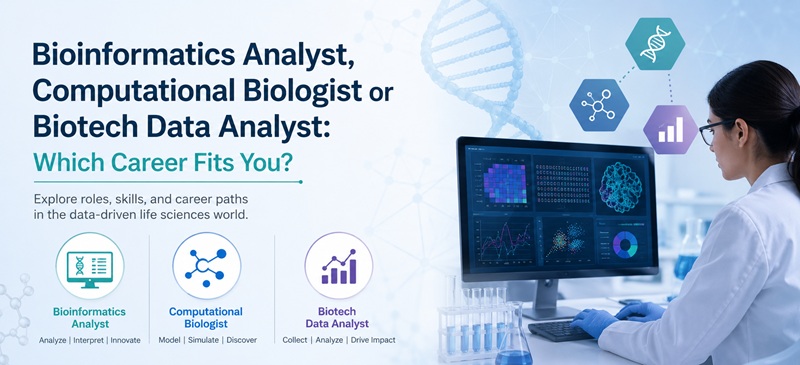
Biology is becoming increasingly data-driven. Genomic sequences, laboratory results and large biological datasets need professionals who understand how to organise, analyse and interpret information. This has created career opportunities where computing and life sciences overlap. Bioinformatics analysts, computational biologists and biotech data analysts all work at this intersection, but their responsibilities differ. Students interested in combining technology with scientific problem-solving can start building relevant computing foundations through a BSc IT course.
What Does a Bioinformatics Analyst Do?
A bioinformatics analyst uses computational tools to organise and analyse biological data. The work often involves genomic, molecular or other life-science datasets.
Depending on the organisation, the role may involve working with databases, running analysis pipelines and helping researchers interpret results. Programming and statistics are useful because biological datasets can be large and complex.
This career suits students who enjoy both biology and structured data analysis.
What Does a Computational Biologist Do?
Computational biology generally goes deeper into using mathematical and computational methods to investigate biological questions.
A computational biologist might study genetic patterns, model biological processes or develop methods for analysing complex datasets. The role often combines biology with statistics, programming and research.
A strong understanding of genetics, molecular biology and biostatistics is useful here. Somaiya's BSc biotechnology curriculum, for example, includes genetics and molecular biology, biostatistics and an elective option in Bioinformatics and Omics.
What Does a Biotech Data Analyst Do?
A biotech data analyst focuses on turning data into useful information for scientific or business decisions.
The role can involve cleaning datasets, finding trends, creating reports and visualising results. Depending on the company, analysts might work with research, laboratory, manufacturing or commercial data.
This path may suit students who enjoy working with numbers and explaining what the data means without necessarily focusing entirely on biological research.
How Are These Three Careers Different?
The easiest way to compare them is through the questions they typically address:
Bioinformatics analyst: What does this biological dataset tell us?
Computational biologist: How can computational methods help us investigate a biological problem?
Biotech data analyst: What patterns in our data can support a better decision?
There is overlap between these careers. Python, statistics, databases and data interpretation can appear across all three, while the amount of biology required differs by role.
Which Career Matches Your Interests?
Bioinformatics may suit you if you enjoy genetics, biological databases and computational analysis.
Computational biology may fit you if research interests you and you like combining biology with mathematics, coding and modelling.
Biotech data analytics may appeal to you if you prefer analysing datasets, creating visualisations and translating numbers into understandable insights.
Students do not need to decide immediately. Projects involving biological datasets are a useful way to test which type of work feels most engaging.
What Skills Should You Start Building?
A strong interdisciplinary foundation matters for all three paths.
Technology-focused students should develop Python, databases, statistics and data structures. Somaiya's B.Sc. IT curriculum includes Python programming, database management, numerical and statistical methods, data structures, artificial intelligence, business intelligence and data science and analytics options. It also lists Biotechnology among its minor-elective domains.
Biotechnology students should strengthen genetics, molecular biology, bioinformatics and biostatistics while gradually adding programming and data skills.
Conclusion
Bioinformatics analysts, computational biologists and biotech data analysts all work where biology, technology and data intersect, but the nature of their work is different. Bioinformatics analysts often focus on organising and interpreting biological datasets, computational biologists use modelling and computational methods to study scientific questions, while biotech data analysts work more broadly with data to support research, operations or business decisions. The right path depends on whether you are more interested in biological research, coding and modelling, or data interpretation and visualisation.
Students who want to build this interdisciplinary foundation can explore programmes at Somaiya Vidyavihar University. The B.Sc. Information Technology programme at Somaiya School of Basic and Applied Sciences provides exposure to areas such as programming, databases, statistics, artificial intelligence, business intelligence and data analytics. These skills can support students who want to work with large datasets, build analytical tools or move towards technology-led roles in life sciences.
The B.Sc. Biotechnology programme, on the other hand, develops knowledge in areas such as molecular biology, genetics, biostatistics, bioinformatics, microbiology and bioprocess technology. This gives students a stronger understanding of biological systems and scientific data. The availability of interdisciplinary and minor electives also allows students to explore subjects beyond their core discipline. For learners interested in careers such as bioinformatics, computational biology or biotech data analytics, this combination of biological knowledge and digital skills can provide a useful starting point for further study, research and specialised career development.