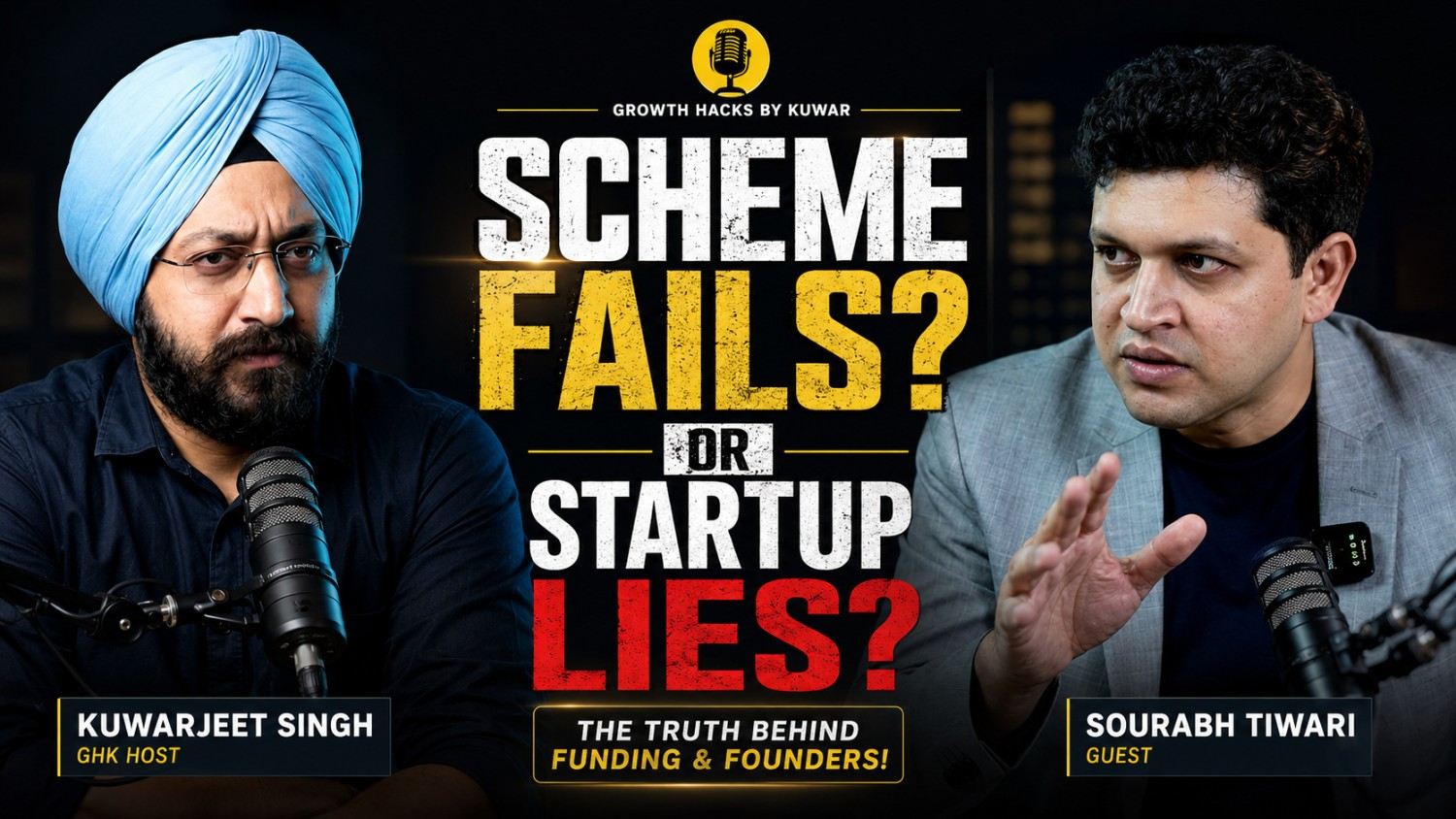
Why Every Indian Startup Needs a Business Consultant Before Scaling - Not After
-

- Published Updated
- 7,348 views

In the last decade, the startup ecosystem in India has undergone a significant transformation. The Startup India movement by the Government of India, a rich funding ecosystem and more than 100 unicorns have created a conducive environment for entrepreneurship. But the rates of failure have not diminished as well; around 90% of Indian startups fail within five years and a substantial number of such failures are due not to poor product quality, but to poor go-to-market strategy, premature scaling, and inefficient marketing efforts.
A startup business consultant targets just these weaknesses. Not by making things more complicated or cumbersome, but by providing clarity: the kind that comes from someone who's helped over a dozen businesses through the same turning points, and who has the advantage of knowing which choices lead to momentum and which choices lead to costly dead ends.
Saurabh Chhabra, based in Noida, Sector 63, works across Delhi NCR with a strong focus on this kind of consulting: taking vision, ideas and aspirations and making them a growth system that can be executed.
What Does a Startup Business Consultant Actually Do?
In the startup context, a consulting engagement typically involves:
Business model validation - stress-testing your revenue model, pricing strategy, and unit economics before committing significant resources
Go-to-market strategy - defining exactly which customer segments to target first, through which channels, with what messaging
Marketing architecture - building the digital infrastructure (website, analytics, CRM, email systems) that enables scalable customer acquisition
Performance benchmarking - setting the right KPIs and helping founders distinguish between vanity metrics and signal metrics
Vendor selection and oversight - ensuring the right agencies, freelancers, and tools are engaged at the right time
Investor readiness - helping startups articulate their traction, market opportunity, and growth roadmap in terms that resonate with investors
Why Most Startups Wait Too Long to Engage a Consultant
The most frequent reply from start-up founders to the question on consulting is time: We'll hire a consultant when we have the money / our first ₹1 crore in revenue / we have enough employees. There is an instinct to do that, but it's the wrong instinct.
Choices on the first 6-18 months of a startup's life - the customer segments to focus on, the channels to invest in, the positioning of the brand, the technology stack on which to build everything - have cascading effects which can be very expensive and difficult to rectify in subsequent years. It can take 2 years and many millions of dollars to correct a wrong positioning decision at Series A.
Consultation is most valuable - most cost effective when used early (not as a fire extinguisher) as a precision tool to make better fundamental decisions.
The Startup Consulting Framework: From Chaos to Clarity
Saurabh Chhabra's consulting approach for startups follows a structured five-step progression:
Step 1: Business & Market Diagnosis
Before any strategy is recommended, a comprehensive review of the business model, target market, competitive landscape, and current traction data is conducted. This removes assumptions and ensures all subsequent recommendations are grounded in reality.
Step 2: Positioning & Messaging Architecture
Most startups underinvest in positioning — the articulation of what makes them uniquely valuable to a specific customer. Without sharp positioning, even large marketing budgets deliver mediocre results. This step produces a clear value proposition, brand voice guidelines, and segment-specific messaging frameworks.
Step 3: Channel Strategy & Digital Marketing System
Not all channels are right for all businesses. A B2B SaaS startup targeting enterprise clients needs a completely different channel mix from a D2C fashion brand targeting Gen-Z consumers. The consultant maps the optimal channel mix and builds the digital marketing infrastructure to execute it.
Step 4: Growth Experimentation & Iteration
Startups must be rapid learners. The consulting engagement structures a disciplined experimentation process — generating hypotheses, testing them with minimum viable investments, measuring outcomes, and iterating based on data rather than intuition.
Step 5: Systemisation & Scale Preparation
Once growth levers are identified and proven, the consultant helps build the processes, tools, and documentation that allow the business to scale without proportional increases in founder time and attention.
Industries Where Startup Business Consulting Delivers Maximum Impact
EdTech — where student acquisition economics and retention are the primary drivers of venture viability
HealthTech & D2C Health - regulatory navigation combined with trust-based digital marketing
Fintech & B2B SaaS - complex sales cycles requiring precise content marketing and outbound strategy
Agritech & CleanTech - mission-driven businesses needing help translating social impact into commercial traction
Retail & Fashion D2C - brand building, influencer strategy, and marketplace optimisation
Professional Services - personal brand building, thought leadership, and digital lead generation
The ROI Case for Startup Business Consulting
Consulting fees are often perceived as a cost rather than an investment. The ROI case is straightforward.
If a consultant's guidance saves a startup from spending ₹20 lakh on a paid marketing strategy that would have failed - a common outcome without strategic direction — and instead directs that budget toward channels with demonstrably better unit economics, the consulting fee is recovered within the first month.
More significantly, compounding benefits accumulate over the engagement period: faster product-market fit, lower customer acquisition costs, stronger brand positioning, and a digital marketing infrastructure that generates returns for years after the engagement ends.
What to Look for in a Startup Business Consultant
Startup experience — has the consultant worked with businesses at your stage? Early-stage advice differs fundamentally from growth-stage guidance
Marketing & digital depth — in 2025, business strategy and digital marketing strategy are inseparable; your consultant should be fluent in both
Execution track record — can they show specific examples of startups they have helped achieve measurable milestones?
Founder empathy — the best consultants understand the psychological reality of founding a company, not just the strategic challenges
Network and ecosystem access — connections to investors, talent, media, and potential customers add additional value beyond the consulting itself
Frequently Asked Questions
Q1: When is the right time for a startup to hire a business consultant?
Ideally, at or just after product-market fit is established — when you have a validated product and are trying to scale customer acquisition efficiently. However, pre-PMF consulting on positioning and go-to-market strategy is also highly valuable for founders who want to reduce the time to product-market fit.
Q2: How do startup business consultants typically charge?
Engagement models vary: monthly retainers for ongoing strategy work, project-based fees for specific deliverables like audits or go-to-market plans, and equity-plus-cash arrangements for some early-stage advisors. Visit saurabhchhabra.com/get-in-touch to discuss options.
Q3: Can a business consultant help with investor pitch preparation?
Yes. A consultant with startup experience can help structure your pitch narrative, sharpen your market sizing analysis, develop financial projections, and prepare you for the types of due diligence questions investors typically ask.
Q4: What is the difference between a startup business consultant and a startup mentor?
A mentor provides guidance informally, typically pro-bono or for minimal compensation. A consultant provides structured, professional advisory services with defined deliverables and accountability. For specific business challenges, a paid consultant's focused engagement typically produces more actionable outcomes.
Q5: Does Saurabh Chhabra work with early-stage startups or only funded companies?
Saurabh works with startups across stages — from bootstrapped early-stage businesses to funded growth-stage companies. His approach is calibrated to the specific constraints and opportunities of each stage. Connect at saurabhchhabra.com to explore how consulting could accelerate your startup's trajectory.
Citations & References
Saurabh Chhabra – Digital Marketing Consultant: https://saurabhchhabra.com
LinkedIn – Saurabh Chhabra: https://in.linkedin.com/in/ersaurabhchhabra