Business Traveler's Handbook: Booking Flights India to USA
-

- March 25th, 2026
- 7,797 views
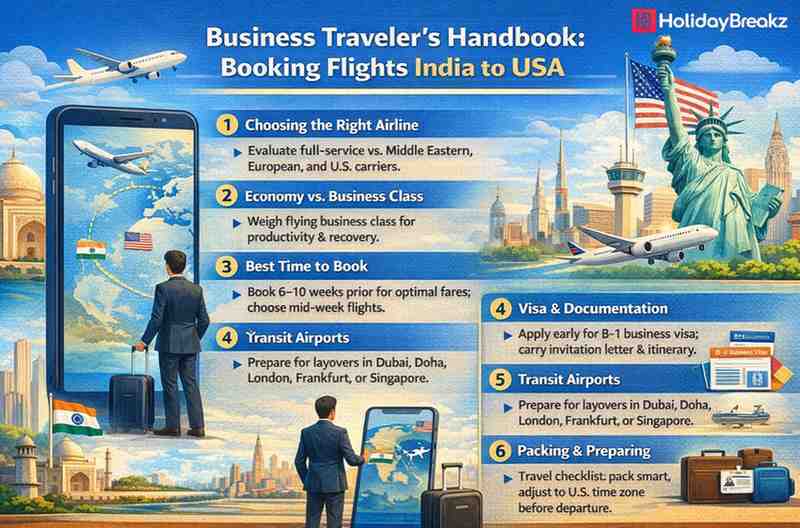
Flying between India and the United States is one of the longest and most logistically demanding journeys a business traveller can take. With flight times ranging from 14 to 22 hours depending on the route, layover cities, and connecting schedules, the difference between a well-planned trip and a poorly booked one is not just comfort — it is productivity, recovery time, and ultimately, your performance in meetings on the other side of the world.
This handbook is written specifically for Indian business travellers who fly to the USA regularly or are preparing for their first corporate trip. It covers everything from choosing the right airline and cabin class, to managing time zones, visa requirements, airport transit, and the hidden costs that can inflate a business travel budget if left unchecked.
Understanding the India–USA Route: Key Facts First
Before diving into booking strategy, it helps to understand the geography and airline landscape of this corridor.
India and the United States have no direct non-stop flights on the majority of routes. As of now, non-stop services operate primarily between select city pairs — such as Delhi and New York, or Mumbai and New York — with a small number of carriers offering these routes. For most other city combinations, travellers connect through one or two hub airports.
Common departure cities from India: Delhi (DEL), Mumbai (BOM), Bengaluru (BLR), Hyderabad (HYD), Chennai (MAA), Ahmedabad (AMD)
Common arrival cities in the USA: New York (JFK/EWR), Chicago (ORD), San Francisco (SFO), Los Angeles (LAX), Washington D.C. (IAD), Houston (IAH), Seattle (SEA), Boston (BOS)
Typical flight durations:
- Non-stop (Delhi–New York): approximately 14–16 hours
- One-stop via Middle East or Europe: 17–20 hours total travel time
- Two-stop itineraries: 22 hours or more
For business travellers, total travel time — including layovers — should be a key factor in route selection, not just the base fare.
Choosing the Right Airline for India–USA Business Travel
The airline you choose shapes everything: the comfort of your seat, the quality of food, lounge access, baggage allowance, and how rested you arrive.
Full-Service Carriers Worth Considering
Air India operates non-stop and one-stop flights between major Indian cities and US destinations. As a full-service carrier with a revamped product under its new management, it offers competitive business class fares and strong route coverage for Indian travellers.
Emirates, Etihad, and Qatar Airways connect Indian cities to the USA via Dubai, Abu Dhabi, and Doha respectively. These Middle Eastern carriers are consistently rated among the world's best for service quality, business class product, and lounge facilities. Layover times in their hubs are generally well-managed, and their Indian route networks are extensive.
United Airlines, American Airlines, and Delta operate transatlantic and transpacific routes and code-share with Indian carriers. These are practical choices for travellers whose final destination is served by strong US domestic networks, or those with corporate agreements tied to US-based airlines.
Lufthansa, British Airways, and Air France route via Frankfurt, London Heathrow, and Paris CDG. European connections add slightly more travel time but can offer excellent business class value, particularly on Lufthansa's long-haul product.
Singapore Airlines and Cathay Pacific connect via Singapore and Hong Kong. These are excellent choices for travellers flying from South or South-East Indian cities, and both airlines maintain strong reputations for long-haul business class quality.
What to Prioritise When Choosing an Airline
For a journey of 16 to 20 hours, comfort is not a luxury — it is a business necessity. Here is what to evaluate:
- Lie-flat business class seats: Essential for overnight legs. Not all business class cabins are equal. Verify whether the aircraft on your specific route has a lie-flat product.
- Direct aisle access: Business class suites with direct aisle access (rather than alternating window-aisle layouts) allow you to get up without disturbing a neighbour — important on long flights.
- Wi-Fi quality: If you plan to work during the flight, check whether the airline offers reliable, reasonably priced Wi-Fi on that aircraft type.
- Lounge access: Priority access to departure and transit lounges matters for business travellers with long layovers. Check which lounges your ticket includes.
Economy vs Business Class: Making the Right Call for Corporate Travel
This is a question every frequent business traveller faces — and the answer depends on more than just company policy.
When Economy Makes Sense
For trips under 10 hours, economy class is usually manageable with the right seat selection and preparation. Premium economy — available on many carriers on the India–USA route — offers a meaningful step up in seat pitch, meal quality, and baggage allowance at a fraction of business class prices.
When Business Class Is the Smarter Investment
On a 16 to 20-hour journey, arriving rested is not a perk — it is a performance requirement. Consider business class when:
- You have an important meeting, presentation, or negotiation within 24 hours of landing
- You are crossing 9 to 11 time zones and need to be functional quickly
- You will be travelling more than four times per year on this route
- Your company policy permits it for flights over a certain duration (many Indian companies set this threshold at 6 or 8 hours)
The productivity lost to jet lag, sleep deprivation, and physical discomfort on a full economy long-haul can far exceed the cost difference between cabin classes — especially when your purpose for travelling is high-stakes business.
When to Book India–USA Business Class Tickets
Timing significantly affects the price you pay for India–USA flights, especially in business class.
The Booking Window
For business class on the India–USA corridor, the sweet spot for booking is typically 6 to 10 weeks before departure. This is when airlines release discounted business class inventory before filling remaining seats at full fare closer to departure.
Booking too early — more than four months out — can mean paying full published fares before any promotional inventory is released. Booking too late — within two weeks of travel — means competing with last-minute travellers and paying peak prices.
Cheapest Months to Fly
India–USA fares follow seasonal demand patterns. The most expensive periods correspond to Indian school holidays, major Indian festivals, and the US summer travel season.
Higher demand (higher fares): December–January (holiday season), June–July (summer), and around Diwali in October–November.
Lower demand (better fares): February–March and August–September tend to offer better availability and pricing on most routes.
Mid-Week Departures
Tuesday and Wednesday departures consistently offer lower fares on the India–USA corridor compared to Friday and Sunday travel, which are peak days for both leisure and business travellers.
Visa Requirements for Indian Business Travellers to the USA
Visa planning is non-negotiable for Indian passport holders travelling to the United States. Unlike some other corridors, there is no visa-on-arrival or visa-free entry option.
B-1 Business Visa
The B-1 visa is the standard non-immigrant visa for business travel to the USA. It covers activities such as attending meetings, conferences, and training sessions, negotiating contracts, and conducting business discussions. It does not permit you to work for a US employer or receive US-sourced income.
Processing time: US visa appointments in India have seen significant backlash in recent years due to demand. Appointment slots at US Consulates in Delhi, Mumbai, Chennai, Hyderabad, and Kolkata should be booked as early as possible — ideally 3 to 6 months before your intended travel date if you do not already hold a valid visa.
Existing Visa Holders
If you hold a valid multiple-entry B-1/B-2 visa with sufficient validity, re-entry is straightforward. Always carry supporting documents — invitation letters, business itinerary, return flight confirmation, and hotel bookings — even if not asked.
ESTA Is Not Available to Indian Passport Holders
The Electronic System for Travel Authorisation (ESTA), which allows citizens of certain countries to visit the USA without a visa, is not available to Indian passport holders. A valid visa is always required.
Global Entry
If you travel to the USA frequently, applying for Global Entry is one of the best investments a regular India–USA business traveller can make. It provides expedited US customs and immigration clearance, and includes TSA PreCheck for US domestic connections. The application involves a background check and an in-person interview at a US Customs facility.
Transit Airports: What to Expect at Major Layover Hubs
For most India–USA itineraries, you will pass through at least one major transit hub. Here is what to expect at the most common ones.
Dubai (DXB) — Emirates Hub
Dubai International is one of the world's busiest airports and a well-oiled transit machine. Business class travellers on Emirates have access to the airline's flagship First Class and Business Class lounges, which are among the best in the world. Minimum connection times at DXB are typically around 90 minutes, but 2 to 3 hours is more comfortable.
Doha (DOH) — Qatar Airways Hub
Hamad International Airport in Doha is consistently ranked among the top airports globally. The Al Mourjan Business Lounge is exceptional. Qatar's connections to both Indian cities and US destinations are extensive. Connections of 2 hours are manageable; longer layovers are actually pleasant here.
Abu Dhabi (AUH) — Etihad Hub
A quieter, less crowded transit experience than Dubai. Etihad's premium lounge offerings are strong. Abu Dhabi also has a unique advantage: the US Customs and Border Protection pre-clearance facility at AUH means eligible travellers clear US immigration in Abu Dhabi and arrive in the USA as domestic arrivals — a significant time saver.
London Heathrow (LHR) — British Airways / Other Carriers
Heathrow is efficient but busy. Terminal 5, used by British Airways, is well-designed for transiting passengers. Allow at least 90 minutes for connections; 2 to 3 hours is safer given immigration queues that may apply to Indian passport holders in transit.
Frankfurt (FRA) — Lufthansa Hub
Frankfurt Airport is one of Europe's most efficient hubs for connections. The Lufthansa Senator and Business Class lounges are excellent. Terminal 1 handles most Lufthansa long-haul operations, and connections within the same terminal are straightforward.
Managing Time Zones: Arriving Ready to Work
The time difference between India and the USA is significant — ranging from 9.5 hours (IST vs EST) to 13.5 hours (IST vs PST). This is one of the most challenging time zone crossings in the world for business travellers.
Before You Fly
- Begin shifting your sleep schedule 2 to 3 days before departure. Move bedtime one hour later each night if flying eastward (India to USA).
- Avoid scheduling important calls or meetings on your first full day in the USA if possible.
- Use the Timeshifter app or a jet lag protocol recommended by a travel medicine specialist for frequent flyers.
On the Flight
- Set your watch to destination time as soon as you board.
- On overnight flights departing India in the evening and arriving in the USA in the morning, sleep as early as possible on the flight — ideally within the first two hours.
- Avoid alcohol, which disrupts sleep quality even if it induces drowsiness.
- Stay hydrated; cabin air is extremely dry and dehydration worsens jet lag.
On Arrival
- If you land in the morning, stay awake until local evening even if exhausted. A short nap of 20 to 30 minutes is acceptable; anything longer resets adaptation.
- Get outside and expose yourself to natural daylight — this is the single most effective tool for resetting your circadian rhythm.
- Plan a light agenda for your first day if your schedule allows it.
Baggage Rules for India–USA Business Travel
Business class tickets on most full-service carriers include generous checked baggage allowances — typically 2 pieces of 32kg each on the India–USA route. However, rules vary by airline and fare class, so always verify before packing.
Carry-On Allowance
Business class passengers are usually permitted one carry-on bag and one personal item. Some carriers allow an additional laptop bag or briefcase.
For business travellers, a well-packed carry-on with essential documents, a change of clothes, medications, laptop, chargers, and toiletries is highly advisable — regardless of what you check. If checked baggage is delayed (which does happen on multi-stop itineraries), you want everything critical within reach.
Laptop and Electronics at US Security
US TSA screening requires laptops and large electronics to be removed from bags and placed in a separate tray. TSA PreCheck (included with Global Entry) exempts you from this requirement — another reason frequent flyers should consider enrolling.
Corporate Travel Programmes and Loyalty Points
If you travel to the USA more than twice a year for business, a structured approach to airline loyalty can generate meaningful benefits.
Most major airlines operating the India–USA route participate in global alliances — Star Alliance (Air India, United, Lufthansa, Singapore Airlines), oneworld (British Airways, American Airlines, Cathay Pacific, Qatar Airways), and SkyTeam (Delta, Air France, Korean Air). Points and status earned with one member airline typically earn and can be redeemed across the alliance.
What Business Class Miles Are Worth
Long-haul business class tickets are the highest-value earning opportunity in airline loyalty programmes. A single business class ticket from Delhi to New York can earn 10,000 to 20,000 miles depending on the fare class and airline — enough, in some cases, to contribute significantly toward a future reward redemption.
Negotiate Corporate Rates
If your company sends three or more employees to the USA annually, it is worth approaching airlines directly about a corporate travel agreement. These agreements can offer discounted fares, flexible change policies, priority check-in, and bonus miles for the company's travel pool.
Building Your India–USA Business Travel Checklist
Use this as a pre-trip reference for every India–USA business journey:
6 to 12 weeks before travel:
- Confirm visa validity or begin US visa application process
- Book flights — aim for mid-week departures in shoulder season for best fares
- Research business class products on your specific aircraft and route
- Enrol in Global Entry if you travel to the USA frequently
2 to 4 weeks before travel:
- Complete online check-in as soon as available (usually 24–48 hours before departure)
- Confirm lounge access at your departure and transit airports
- Arrange airport transfers at both ends
- Verify hotel and meeting logistics in the USA
2 to 3 days before travel:
- Begin adjusting sleep schedule toward destination time zone
- Pack carry-on with all essential documents and valuables
- Weigh checked baggage to avoid excess baggage fees
- Download entertainment, documents, and maps for offline use on the flight
Day of travel:
- Arrive at the airport at least 3 hours before international departure
- Check in online if not already done to access fast-track queues
- Visit the business class lounge for a meal before boarding
- Set device to destination time zone on boarding
How to Find the Best India–USA Business Fares
Prices on the India–USA corridor can vary enormously between airlines, booking dates, and fare classes. A business class ticket that costs ₹3,00,000 on one date may be available for ₹1,80,000 just two weeks earlier or later.
The most effective approach is to compare India–USA business class fares across multiple airlines on a single platform rather than checking each airline individually. This gives you a clear picture of which carrier offers the best value on your specific travel dates, and lets you review fare conditions — flexibility, baggage allowance, lounge access — side by side before committing.
HolidayBreakz India is built for exactly this kind of informed decision-making, giving Indian travellers a clear breakdown of what each fare includes so you can book with confidence rather than guesswork.
Key things to look for when comparing fares:
- Is the business class on this route a lie-flat product or an angled seat?
- Does the fare include lounge access at all transit points?
- What are the change and cancellation terms — especially important for business travel?
- Is the baggage allowance sufficient, or will you need to pay extra?
- What is the total travel time, including all layovers?
Frequently Asked Questions: India to USA Business Travel
Which airline is best for business class on India–USA routes?
This depends on your departure city and personal priorities. Emirates, Qatar Airways, and Singapore Airlines consistently rank highly for business class quality and service on long-haul routes. Air India offers competitive non-stop options from Delhi and Mumbai. For travellers who prioritise US domestic connectivity, United or American Airlines may be more practical.
How far in advance should I book India–USA business class tickets?
The optimal booking window is typically 6 to 10 weeks before departure for discounted business class inventory. Booking too far in advance often means paying full published fares.
Do I need a visa to transit through Dubai or Doha?
Indian passport holders do not require a transit visa for airside transits through Dubai or Doha, provided you do not exit the airport. Always verify this with the airline and relevant consulate before travel, as rules can change.
What is the best seat on a long-haul business class flight?
This depends on the aircraft and cabin configuration. For most wide-body aircraft, seats in the forward section of the business cabin tend to be quieter. On herringbone or reverse herringbone layouts, window seats offer more privacy. The SeatGuru website provides detailed cabin maps for specific aircraft and routes.
Can I use my Indian driving licence as ID at US airports?
No. At US airports, your passport is the primary identification document. Indian driving licences are not accepted as identification for air travel in the USA.
How do I handle jet lag on a Delhi–New York business trip?
Begin adjusting your sleep schedule before departure, sleep on the plane during the flight's night hours, get daylight exposure on arrival, and avoid long naps on your first day. Many frequent flyers also use low-dose melatonin to support the adjustment, but consult a doctor before using any sleep aids.
Is travel insurance necessary for India–USA business trips?
Yes, strongly advisable. Medical costs in the USA are among the highest in the world. A comprehensive travel insurance policy covering medical emergencies, trip cancellation, and baggage loss is a sensible precaution for any business trip to the United States.
What documents should I carry for a US business trip?
Your passport, US visa, return flight confirmation, hotel booking, an invitation letter or event registration from your US host, and any relevant business documents. Keep digital copies stored separately in case of loss.
Final Thoughts
The India–USA route is demanding by any measure. It crosses continents, climates, and nearly half the world's time zones. For business travellers, the stakes are higher than on leisure trips — you are expected to arrive functional, focused, and ready to represent your company at its best.
The best India–USA business travel experiences share a few common traits: they are booked at the right time with the right airline on the right aircraft, they account for visa timelines and transit logistics well in advance, and they treat recovery time and comfort not as indulgences but as professional necessities.
Planning this kind of trip does not need to be complicated. With the right tools, the right information, and a clear sense of what to look for, the India–USA corridor becomes a manageable, even rewarding, part of doing international business.
Safe travels — and productive meetings on the other side.