Cancer Treatment Market Value to Surpass USD 707.34 Billion by 2035
-
- May 20th, 2026
- 6,628 views
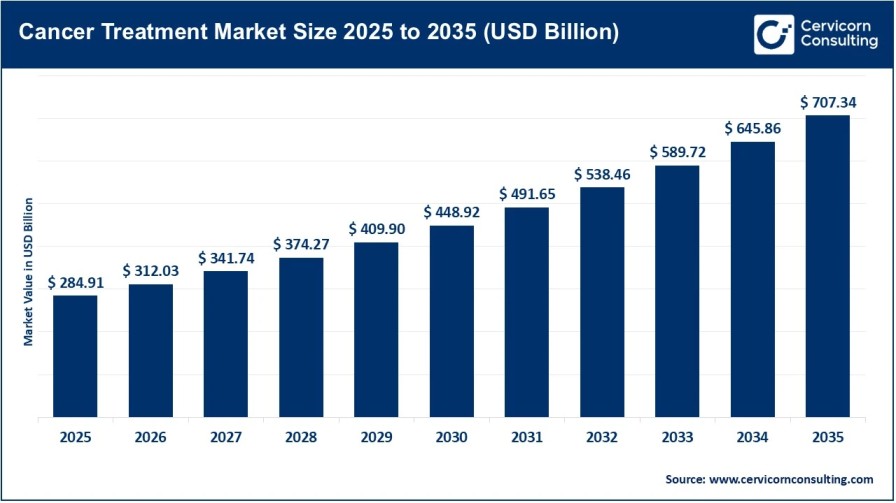
Cancer Treatment Market Size
The global cancer treatment market accounted for approximately USD 284.91 billion in 2025 and is forecasted to reach nearly USD 707.34 billion by 2035, expanding at a CAGR of 9.5% during the projected period. Market growth is being fueled by the increasing prevalence of cancer worldwide, growing investments in oncology-related R&D, and significant progress in immunotherapy and targeted cancer treatment technologies.
Cancer Treatment Market Growth Factors
The cancer treatment market is experiencing strong momentum due to several contributing factors, including the rising number of cancer patients globally, growth in the aging population, and increasing demand for advanced therapies such as immunotherapy and precision medicine. Improvements in cancer diagnostic technologies, supportive government initiatives for oncology innovation, and increasing healthcare expenditures in emerging countries are also accelerating market development. In addition, growing adoption of biologics, minimally invasive procedures, and reimbursement assistance programs is improving patient access to modern cancer treatments.
Furthermore, advancements in AI-enabled cancer diagnostics, next-generation sequencing technologies, and rising awareness regarding early cancer screening programs are supporting oncology innovation. Strategic collaborations between biotechnology firms, pharmaceutical manufacturers, and research organizations are further encouraging the development of innovative therapies, while favorable regulatory frameworks for orphan drugs and accelerated approvals for oncology medicines continue to support market expansion globally.
Get a Free Sample: Cancer Treatment Market Sample Report
What is the Cancer Treatment Market?
The cancer treatment market encompasses the global industry focused on the diagnosis, prevention, treatment, and management of different cancer types using pharmaceuticals, radiation therapy, surgery, and biologic therapies. The market includes a broad ecosystem of pharmaceutical companies, biotechnology firms, hospitals, diagnostic laboratories, oncology clinics, research institutions, and healthcare organizations.
Cancer treatment approaches vary depending on the type and stage of cancer, along with patient-specific health conditions. Although chemotherapy and radiation therapy remain widely used, the oncology sector is increasingly shifting toward targeted and personalized treatment methods. Immunotherapy has revolutionized cancer care by helping the immune system attack cancer cells more effectively, while targeted therapies focus on specific genetic mutations that contribute to tumor growth.
The market covers therapies for various cancers, including breast cancer, lung cancer, colorectal cancer, prostate cancer, cervical cancer, liver cancer, blood cancer, and skin cancer. The growing adoption of companion diagnostics and combination therapies is also reshaping the global oncology landscape.
Why is the Cancer Treatment Market Important?
The cancer treatment market is critically important because cancer continues to be one of the leading causes of death worldwide. Millions of new cancer cases are diagnosed annually, creating rising demand for effective, innovative, and accessible treatment solutions.
One of the major benefits of the market is its role in improving survival rates, enhancing quality of life, and lowering cancer-related mortality. Ongoing advancements in oncology therapies have enabled healthcare providers to treat multiple cancer types more efficiently. Innovative solutions such as immune checkpoint inhibitors, CAR-T cell therapies, and precision oncology are reshaping cancer management and, in some instances, transforming cancer into a manageable long-term condition.
Economically, oncology remains among the most lucrative segments within the pharmaceutical industry. Major pharmaceutical companies continue investing heavily in oncology research, biologics manufacturing, and clinical trials.
Additionally, the market promotes innovation in diagnostics, genomics, biotechnology, and digital healthcare technologies. Artificial intelligence, genomic sequencing, and machine learning are improving early cancer detection and enabling personalized treatment planning. Governments and healthcare organizations are also focusing on cancer awareness campaigns, vaccination initiatives, and early screening programs to reduce the global cancer burden.
Major Companies in the Cancer Treatment Market
Roche
| Category | Details |
|---|---|
| Specialization | Oncology therapeutics, diagnostics, and precision healthcare |
| Key Focus Areas | Personalized medicine, targeted therapies, immunotherapy |
| Notable Features | Oncology products including Herceptin, Avastin, and Tecentriq |
| 2025 Revenue | Approximately USD 71 billion |
| Market Share | One of the leading players in the global oncology market |
| Global Presence | Operations across more than 100 countries |
Roche is globally recognized for its expertise in oncology and precision medicine. Its extensive portfolio of advanced cancer therapies and diagnostic technologies supports personalized treatment approaches based on patient genetics and molecular profiling.
Novartis
| Category | Details |
|---|---|
| Specialization | Oncology, gene therapy, and radioligand therapy |
| Key Focus Areas | CAR-T therapies, radiopharmaceuticals, targeted treatments |
| Notable Features | Products such as Kisqali and Pluvicto |
| 2025 Revenue | Approximately USD 53 billion |
| Market Share | Strong position in targeted oncology therapies |
| Global Presence | Presence across Europe, North America, Asia-Pacific, and Latin America |
Novartis continues to strengthen its oncology leadership through advancements in radioligand therapies and innovative cell-based cancer treatments. The company maintains a strong focus on precision medicine and biologic therapies.
Merck & Co.
| Category | Details |
|---|---|
| Specialization | Immuno-oncology and cancer immunotherapy |
| Key Focus Areas | Immune checkpoint inhibitors and combination therapies |
| Notable Features | Worldwide success of Keytruda |
| 2025 Revenue | Approximately USD 65 billion |
| Market Share | Leading share in the global immunotherapy market |
| Global Presence | Extensive global operations |
Merck & Co. has transformed the oncology sector through the success of Keytruda, one of the most successful immunotherapy drugs globally. The company continues expanding its oncology pipeline through strategic partnerships, innovation, and acquisitions.
Bristol Myers Squibb
| Category | Details |
|---|---|
| Specialization | Hematologic oncology and immunotherapy |
| Key Focus Areas | Cell therapies and immune checkpoint inhibitors |
| Notable Features | Oncology portfolio featuring Opdivo and Yervoy |
| 2025 Revenue | Approximately USD 48 billion |
| Market Share | Major contributor to the immuno-oncology segment |
| Global Presence | Broad international footprint |
Bristol Myers Squibb remains a pioneer in immuno-oncology, delivering therapies that have improved treatment outcomes for melanoma, lung cancer, kidney cancer, and blood cancers.
AstraZeneca
| Category | Details |
|---|---|
| Specialization | Biologics and targeted oncology therapies |
| Key Focus Areas | Precision medicine, breast cancer, lung cancer |
| Notable Features | Innovative treatments such as Tagrisso and Imfinzi |
| 2025 Revenue | Approximately USD 56 billion |
| Market Share | Strong foothold in targeted cancer therapies |
| Global Presence | Operations across developed and emerging economies |
AstraZeneca has rapidly expanded its oncology business through biomarker-driven therapies and strategic collaborations focused on precision medicine and biologic cancer solutions.
Leading Trends in the Cancer Treatment Market and Their Impact
Growth of Immunotherapy
Immunotherapy has become one of the most groundbreaking developments in oncology. Therapies such as CAR-T cell therapy, monoclonal antibodies, and immune checkpoint inhibitors help the immune system detect and eliminate cancer cells more effectively. These therapies have improved survival outcomes and reduced side effects associated with traditional chemotherapy.
Expansion of Precision Medicine
Precision medicine is reshaping oncology by enabling customized treatment strategies based on a patient’s genetic profile. Advances in genomic sequencing and biomarker testing are helping healthcare providers identify the most effective therapies with improved clinical outcomes.
Increasing Adoption of Radioligand Therapy
Radioligand therapy is gaining attention as a targeted treatment approach that delivers radiation directly to cancer cells while minimizing damage to surrounding healthy tissues.
Integration of Artificial Intelligence
Artificial intelligence is becoming increasingly important in oncology through applications in predictive analytics, early diagnosis, treatment planning, and drug discovery. AI-powered systems can process complex genomic and imaging data with greater speed and accuracy.
Development of Combination Therapies
Combination therapies are increasingly being adopted because they target cancer through multiple biological pathways simultaneously. The combination of immunotherapy with chemotherapy or targeted therapies has shown promising clinical results across multiple cancer types.
Successful Examples of the Cancer Treatment Market Around the World
United States
The United States remains one of the leading oncology markets globally due to its advanced healthcare infrastructure, strong pharmaceutical innovation, and robust research ecosystem. Institutions such as MD Anderson Cancer Center and Memorial Sloan Kettering Cancer Center continue driving breakthroughs in oncology research and treatment.
Germany
Germany has established itself as a major oncology hub in Europe through strong support for biotechnology innovation, advanced diagnostics, and precision medicine initiatives.
Japan
Japan continues to play a key role in oncology innovation through advancements in regenerative medicine, robotic surgery, and targeted cancer therapies. The country’s aging population is also increasing demand for sophisticated oncology treatments.
China
China is rapidly strengthening its presence in the global cancer treatment market through major investments in biotechnology, pharmaceutical manufacturing, and oncology clinical research.
India
India’s oncology market is witnessing strong growth due to improving healthcare infrastructure, increasing cancer awareness, and expanding access to affordable cancer therapies and biosimilars.
Global Regional Analysis Including Government Initiatives and Policies Shaping the Market
North America
North America dominates the cancer treatment market due to advanced healthcare infrastructure, high healthcare spending, and strong pharmaceutical R&D capabilities. Organizations such as the National Cancer Institute and Food and Drug Administration continue supporting oncology innovation through research funding and accelerated drug approvals.
Europe
Europe remains a major oncology market supported by advanced healthcare infrastructure and favorable reimbursement systems. Initiatives such as Europe’s Beating Cancer Plan are helping improve cancer prevention, diagnosis, and treatment accessibility throughout the region.
Asia-Pacific
The Asia-Pacific region is projected to witness the fastest growth due to increasing cancer prevalence, expanding healthcare infrastructure, and rising healthcare investments. Governments in China, Japan, India, and South Korea are actively promoting biotechnology and precision medicine development.
Latin America
Latin America is gradually strengthening its oncology sector through healthcare investments and cancer awareness initiatives. Brazil and Mexico remain leading oncology markets in the region despite ongoing infrastructure challenges.
Middle East and Africa
The Middle East and Africa region is experiencing increasing investments in healthcare modernization and oncology infrastructure. Countries such as Saudi Arabia and United Arab Emirates are expanding access to cancer treatment through government-supported healthcare initiatives.
To Get Detailed Overview, Contact Us: Cervicorn Consulting Contact Page