Caste-Based Matrimony in India: Finding the Right Match Within Your Community
-

- August 29th, 2026
- 1,926 views
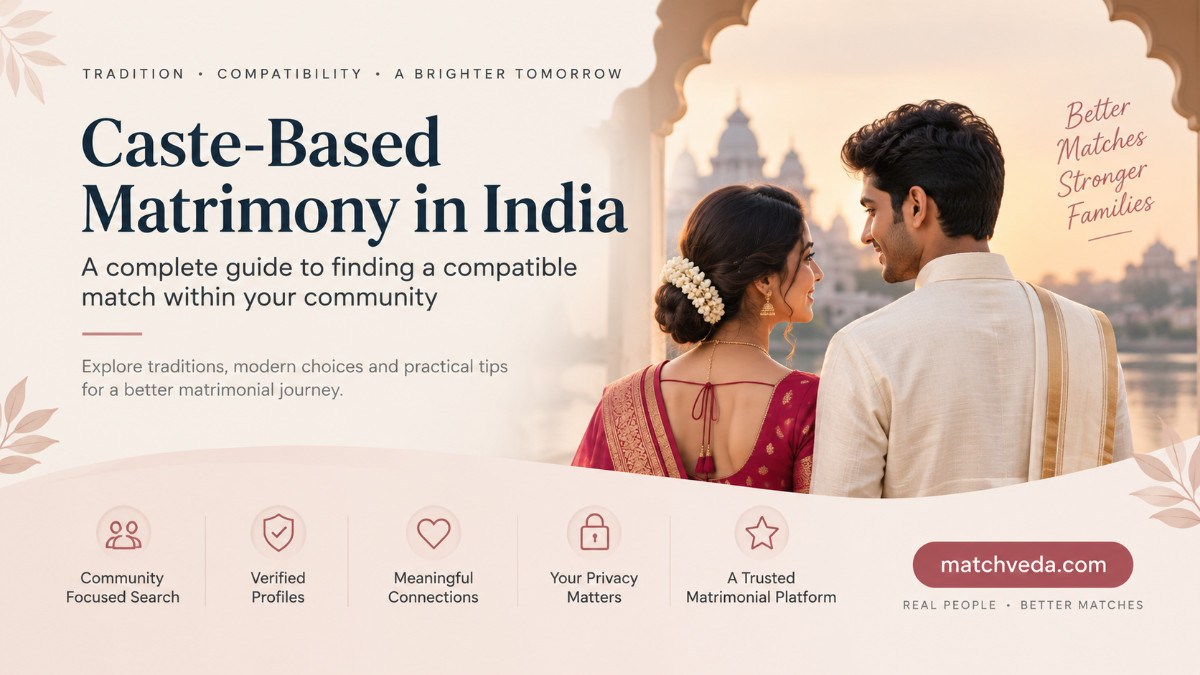
Marriage in India is often about more than two individuals. Family values, traditions, culture, language, religion and community can all influence how families search for a suitable life partner.
For many Indian families, caste or community continues to be an important consideration when looking for a matrimonial match. At the same time, modern matchmaking is increasingly focused on compatibility, education, career, personality, lifestyle and future expectations.
This has made caste-based matrimony in India more flexible. Community can be a useful starting point for a matrimonial search, but it does not have to be the only factor when deciding whether two people are compatible.
What Is Caste-Based Matrimony?
Caste-based matrimony refers to searching for a marriage partner within a particular caste or sub-community.
Depending on the region and family, people may consider communities such as Brahmin, Rajput, Maratha, Agarwal, Reddy, Nair, Kayastha, Jat and many others.
However, community identity can be broader than caste. Families may also consider:
Religion
Sub-caste
Language
Region
Cultural background
Family traditions
Gotra or similar traditions
Lifestyle preferences
These preferences can help families find people with a familiar cultural background while creating a more focused matrimonial search.
Why Do Families Consider Community While Choosing a Partner?
Shared Cultural Background
People from similar communities may share traditions, festivals, food habits, languages and family customs.
This familiarity can make some aspects of married life easier to discuss, particularly when both families are involved in the process.
Family Expectations
In many Indian families, parents and relatives participate in finding a suitable partner.
A community-based search can provide families with a familiar starting point while allowing the individuals themselves to make the final decision.
Similar Traditions
Some families consider community-specific traditions, religious practices, family customs or other cultural factors before taking a matrimonial conversation forward.
These considerations vary significantly between families and regions.
A More Focused Search
Searching across thousands of matrimonial profiles can be overwhelming.
Community preferences can help narrow the initial search and allow individuals to focus on profiles that match some of their cultural or family expectations.
Caste Preference Does Not Equal Compatibility
One of the most important things to remember is that sharing the same caste or community does not automatically mean two people are compatible.
A successful matrimonial search should also consider:
Values:
Do both individuals have similar expectations around respect, communication and family life?
Career:
Are their professional goals and expectations compatible?
Lifestyle:
Do they have similar expectations about food, travel, social life and daily routines?
Location:
Are they comfortable living in the same city or relocating after marriage?
Family involvement:
How involved do both individuals expect their families to be?
Future plans:
Have they discussed important subjects such as children, finances, careers and living arrangements?
Community can provide familiarity, but these conversations help determine actual compatibility.
Community Matrimony vs General Matrimony
General matrimonial search allows people to explore a broad range of profiles and then narrow the search according to their preferences.
Community matrimony starts with a particular community, caste, cultural or religious preference and then uses additional criteria to identify suitable profiles.
Both approaches can work.
Some people prefer to start within their community and expand the search later. Others prefer a wider search from the beginning.
The right approach depends on personal preferences, family expectations and how flexible the individual wants the search to be.
How to Search for a Community-Based Matrimonial Match
1. Decide Your Important Preferences
Before beginning the search, decide which factors are essential and which ones are flexible.
For example:
Community or caste
Religion
Age
Education
Profession
Location
Lifestyle
Family background
Personal values
This prevents every preference from becoming a strict requirement.
2. Start With Your Community
If community background is important to you, begin with profiles from the relevant community.
MatchVeda provides dedicated community-based matrimonial searches that allow users to explore different communities and cultural backgrounds.
Explore community matrimony on MatchVeda:
https://www.matchveda.com/community-matrimony
3. Complete Your Profile Honestly
A detailed matrimonial profile makes it easier for potential matches and their families to understand your background.
Include relevant information about:
Education
Profession
Location
Community
Family background
Lifestyle
Partner expectations
Accurate information also helps create more relevant recommendations.
4. Look Beyond Community
After finding profiles within your preferred community, compare other important factors.
Consider education, profession, age, location, personality, values and future expectations.
The objective should not simply be to find someone from the same community, but to find someone who is also personally compatible.
5. Communicate Before Making a Decision
A profile provides only a basic introduction.
Meaningful conversations can help you understand someone's personality, expectations and plans for the future.
Discuss important subjects gradually and give both individuals enough time to make an informed decision.
Should You Search Only Within Your Caste?
There is no universal answer.
Some families have strong cultural or family reasons for preferring the same caste or community. Others are comfortable considering people from different backgrounds.
A practical approach is to start with your preferred community and gradually expand the search if you are not finding suitable matches.
For example:
First preference: Same caste or community
↓
Second preference: Related community or cultural background
↓
Broader preference: Similar values and lifestyle
↓
Open search: Compatibility-focused matchmaking
This approach allows individuals and families to maintain their preferences without making the search unnecessarily restrictive.
Community Matrimony Is Broader Than Caste
Community matrimony should not always be treated as another term for caste matrimony.
Community identity can also be based on:
Religion
Language
Region
Culture
Traditions
Social background
For example, someone may prefer a partner who speaks the same language or comes from a similar regional background, even when caste is not a strict requirement.
This makes community matchmaking a broader approach to finding a partner with shared cultural familiarity.
Benefits of Online Community Matrimony
Online matrimonial platforms make it easier to combine community preferences with other important requirements.
Instead of depending entirely on personal contacts, individuals can explore profiles using multiple criteria.
Useful features can include:
Community-based search
Location preferences
Education and profession filters
Profile verification
Privacy controls
Mutual-interest connections
Secure communication
MatchVeda combines community matchmaking with broader matrimonial profile discovery, helping individuals and families search according to their preferences.
Explore MatchVeda community matrimony:
https://www.matchveda.com/community-matrimony
Safety Tips for Online Matrimony
Finding a matrimonial match online should also involve basic digital safety.
Avoid sharing sensitive financial or personal information with someone you have recently met online.
Be cautious if someone:
Requests money
Asks for OTPs or banking information
Pressures you to make a quick decision
Provides inconsistent personal information
Requests sensitive documents unnecessarily
Avoids reasonable identity verification
Take time to understand the person and involve trusted family members when appropriate.
The Future of Caste-Based Matrimony in India
Caste and community preferences continue to be relevant for many Indian families, but the way people search for partners is evolving.
Modern matrimonial searches increasingly combine traditional preferences with individual requirements such as education, career, personality, lifestyle, location and future goals.
This creates a more balanced approach:
Community preference + Individual choice + Compatibility + Family values
Instead of treating caste as the complete definition of a suitable partner, it can be used as one of several filters in the search.
Final Thoughts
Caste-based matrimony can be a useful starting point for individuals and families who value shared cultural or community backgrounds.
However, the same community does not guarantee a successful marriage.
The most meaningful matrimonial search considers the complete person — their values, personality, goals, lifestyle and expectations — alongside community preferences.
Whether you prefer a specific caste, a broader community or a more open search, taking time to understand compatibility can lead to better matrimonial decisions.
For individuals and families looking for community-based matrimonial matches, MatchVeda provides dedicated community matchmaking pages where you can explore profiles based on community and other preferences.
Explore Community Matrimony on MatchVeda:
https://www.matchveda.com/community-matrimony
Frequently Asked Questions
What is caste-based matrimony?
Caste-based matrimony is a matrimonial search where individuals or families look for a marriage partner within a particular caste or sub-community.
Is caste important in Indian matrimony?
Caste remains an important consideration for some Indian families, while others place greater emphasis on education, career, personality, lifestyle and compatibility.
What is community matrimony?
Community matrimony is broader than caste matrimony. It can include preferences based on caste, religion, language, region, culture or other shared backgrounds.
How can I find community-based matrimonial profiles?
You can use a matrimonial platform with community-based search options. MatchVeda provides dedicated community matrimony pages for individuals and families looking for matches based on community preferences.
Visit: https://www.matchveda.com/community-matrimony
Should I consider matches outside my caste?
That is a personal decision. You can begin with your preferred community and expand your search if you are comfortable doing so.
What should I consider besides caste?
Consider personality, values, education, profession, location, lifestyle, family expectations, financial outlook and future plans. These factors can be important for long-term compatibility.
Is online matrimony safe?
Online matrimony can be safer when users take appropriate precautions. Avoid sharing financial information or sensitive documents with unknown individuals, take time to verify information and use secure communication channels.
Why use community matrimony?
Community-based search can help narrow a large matrimonial pool and make it easier to find people who share similar cultural, regional, religious or community backgrounds.
Explore MatchVeda Community Matrimony:
https://www.matchveda.com/community-matrimony