How Clear Lake City Businesses Can Build Local Search Authority Beyond Google Maps
-

- Published Updated
- 3,854 views
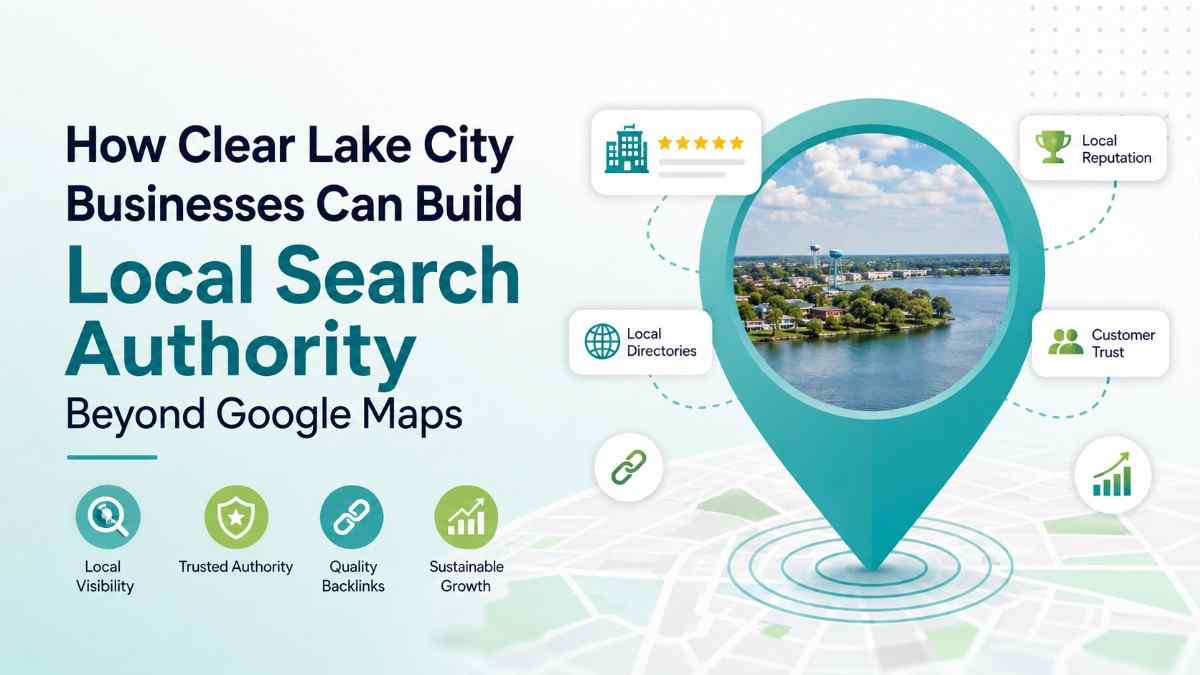
If you own or market a business in Clear Lake City, chances are your local SEO strategy starts and ends with one thing: your Google Business Profile. But Clear Lake City SEO goes far beyond optimizing a map listing. While your profile is an important foundation, businesses that consistently appear in local search results usually build authority across their entire online presence. That includes local content, relevant mentions, reviews, citations, backlinks, and location-specific signals that help Google understand your business and its connection to the Clear Lake City community.
Google Maps is a distribution channel, not a complete strategy. It showcases businesses that Google's algorithms already consider relevant, trustworthy, and established in a particular area. The businesses that appear consistently not just for their brand name, but for competitive searches like "HVAC repair Clear Lake City" or "family dentist near NASA Road 1" typically have local authority signals extending well beyond their Google Business Profile.
Why Google Maps Alone Isn't Enough
Google Business Profile rankings are influenced by three core factors: relevance, distance, and prominence. The first two are largely out of your control; you can't change where your storefront physically sits relative to a searcher, and you can't manufacture relevance out of thin air if your category or service listing doesn't match what people are searching for. But prominence is earned, and Google builds its sense of prominence from signals scattered across the entire web: citations, backlinks, review sentiment, mentions in local news and directories, and how consistently your business information appears everywhere it's referenced online.
In other words, Google Maps is a reflection of authority you've built elsewhere, not the source of it. If your only local SEO activity happens inside your Google Business Profile dashboard, you're optimizing the mirror instead of the thing being reflected.
This is where a lot of Clear Lake City businesses get stuck. They treat their Business Profile like a static listing to be filled out once, rather than one node in a much larger web of signals. The businesses that consistently rank well tend to be the ones treating their entire online presence website, citations, reviews, backlinks, and content as a coordinated system, all pointing back to the same accurate, consistent, locally relevant story about who they are and where they operate.
1. Build a Real Local Citation Network
Citations mentioning your business name, address, and phone number (commonly called NAP) on other websites are one of the oldest and still most reliable local SEO signals. They function almost like votes of existence: the more places online consistently confirm that your business is real, operating, and located where you say it is, the more confidence Google has in surfacing you for local searches.
For Clear Lake City businesses, this means going beyond generic national directories and getting listed on sources that actually carry local weight:
Houston-area business directories and regional chamber of commerce sites
The Bay Area Houston Economic Partnership and similar local business associations
Industry-specific directories relevant to your niche legal, medical, home services, automotive, and so on
Local news outlets and community blogs covering the Clear Lake and Bay Area Houston region
Neighborhood association websites, if your business serves or sponsors a specific subdivision or community group
Consistency matters more than volume here. A business with forty accurate, matching citations will typically outperform one with two hundred citations that have inconsistent addresses, old phone numbers, or slightly different business name formatting. Something as small as listing your business as "Clear Lake Plumbing Co." on one directory and "Clear Lake Plumbing Company LLC" on another creates friction that search engines have to work around rather than confidently trust.
Before adding new citations, it's worth doing a full audit of existing ones. Search your business name and phone number in quotation marks and see what comes up. You'll often find old addresses from a previous location, outdated hours, or duplicate listings that were created years ago and never claimed. Cleaning these up first gives every new citation you build a stronger foundation to stand on.
2. Earn Local Backlinks, Not Just Local Mentions
A citation tells Google your business exists in a location. A backlink from a locally relevant, high-authority site tells Google your business matters in that location which is a meaningfully stronger trust signal, and one that's much harder for competitors to replicate quickly.
Realistic, sustainable ways to earn these links as a Clear Lake City business include:
Sponsoring a local youth sports league, school fundraiser, or community event and getting listed as a sponsor on the organization's website
Partnering with complementary local businesses for cross-promotion a landscaper and a pool service, or a realtor and a home inspector, linking to one another as trusted local partners
Getting featured in coverage by Houston-area news sites or neighborhood publications, which often welcome local business stories, grand openings, or expert commentary
Contributing expert commentary to local journalists covering your industry, whether that's a plumber weighing in on a hurricane-preparedness piece or a financial advisor commenting on local housing trends
Hosting or participating in community events a small business open house, a charity drive, a seasonal market that naturally attract coverage and links from organizers
These links don't need to be numerous to matter. A handful of genuinely local, contextually relevant backlinks will do more for your local rankings than dozens of low-quality, purchased, or irrelevant directory links. Search engines are increasingly good at distinguishing links that reflect real community involvement from links that were clearly built purely for SEO purposes, and the former carries far more weight over time.
3. Turn Reviews Into an Ongoing Authority Signal
Review volume and velocity how often new reviews come in are ranking factors Google actively considers, but the bigger opportunity most businesses miss is review content. When customers mention specific services, neighborhoods, or landmarks in their reviews "best AC repair near Clear Lake High School," or "fixed our dock right on the water off Taylor Lake" that language reinforces topical and geographic relevance in a way your own website copy can't fully replicate on its own. Reviews are, in effect, user-generated content that search engines read as independent confirmation of what you do and where you do it.
Building a review engine that actually works doesn't require complicated software or aggressive tactics. It requires a simple, repeatable system:
Ask for reviews at the natural end of a positive interaction, when satisfaction is highest and top of mind
Make the process as low-friction as possible a direct link, ideally two clicks or fewer from request to submission
Respond to every review, positive or negative, with a specific, human reply rather than a generic template. A reply that references the actual service performed does double duty: it reassures future customers and reinforces relevant keywords and context for search engines
Diversify beyond Google to include reviews on Facebook, Yelp, and any industry-specific platforms relevant to your field, since a strong reputation spread across multiple platforms strengthens overall trust signals rather than concentrating risk in a single source
Address negative reviews promptly and professionally rather than ignoring or disputing them reflexively how a business handles criticism publicly is itself a trust signal to both customers and search engines
Businesses that treat review generation as an ongoing operational habit, rather than a one-time push after opening or a rare campaign, tend to build steadier, more resilient local visibility over time.
4. Create Genuinely Local Content
Most local business websites have a homepage, a services page, and a contact page and that's it. That's simply not enough content for Google to fully understand the scope of what a business does, who it serves, and where it operates, and it leaves almost nothing for a searcher to engage with beyond a basic transaction.
Location-specific landing pages, neighborhood guides, and locally relevant blog content give search engines far more context to work with. Think "What Clear Lake City Homeowners Should Know Before Hurricane Season" for a roofing company, "A Guide to Waterfront Dining Near Clear Lake" for a restaurant, or "Choosing the Right AC System for a Bay Area Houston Home" for an HVAC contractor. This kind of content does three things at once: it signals geographic and topical relevance to search engines, it builds the kind of genuinely useful resource that earns organic backlinks and shares, and it captures long-tail, lower-competition search traffic that map pack results alone will never reach.
The key is specificity. Generic content about "why AC maintenance matters" competes with thousands of similar articles nationwide. Content that speaks directly to Clear Lake City's climate, neighborhoods, housing stock, and community calendar has almost no real competition, and it reads as authentic rather than templated both to readers and to search algorithms.
5. Get Your Local Data Structured, Not Just Listed
Beyond citations, structured data often called schema markup on your website tells search engines explicitly what your business is, where it's located, what services you offer, and what hours you keep. This isn't glamorous work, and it's invisible to the average visitor, but it's foundational. It's the difference between Google guessing at your relevance based on scattered clues and knowing it because you've told it directly, in a format built for machine reading.
According to Google's own Business Profile guidance, businesses with complete and accurate information are more likely to appear in local search results, while inaccurate or inconsistent details can keep a profile from showing up for relevant searches altogether. That same principle extends well beyond your Business Profile and out to your website: the more clearly and consistently your local information is structured across your entire web presence from schema markup to page titles to your footer NAP the more confidently Google can rank you for it.
For most businesses, this means working with a developer or agency to implement LocalBusiness schema, service-area markup, and review schema correctly, then verifying it renders properly using testing tools before assuming it's live and working.
Local Authority Is Built Across the Whole Web, Not Just One Listing
Put these five pillars together with citations, backlinks, reviews, content, and structured data and a clear pattern emerges. None of them work in isolation, and none of them are shortcuts. Citations without accurate NAP consistency create confusion instead of trust. Backlinks without relevant local context read as manufactured rather than earned. Reviews without a real system behind them dry up after the initial launch push. Content without specificity blends into the noise of every other local business site. And structured data without an accurate, consistent business identity behind it is just marking up information that was never trustworthy to begin with.
The businesses that win in Clear Lake City's local search results are the ones treating all five of these as one connected system rather than five separate checkboxes. That's the real shift required from thinking about "Google Business Profile optimization" as the whole job, to thinking about local search authority as something built deliberately, over time, across the entire web presence of the business.
Conclusion
The map pack is the visible result of local search authority, not the source of it. Effective Clear Lake City SEO goes beyond a single Google Business Profile. Businesses that consistently outrank competitors are usually building several local signals at the same time: accurate citations, genuinely local backlinks, a consistent review strategy, location-specific content, and properly structured local data. The key is not simply having these elements, but making sure they work together to strengthen the business’s overall local presence.
That consistency is often the hardest part. It is easy to complete a Google Business Profile once and move on. It is much harder to maintain accurate citations, earn backlinks through genuine community relationships, encourage ongoing reviews, publish content that addresses local search needs, and keep all business information consistent over time. This is where working with an experienced Clear Lake City SEO company like DevOptiv can help businesses build and maintain a more coordinated local search strategy without making the process unnecessarily complicated.
If your Clear Lake City business has been relying mainly on Google Maps and your growth has stalled, the issue may not be your Google Business Profile, it may be a lack of broader local authority. Building that authority requires a consistent presence across the web, from accurate citations and relevant backlinks to useful local content and genuine customer reviews. With the right Clear Lake City SEO strategy, each of these signals can work together to strengthen your visibility in local search.