Comprehensive Python Code Reference: Syntax, Libraries, and Best Practices
-

- Published Updated
- 1,887 views
Introduction
Python code is a widely used programming resource for scripting, web development, data analysis, automation, and scientific computing. This reference summarizes core language syntax, the standard library, common development tools, testing and packaging approaches, and recommended practices that help produce readable, maintainable, and efficient code.
- Core concepts: variables, control flow, functions, classes, modules, and exceptions.
- Standard library and ecosystem: batteries-included modules, PyPI packages, and virtual environments.
- Tools: linters, formatters, type checkers, debuggers, and test frameworks.
- Best practices: follow PEP 8, use type hints, prefer clear naming, and write tests.
Python code: Syntax and core concepts
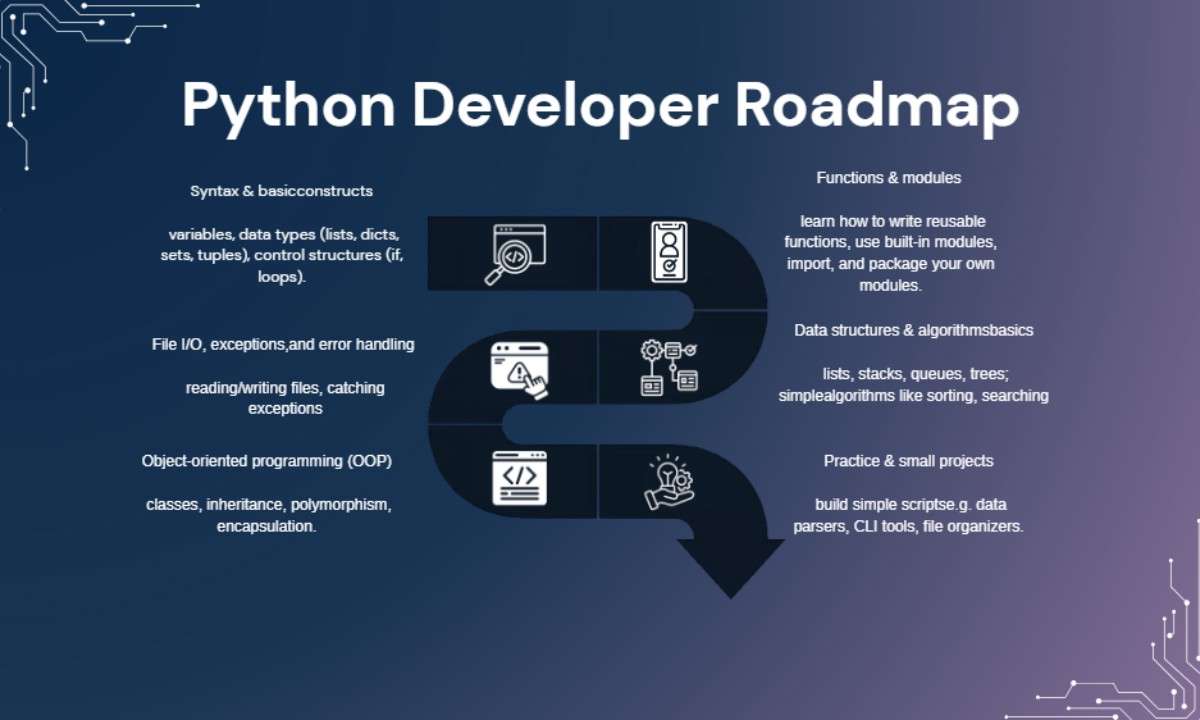
Basic Python code constructs include expressions, statements, and compound statements. Indentation defines block structure rather than braces. Common primitives are integers, floats, strings, lists, tuples, sets, and dictionaries. Control flow uses if/elif/else, for and while loops, and comprehensions for concise iteration.
Variables and data types
Variables are dynamically typed names bound to objects. Type hints (PEP 484) can be added to function signatures and variables to aid static analysis. Immutable types include tuple and str; mutable types include list and dict.
Functions and classes
Functions are defined with def and can be nested or higher-order. Classes support object-oriented patterns with instance methods, class methods, and static methods. Use __init__ for construction and dunder methods for operator behavior.
Modules and packages
Files are modules; directories with __init__.py (or implicit namespace packages) form packages. The import system supports absolute and relative imports. Use meaningful module names and keep modules focused on a single responsibility.
Standard library and packages
The Python standard library includes modules for file I/O, networking, concurrency, data encoding, and more. For ecosystem packages, PyPI hosts thousands of third-party libraries. Manage dependencies with virtual environments and package managers.
Key standard modules
Important modules include os and pathlib for filesystem operations, datetime for time handling, json and csv for data interchange, subprocess for process control, threading and asyncio for concurrency, and unittest for testing.
Package management
Use virtual environments (venv or virtualenv) to isolate dependencies. Install packages with pip and pin versions via requirements.txt or lockfiles to ensure reproducible installations. Packaging for distribution uses setup.py, setup.cfg, pyproject.toml, and build tools following PyPA recommendations.
Development tools and workflow
Efficient development relies on editors or IDEs, linters, formatters, type checkers, and continuous integration. Common tools include code formatters that enforce consistent style, static analysis to catch errors early, and test runners that automate verification.
Linters and formatters
Adopt a code formatter to produce consistent style and a linter to identify potential bugs or style violations. Follow community style guidance such as PEP 8 for naming, line length, and whitespace conventions.
Type checking and static analysis
Type annotations improve documentation and enable static checking. Tools that analyze types help detect mismatches before runtime. Use them as part of the development pipeline, especially in larger codebases.
Best practices and style
Maintainable Python code emphasizes readability, simplicity, and explicit behavior. Adhere to PEPs (Python Enhancement Proposals) for language evolution and style conventions. Use clear function and variable names, small functions, and modules with single responsibilities.
Documentation and comments
Document public interfaces with docstrings using a consistent style (reStructuredText, Google, or NumPy style). Use type hints and example snippets in documentation to clarify expected inputs and outputs.
Error handling
Handle exceptions explicitly; avoid bare except clauses. Prefer raising specific exceptions and using context managers (with) to manage resources reliably.
Testing, debugging, and performance
Automated tests, debugging tools, and profiling are essential to verify correctness and identify bottlenecks. Unit tests and integration tests form a testing pyramid that supports confident changes.
Testing strategies
Use a testing framework to write unit tests, and include integration or end-to-end tests where appropriate. Continuous integration services can run tests automatically on commits and pull requests.
Debugging and profiling
Use interactive debuggers to inspect state at runtime. Profilers reveal hotspots; optimize only after measuring. For CPU-bound code, consider algorithmic improvements or compiled extensions; for I/O-bound workloads, concurrency approaches can increase throughput.
Packaging and distribution
Publish packages following standards from the Python packaging authority. Provide metadata, license information, and clear installation instructions. Use semantic versioning to communicate changes to users and automated tools.
Security and dependencies
Regularly scan dependencies for vulnerabilities and pin trusted versions. Use minimal privileges when running code and audit third-party packages before inclusion in production systems.
Resources and standards
Official guidance and technical specifications are maintained by the Python Software Foundation and the Python core development community. Reference official documentation for the language reference, library reference, and packaging guidelines.
Official documentation and downloads are available from the Python Foundation's website: https://www.python.org/
FAQs
What is the best way to learn writing effective Python code?
Practice by reading and writing small, focused programs, study the standard library, and follow style guides such as PEP 8. Read source code from well-regarded projects and write tests to validate learning.
How should dependencies be managed for a Python code project?
Use virtual environments to isolate project dependencies, pin versions in a requirements file or lockfile, and use CI to reproduce installations. Prefer minimal and actively maintained packages.
How can Python code be made faster and more memory efficient?
Profile to identify bottlenecks, choose appropriate data structures, avoid unnecessary copying, and consider compiled extensions or optimized libraries for compute-heavy tasks. For concurrency, evaluate threading, multiprocessing, or asyncio based on workload characteristics.
Where to find official language standards and proposals such as PEPs?
The Python Software Foundation and the Python core development community publish PEPs and language documentation on the official website and developer portals. PEPs explain language changes, design decisions, and style recommendations.