9 Best Corporate e Learning Platforms for Employee Training
-

- Published Updated
- 1,248 views
Corporate training has changed quite a bit.
Employees don't necessarily want to sit through long classroom sessions, go through piles of training documents, or wait for a trainer to become available. They expect learning to be accessible, engaging, flexible, and easy to fit into their workday.
That's where a corporate e learning platform comes in.
A good platform can bring training content, assessments, learning paths, certifications, reporting, and employee progress into one place. More importantly, it can help organizations turn training from a one-time activity into an ongoing learning experience.
But with so many platforms available today, choosing one can get confusing.
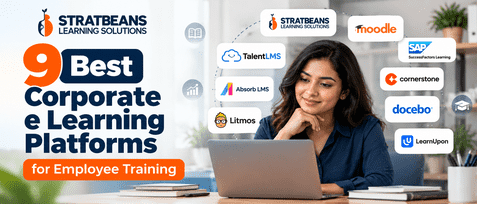
So, if you're evaluating a corporate e learning platform for your organization, here are nine options worth considering.
1. Stratbeans
Let's start with a platform built around the broader requirements of corporate learning.
Stratbeans offers digital learning and eLearning solutions designed to help organizations create, deliver, manage, and measure employee training.
Its learning technology ecosystem includes Bytecasting LMS, which provides organizations with a centralized environment for managing digital learning programs.
Depending on the organization's requirements, Stratbeans can support use cases such as employee onboarding, compliance training, skill development, assessments, certifications, and structured learning paths.
What makes the approach interesting is that corporate learning isn't treated simply as a place to upload training videos. Organizations can build a more structured learning environment where administrators can manage programs while employees have a more organized learning journey.
Why consider Stratbeans?
Corporate learning and employee training
Centralized LMS administration
Digital course delivery
Assessments and quizzes
Learning paths
Employee progress tracking
Certification management
Training reports and analytics
eLearning solutions and content support
Best suited for: Organizations looking for a corporate eLearning ecosystem that combines LMS and broader digital learning capabilities.
2. Moodle
Moodle is one of the most recognized names in the learning technology space.
Its open-source foundation gives organizations considerable flexibility when creating and configuring their learning environment.
For companies with technical resources and specific customization requirements, Moodle can be an interesting option.
It can support online courses, assessments, learner management, reporting, and integrations, while its plugin ecosystem allows organizations to extend its capabilities.
Best suited for: Organizations that value customization and have the technical resources to manage their LMS environment.
3. SAP SuccessFactors Learning
Large organizations often need their learning platform to connect with their wider HR ecosystem.
That's where SAP SuccessFactors Learning can become relevant.
The platform is designed for enterprise learning and can connect learning activities with broader employee and talent-management processes.
For companies already using SAP's HR solutions, having learning capabilities within the same ecosystem can simplify technology management.
Best suited for: Large enterprises looking for an LMS connected to their broader HR and talent-management environment.
4. Cornerstone
Cornerstone is an enterprise learning and talent development platform designed for organizations managing learning at scale.
It supports different types of workforce learning and provides organizations with tools for managing training, development, and skills.
For large businesses with multiple teams, locations, and learning requirements, centralized management can be an important consideration.
Best suited for: Enterprises with complex employee learning and development requirements.
5. Docebo
Docebo is a cloud-based learning platform that focuses on corporate and extended-enterprise learning.
Organizations can use it to deliver training to employees as well as audiences such as customers and partners.
Its focus on automation and digital learning experiences makes it an option for businesses looking to modernize how they deliver training.
Best suited for: Organizations looking for a cloud-based platform for employee and extended-enterprise learning.
6. TalentLMS
Sometimes, an organization doesn't need an extremely complex enterprise system.
It simply needs an LMS that's straightforward to set up, administer, and use.
TalentLMS focuses on that relatively simple learning experience while providing common LMS functionality such as course management, assessments, learner administration, and reporting.
For small and medium-sized businesses, ease of use can be an important factor when selecting a corporate eLearning platform.
Best suited for: Small and medium-sized businesses looking for a relatively straightforward LMS.
7. Absorb LMS
Absorb LMS is designed to support employee training as well as learning for external audiences.
That makes it relevant for organizations that need to train more than just their internal workforce.
For example, businesses may use an LMS to train employees while also providing learning programs to customers, partners, distributors, or other stakeholders.
Best suited for: Organizations with employee and extended-enterprise training requirements.
8. Litmos
Litmos is another established corporate learning platform.
It focuses on helping organizations deliver and manage employee training, including areas such as onboarding, compliance, professional development, and other workplace learning programs.
For organizations where mandatory training and structured employee development are important, Litmos can be considered as part of the evaluation process.
Best suited for: Organizations managing structured employee, onboarding, and compliance training.
9. LearnUpon
LearnUpon is a learning management platform designed to support training for different audiences.
One of its relevant use cases is extended enterprise learning, where organizations need to provide training to people outside their direct employee base.
That can include customers, partners, resellers, or other business audiences.
For companies with multiple learner groups, audience management becomes an important factor when selecting a corporate eLearning platform.
Best suited for: Organizations delivering learning to employees, customers, and business partners.
How to Choose the Right Corporate e Learning Platform
Now comes the part that can actually save you from making an expensive mistake.
Don't select a platform simply because its feature list looks impressive.
Start with your organization's actual learning requirements.
Understand Your Learners
Who will use the platform?
Is it meant only for employees, or will customers, partners, distributors, or franchisees also access the training?
Different audiences can require different LMS capabilities.
Look at Your Training Goals
Are you primarily interested in:
Employee onboarding?
Compliance training?
Product training?
Leadership development?
Technical skills?
Certifications?
Continuous learning?
Defining your goals first makes it much easier to identify the right platform.
Check Content Compatibility
Think about the content you already have—or plan to create.
Will you use videos, PDFs, presentations, SCORM courses, quizzes, assessments, live sessions, or microlearning?
Your corporate e learning platform should be able to accommodate the formats that matter to your training strategy.
Don't Ignore Reporting
Training isn't just about getting employees to complete courses.
You also need to know what's happening.
Can administrators see completion rates? Can they identify learners who haven't completed mandatory training? Can they track assessment results and certifications?
Good reporting can turn LMS data into useful information for the L&D team.
Think About Scalability
Your organization today may have 500 employees.
What happens when it has 2,000?
Or 10,000?
The platform you choose should be capable of supporting your expected growth without creating unnecessary administrative complexity.
Consider the Employee Experience
This one is easy to overlook.
Your employees are the people who will actually use the platform.
If navigating courses feels complicated, finding content takes too long, or the interface feels outdated, adoption can suffer.
A technically powerful platform still needs to provide a practical learner experience.
Why Stratbeans Is Worth Considering
There are plenty of choices when you're searching for a corporate e learning platform.
The important thing is to look beyond the sales demo.
Ask yourself:
Can this platform support the way our organization actually trains people?
That's where Stratbeans can be worth exploring.
Through solutions such as Bytecasting LMS, Stratbeans brings together capabilities designed around corporate learning, digital training, assessments, learner management, and reporting.
Whether an organization is building an employee onboarding program, implementing structured compliance training, developing employee skills, or creating a broader digital learning strategy, the LMS can form an important part of that ecosystem.
And because corporate learning is rarely limited to one type of content or one type of learner, having a platform that can support different learning requirements becomes increasingly important.
Final Thoughts
Choosing a corporate e learning platform(https://stratbeans.com/customized-elearning-services/) isn't about finding the platform with the longest list of features.
It's about finding the right fit.
Think about your learners. Think about your training goals. Think about the content you need to deliver, the reports your team needs, and where your organization expects to be a few years from now.
Platforms such as Stratbeans, Moodle, SAP SuccessFactors Learning, Cornerstone, Docebo, TalentLMS, Absorb LMS, Litmos, and LearnUpon offer different approaches to corporate learning.
Take the time to compare them against your actual requirements.
Because when the technology fits the learning strategy, employee training becomes much easier to manage—and much easier for employees to engage with.