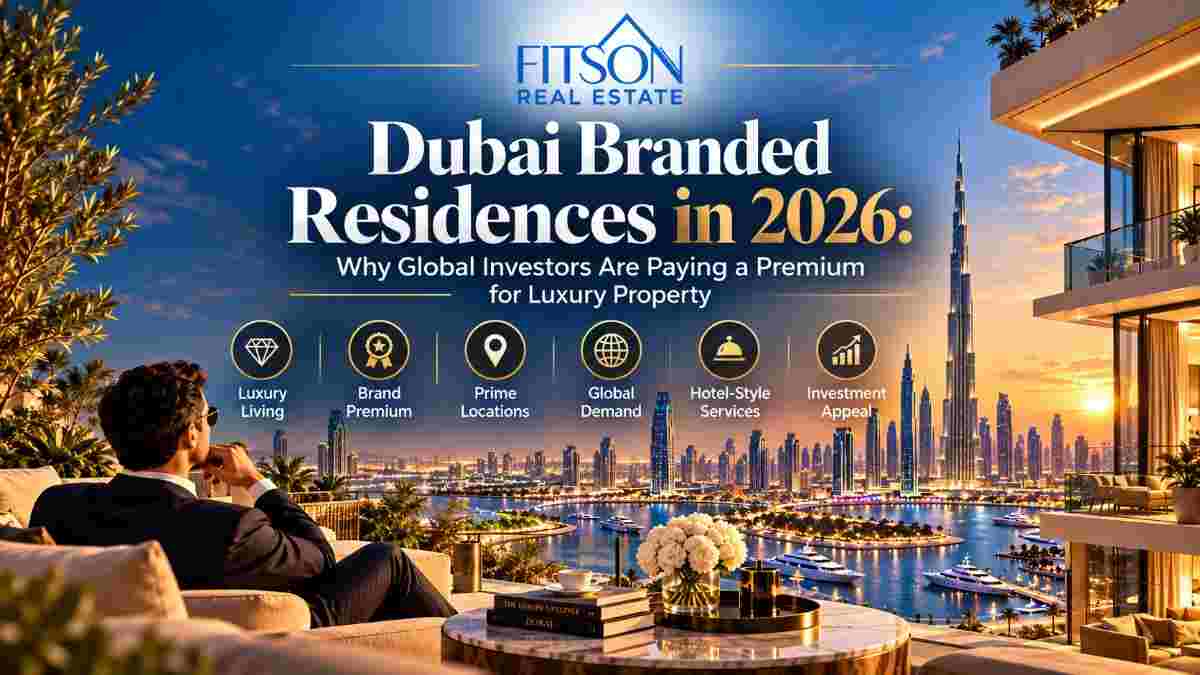
Dubai Branded Residences in 2026: Why Global Investors Are Paying a Premium for Luxury Property
-
- Published Updated
- 121 views
Why would an investor pay substantially more for an apartment simply because it carries a luxury hotel, fashion, or automotive name? In Dubai, the answer goes far beyond a logo on the entrance. Branded residences increasingly combine prime locations, distinctive architecture, high-specification interiors, hospitality-level services, professional management, and global brand recognition. For wealthy international buyers, that combination can create lifestyle value as well as investment appeal. Yet a premium purchase price does not automatically guarantee stronger returns. In 2026, buyers need to understand what the brand actually provides, how much it costs to maintain, and whether the premium can survive resale.
Dubai Has Become the Global Capital of Branded Residences
Dubai is no longer simply participating in the luxury branded residence market. It is leading it.
Knight Frank's September 2026 research identifies Dubai as the world's largest city market for branded residences, with 175 schemes—68 operational and 107 in the development pipeline. For comparison, Miami has 73 schemes and London 30. (knightfrank.ae)
The wider Middle East now accounts for roughly 20% of live branded-residence schemes globally and around 25% of the global pipeline. (knightfrank.ae)
Savills also reported strong regional expansion, noting that branded-residence supply across the Middle East and North Africa had grown rapidly over the previous five years, with Dubai remaining the leading city by completed and pipeline projects. (savills.com)
This scale matters because branded real estate is becoming an established segment of Dubai's prime residential market rather than a niche luxury concept.
What Exactly Is a Branded Residence?
A branded residence is a privately owned home associated with an established hospitality, fashion, automotive, design, or lifestyle brand.
Different projects can involve very different levels of brand participation.
Some brands:
Operate the residences
Manage hospitality services
Set architectural standards
Specify interiors and materials
Provide concierge services
Manage amenities
Offer housekeeping or valet services
Maintain brand standards after completion
Others may have a more limited design or licensing relationship.
This distinction is important.
A residence professionally operated by an international hospitality group is a different investment proposition from a building that mainly licenses a famous name.
Investors considering luxury Dubai property should therefore ask not only:
“Which brand is attached?”
but:
“What will that brand actually do after I purchase the property?”
Why Are Global Buyers Paying a Premium?
The premium attached to branded property generally reflects several elements working together.
Brand Recognition
A recognised international brand gives the property an identity that overseas buyers immediately understand.
For someone living in London, New York, Mumbai, Singapore, or Riyadh, a familiar hospitality or luxury name can reduce some of the uncertainty associated with purchasing property in another country.
Professional Management
Many high-end branded schemes provide professionally managed common areas, concierge teams, security, valet services, and hospitality-style operations.
For investors who spend only part of the year in Dubai, this can make ownership more convenient.
Design and Specification
Luxury brands often establish strict standards for:
Materials
Architecture
Interior design
Furniture
Fixtures
Amenities
Common spaces
The objective is to deliver a more consistent premium experience.
Scarcity and Status
A limited number of residences associated with a globally recognised brand can create scarcity value, particularly in prime waterfront or central Dubai locations.
Current UAE market commentary commonly places hospitality-branded residential premiums at meaningful levels above comparable non-branded stock, although the exact premium varies widely by project, location, operator, and quality.
That final point is crucial: there is no universal branded-residence premium.
Dubai's Luxury Market Is Supporting the Trend
Branded residences are expanding within an already strong Dubai luxury real estate market.
Knight Frank reported 296 residential sales above US$10 million during the first half of 2026, worth approximately US$5.1 billion. This represented a 14% increase in value compared with H1 2025.
Twenty-six homes also sold for more than US$25 million during Q2 alone. (knightfrank.ae)
That level of ultra-prime activity indicates continued interest from high-net-worth and ultra-high-net-worth buyers.
Dubai's appeal to wealthy international purchasers is supported by:
Global connectivity
Luxury hospitality
Waterfront communities
Modern infrastructure
International schools
Business opportunities
High-end retail
Lifestyle amenities
Foreign property ownership in designated areas
Branded homes sit naturally within that ecosystem.
Hotel Brands Are No Longer the Only Players
Historically, hotel-branded residences dominated the category.
That is changing.
Knight Frank reports that around 70% of operational branded-residence schemes globally remain hotel-branded, but this falls to roughly 60% when projects under development are included. Non-hotel brands are expected to represent almost 40% of supply by 2028. (knightfrank.ae)
Dubai now features associations with:
Hospitality brands
Fashion houses
Automotive brands
Interior-design names
Luxury lifestyle brands
Automotive-branded residences in particular have become increasingly visible, extending the identity of luxury car manufacturers into architecture, interiors, and residential experiences. (knightfrank.ae)
This broadening of the market gives investors more choice—but also increases the need for careful comparison.
Branded vs Non-Branded Luxury Property
A luxury residence does not need a famous brand to be an excellent investment.
Consider the difference:
| Factor | Branded Residence | Non-Branded Luxury Residence |
|---|---|---|
| Brand recognition | Usually strong | Depends on developer/project |
| Purchase price | Often premium | Potentially lower |
| Management | Frequently professional/hospitality-led | Varies |
| Services | Often extensive | Project dependent |
| International recognition | Potentially stronger | Location/developer dependent |
| Service charges | Often higher | Frequently lower |
| Resale audience | Global luxury buyers | Broader or location-specific |
| Investment case | Brand + location + service | Location + quality + price |
Investors comparing Real estate properties should therefore avoid assuming branded automatically means superior.
A well-located non-branded residence bought at the right price can outperform an overpriced branded development.
The Biggest Cost Investors Often Underestimate
The premium does not end at the purchase price.
Branded residences can carry higher ongoing service charges because hotel-level amenities and staffing cost money.
Owners may be paying for:
Concierge teams
Valet services
Security
Housekeeping of shared areas
Luxury pools and spas
Wellness facilities
Private lounges
High-specification landscaping
Residence management
Hospitality infrastructure
This matters when calculating net rental yield.
Imagine two AED10 million apartments generating similar rent.
If one has significantly higher annual service charges, the difference in retained income can become substantial over a five- or ten-year holding period.
Before buying, ask:
What is the projected service charge per square foot?
What services are included?
Is the brand operating the building?
Can service charges rise after handover?
Is there a reserve or sinking fund?
Are hotel facilities shared with residences?
The correct investment comparison is therefore not:
Purchase price vs purchase price
It is:
Total ownership cost vs long-term value.
Does the Brand Improve Rental and Resale Demand?
Potentially—but not automatically.
International recognition can make certain branded residences easier to explain and market globally.
Luxury tenants may also value:
Turnkey living
Concierge assistance
Professional management
Prime locations
Hotel-style facilities
Privacy and security
But rental yield should still be calculated normally:
Annual rental income – service charges – management – maintenance – vacancy = estimated net rental income
A buyer reviewing branded opportunities through Fitson Real Estate or another licensed UAE brokerage should request comparisons with nearby non-branded luxury residences rather than judging the project in isolation.
Location Still Matters More Than a Logo
A famous name cannot completely compensate for a poor location.
Dubai's strongest branded-residence clusters are generally connected to areas with established luxury demand, including locations around:
Palm Jumeirah
Downtown Dubai
Business Bay
Dubai Canal
Jumeirah Bay
Dubai Harbour
Dubai Marina
Investors should evaluate:
Waterfront position
View protection
Access
Surrounding development
Community maturity
Future supply
Tourism appeal
Business connectivity
Rental demand
If competing branded towers enter the same location simultaneously, scarcity may decline.
This makes future supply analysis especially important in 2026.
Sharjah Is Entering the Branded-Residence Market Too
Dubai remains the UAE's dominant branded-residence market, but the concept is spreading.
In January 2026, Sharjah saw the launch of Palace Residences Al Mamsha, a luxury branded residential development created by Alef Group in collaboration with Emaar Hospitality.
The AED500 million project introduced the Palace Residences brand to Sharjah and includes premium one-, two-, and three-bedroom apartments. (wam.ae)
This is significant.
It shows that branded living is expanding beyond Dubai into other UAE markets as developers respond to demand for higher-end residential experiences.
| Market | Branded Residence Position |
|---|---|
| Dubai | Mature global leader |
| Sharjah | Emerging branded-luxury segment |
| Abu Dhabi | Growing pipeline |
| Ras Al Khaimah | Strong resort-led future pipeline |
For investors, this creates opportunities at different stages of market development.
Seven Questions to Ask Before Buying
Before paying a reservation deposit, ask:
What does the brand actually contribute?
Who operates the residences after handover?
How long does the brand agreement last?
What are the expected annual service charges?
How does the price compare with nearby non-branded luxury property?
How much competing branded supply is planned nearby?
Who is likely to buy the property from me later?
These questions help separate brand value from brand marketing.
Useful Branded-Residence Terms
| Term | Meaning |
|---|---|
| Branded residence | Private home associated with a recognised brand |
| Hospitality branded | Residence linked to a hotel operator |
| Brand premium | Extra price paid compared with similar non-branded property |
| Ultra-prime | Highest tier of luxury real estate |
| HNWI | High-net-worth individual |
| Service charge | Recurring cost of building/community operations |
| Capital appreciation | Increase in property value |
| Rental yield | Rental income relative to property price |
| Trophy asset | Rare prestige property held partly for status/scarcity |
| Turnkey property | Residence delivered ready for occupation |
Conclusion
Dubai branded residences in 2026 are becoming one of the defining segments of the UAE's luxury property market.
The numbers explain why. Dubai now leads the world by branded-residence scheme count, while record levels of US$10 million-plus home sales demonstrate continued demand from global wealth.
But buyers should not pay a premium simply because a famous name appears on the brochure.
The strongest branded residence combines:
a desirable location + excellent property + credible developer + meaningful brand involvement + quality management + sensible service costs + long-term scarcity.
If one of those elements is weak, the premium deserves closer examination.
Sharjah's entry into branded residential development also shows that the concept is broadening across the UAE, creating new options for buyers who want luxury living outside Dubai's traditional prime districts.
For international investors, the core principle remains simple:
Buy the property first and the brand second.
A powerful brand can enhance value, service, prestige, and global appeal—but only when the underlying luxury real estate investment already makes sense.
Frequently Asked Questions
What is a branded residence in Dubai?
A branded residence is a privately owned luxury home associated with an established hotel, fashion, automotive, or lifestyle brand. Brand involvement may include design, management, services, or hospitality operations.
Is Dubai the world's largest branded-residence market?
Yes. Knight Frank's September 2026 research identifies Dubai as the world's largest city market, with 175 live and pipeline branded-residence schemes. (knightfrank.ae)
Why are branded residences more expensive?
Buyers may pay extra for brand recognition, premium design, professional management, hospitality services, amenities, scarcity, and perceived resale appeal. The exact premium varies considerably by project.
Are branded residences good investments?
They can be, particularly in prime locations with meaningful brand involvement and limited competing supply. However, high purchase prices and service charges can reduce net returns, so every project should be assessed individually.
Are branded residences available outside Dubai?
Yes. Other UAE markets are expanding in this segment. Sharjah launched Palace Residences Al Mamsha in 2026, while Abu Dhabi and Ras Al Khaimah also have growing branded-residence pipelines.