How Enterprise Integration Strengthens Modern Quality Management
-

- Published Updated
- 4,847 views
QualityPro by TecWork is a modern Quality Management System designed to help organizations manage and connect their quality processes across the enterprise. As businesses adopt multiple digital platforms for managing operations, production, products, and resources, having a quality system that can integrate with these platforms becomes increasingly important.
Quality management is no longer limited to inspections, documentation, and corrective actions. Modern quality teams need access to information from different departments and systems to make informed decisions, identify quality issues faster, and maintain better process visibility.
This is where enterprise integration becomes an important capability of a Quality Management System.
Why Enterprise Integration Matters for Quality Management
Manufacturing and enterprise organizations often use multiple software applications to manage different parts of their operations. An ERP system may manage resources, purchasing, inventory, and business processes.
An MES platform may manage manufacturing execution and production activities. A PLM system may contain product lifecycle information.
When quality management operates separately from these systems, teams may need to manually transfer information between applications. This can create duplicated data, delays, and additional administrative work.
An integrated QMS can help create a more connected digital environment where quality processes can work alongside existing enterprise applications.
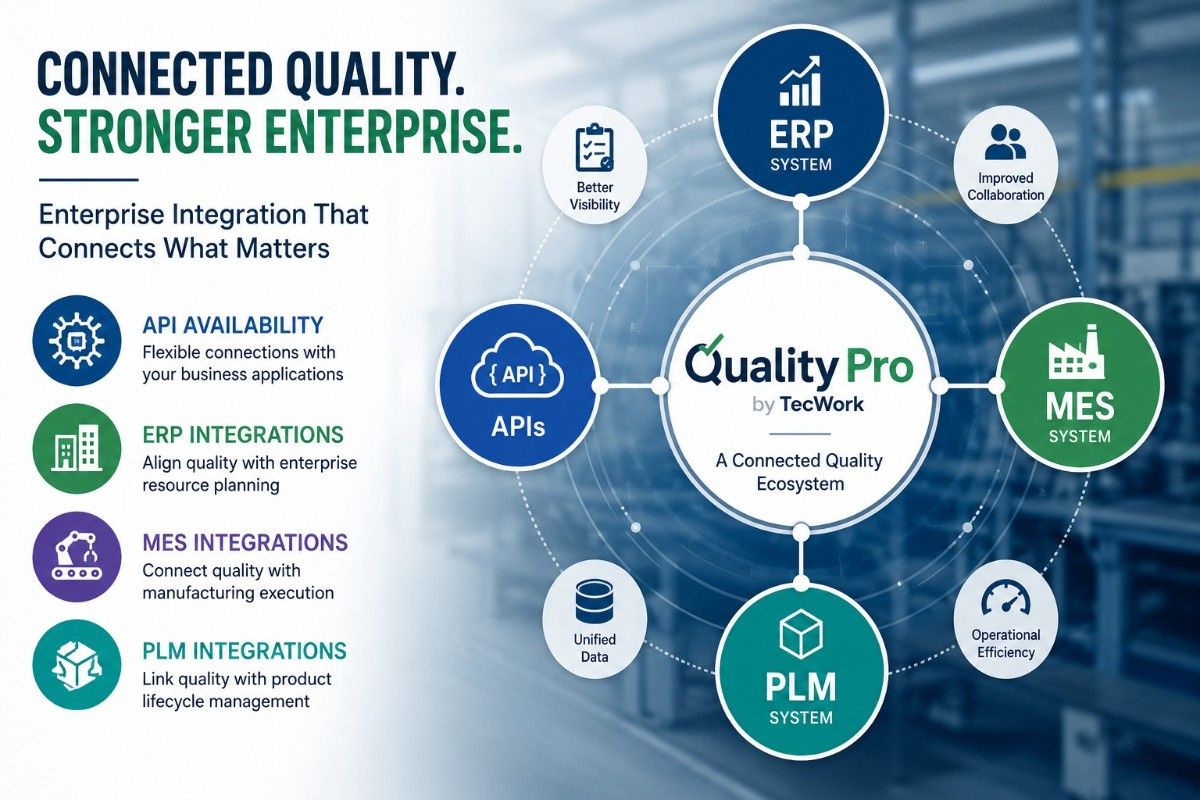
QualityPro by TecWork supports this approach through API availability, ERP integrations, MES integrations, and PLM integrations.
API Availability for Flexible Integration
Every organization has its own technology environment. Some companies may use industry-specific applications, internally developed systems, or multiple enterprise platforms.
API availability provides an important foundation for connecting a QMS with other applications.
Through API-based integration, organizations can create connections between QualityPro and relevant business systems according to their specific requirements.
This flexibility can help reduce isolated quality data and support the exchange of information between different applications.
Rather than requiring quality teams to work with disconnected systems, API capabilities can contribute to a more unified digital workflow.
ERP Integration and Quality Management
Enterprise Resource Planning systems are central to many organizations. They help manage business processes such as purchasing, inventory, finance, suppliers, resources, and other operational activities.
Quality is closely connected with many of these functions.
For example, supplier-related activities can influence incoming quality, materials can affect production quality, and business processes can generate information relevant to quality management.
ERP integration can help organizations connect quality processes with broader enterprise operations. This can improve coordination between quality teams and other departments while providing greater visibility into information that may influence quality decisions.
A connected environment can also reduce the need for teams to repeatedly enter or retrieve information from separate systems.
MES Integration for Manufacturing Visibility
Manufacturing Execution Systems are commonly used to monitor and manage production activities.
Production processes and quality processes are naturally connected. Manufacturing issues can result in non-conformances, deviations, corrective actions, inspections, and other quality activities.
MES integration can help bring manufacturing execution information closer to quality management processes.
By connecting quality and manufacturing systems, organizations can work toward better visibility across production and quality activities.
This can support a more proactive approach to identifying issues and managing quality throughout manufacturing operations.
For manufacturers focused on improving operational efficiency, connecting QMS and MES capabilities can be an important part of digital transformation.
PLM Integration for Product Quality
Product Lifecycle Management systems support processes and information related to products throughout their lifecycle.
Quality management also plays an important role throughout product development and lifecycle activities.
PLM integration can help connect product-related information with quality processes. This can support better alignment between product development, engineering, manufacturing, and quality teams.
When product and quality information can work together, organizations can create a more connected approach to managing product requirements, changes, issues, and quality activities.
Creating a Connected Enterprise Quality Ecosystem
Enterprise integration is not simply about connecting software applications. The larger objective is to create a connected flow of information across the organization.
Consider a manufacturing organization where a production-related issue is identified. The information may involve manufacturing data, product information, supplier details, quality records, and corrective actions.
If these processes exist in disconnected systems, employees may spend significant time collecting and comparing information manually.
With integrated systems, organizations can work toward a more connected process where information is available across relevant workflows.
This can help support:
- Better information visibility
- Reduced manual data entry
- Improved coordination between departments
- More connected quality processes
- Faster access to relevant information
- Better process traceability
- Improved decision-making
- Greater operational efficiency
Supporting Digital Quality Transformation
Digital transformation in quality management is about more than replacing paper forms with software. Organizations increasingly need quality systems that can communicate with the broader technology environment.
A QMS with enterprise integration capabilities can become part of a larger digital ecosystem rather than functioning as an isolated application.
QualityPro by TecWork supports this connected approach with capabilities including:
API Availability: Provides a foundation for connecting QualityPro with other applications.
ERP Integrations: Helps connect quality management with enterprise resource planning processes.
MES Integrations: Supports connectivity between quality activities and manufacturing execution processes.
PLM Integrations: Helps align quality processes with product lifecycle management activities.
These capabilities can be particularly valuable for organizations that already have established enterprise systems and want to strengthen their digital quality infrastructure.
Quality Should Be Part of the Connected Enterprise
Quality affects almost every part of an organization. From suppliers and materials to production, products, documentation, and customer requirements, quality information is closely linked with other business processes.
For this reason, a QMS should be capable of working alongside the systems an organization already uses.
Enterprise integration can help organizations move toward a more connected quality environment where information flows between systems and quality processes become part of the broader operational workflow.
QualityPro by TecWork is designed to support this approach through API availability and integration capabilities for ERP, MES, and PLM systems.
For organizations looking to strengthen digital quality management, enterprise integration can be an important consideration when evaluating a modern QMS.
A connected quality ecosystem can help organizations move beyond isolated quality processes and toward a more integrated, visible, and efficient approach to managing quality across the enterprise.