F-1 Duration of Status Blocked: A Guide for Students
-

- September 21st, 2026
- 23 views
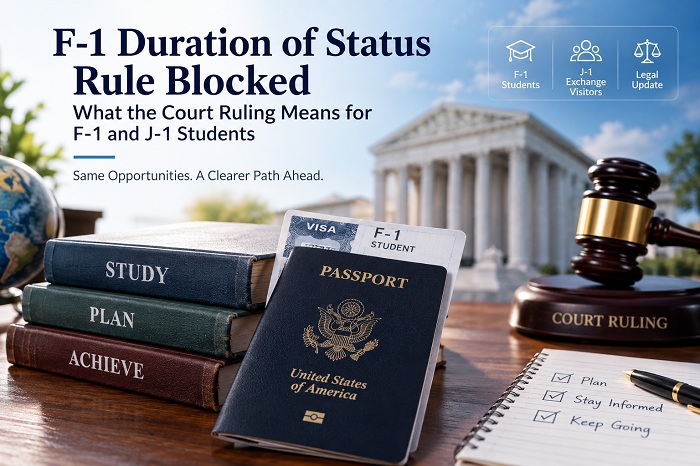
International students often plan their education years in advance. A degree has a start date, expected completion date, research milestones and, for many students, plans for work after graduation. A proposed immigration rule threatened to add another deadline to that equation: a four-year limit on admission.
That rule did not take effect. On September 14, 2026, a federal judge in Massachusetts issued a nationwide preliminary injunction blocking the Department of Homeland Security's duration of status rule just one day before its scheduled implementation.
For F-1 and J-1 students, the existing duration-of-status framework therefore remains in place for now. But the legal case is still developing, so students should understand what changed, what stayed the same and why their academic planning still matters.
The Existing D/S System Explained
Most F-1 students have historically been admitted to the United States for “duration of status,” commonly represented as D/S on their immigration records. Instead of receiving a fixed departure date tied to a specific number of years, students can generally remain while maintaining the requirements of their status and progressing through their academic program.
The proposed rule would have changed that arrangement.
DHS planned to replace D/S with fixed admission periods of no more than four years. Students who needed additional time would generally have needed to apply to USCIS for an extension of stay.
That difference could be significant for students enrolled in long or unpredictable programs. A four-year undergraduate program may fit comfortably within a four-year admission period. A doctoral program may not.
Research rarely moves according to a perfect calendar. A dissertation can require another round of data collection. A laboratory project can take longer than expected. A major revision can push graduation into another semester.
Under the proposed framework, those academic delays could have created additional immigration paperwork.
Why the Court Stepped In
The federal court's preliminary injunction focused largely on the process DHS used to develop and justify the rule.
The judge concluded that the plaintiffs were likely to succeed on claims that DHS had not adequately analyzed the rule's costs and benefits, seriously considered less burdensome alternatives or sufficiently addressed significant public comments. The court also questioned whether the agency had adequately demonstrated how the rule would accomplish its stated objectives.
The distinction between a preliminary injunction and a final ruling matters.
The court did not permanently eliminate the policy. Instead, the injunction prevents DHS and ICE from implementing or enforcing the rule while the litigation continues.
That means students should avoid treating the current situation as either a permanent victory or an immediate immigration crisis. The legal process still has room to develop.
What F-1 Students Can Rely on Right Now
The most immediate effect of the injunction is that the proposed four-year maximum did not begin on September 15.
Students admitted under D/S therefore remain under the existing framework described in the source material. They did not suddenly become responsible for filing a new USCIS extension simply because the proposed rule had been published.
The proposed reduction in the F-1 post-completion grace period also remains blocked. Instead of the proposed 30-day period, the existing 60-day framework remains in place under the current arrangement described in the resource.
Changes affecting transfers, changes in educational objectives and additional degrees were also part of the blocked rule.
For students considering a change in their academic plans, that distinction is useful. There is no need to make a rushed decision simply because the proposed regulations were announced.
At the same time, individual circumstances vary. Students should discuss their specific records and plans with their designated school official rather than relying on a general article for case-specific immigration advice.
Academic Planning Still Deserves Attention
The court ruling may have removed an immediate four-year deadline, but it has not made academic planning less important.
Students should know how many credits remain, when major research milestones are expected and whether their current program has a realistic completion date. This becomes particularly important for students working on dissertations, capstones and research-heavy coursework.
Academic workload can also affect those timelines. A student managing several demanding assignments may discover that research tasks take longer than anticipated. A literature review, for example, can involve finding sources, evaluating evidence, organizing themes and developing a coherent argument.
When students need additional guidance with that type of academic work, Expertsmind's Literature Review Homework Assignment Help can be a relevant resource for support with literature-review-focused coursework.
The goal is not to outsource academic responsibility. It is to give students another source of subject-focused assistance while they remain responsible for understanding and completing their university work.
Research papers can create similar demands. Students may need to refine a research question, organize methodology, interpret findings or present evidence clearly. Expertsminds' Research Paper Help can provide another academic resource for students working through research-based assignments.
Keeping academic work moving matters because immigration uncertainty becomes harder to manage when a student is already behind schedule.
What Students Should Prepare During the Pause
The current injunction gives students something valuable: time.
Use it to speak with your DSO about your expected completion date. If your degree could extend beyond four years, ask what your school would recommend if a fixed admission system eventually returns.
Students should also keep copies of important records, including their I-20 or DS-2019, latest I-94, enrollment documentation and travel history. Organized records can make future administrative processes easier if requirements change.
It is also sensible to maintain a realistic academic timeline. Break major projects into smaller milestones and identify where delays are most likely. A dissertation deadline six months away can feel distant, but several delayed research stages can quickly consume that time.
Students should also follow the court case through reliable sources rather than assuming that every online discussion reflects the current legal position. The attached resource notes that a status conference was scheduled for October 2, 2026, while organizations tracking international education and immigration continue to follow the litigation.
Could the Rule Return?
The possibility remains open.
The government is expected to appeal, and an appeals court could uphold, narrow or lift the injunction. The underlying case could also result in a final ruling that affects the rule's future.
DHS could potentially attempt another rulemaking effort as well. The court's concerns focused on procedural issues, including the agency's analysis and treatment of public comments.
If a similar rule returns, students in long programs may again need to pay close attention to admission periods, extension procedures and transition provisions.
For now, however, the most useful response is preparation rather than speculation.
International students should know their academic timeline, maintain their immigration records and stay connected with their DSO. The duration of status rule may be blocked today, but the legal questions surrounding it have not disappeared.
The central lesson is simple: an immigration pause is most useful when students use the extra time to prepare, not to ignore the issue.