Generative AI Data Pipeline: Building Smarter and Scalable Enterprise AI Solutions
-
- Published Updated
- 111 views
Businesses are increasingly adopting artificial intelligence to improve productivity, automate workflows, and make better-informed decisions. However, successful AI implementation depends on more than choosing a powerful language model. Organizations also need reliable data, secure integrations, effective governance, and scalable infrastructure. A well-designed Generative AI Data Pipeline connects these essential components to help businesses turn enterprise information into useful AI-driven outcomes.
As companies integrate generative AI into customer service, analytics, knowledge management, and business operations, building a dependable data pipeline becomes an important step toward production-ready AI applications.
What Is a Generative AI Data Pipeline?
A Generative AI Data Pipeline is a structured process for collecting, preparing, transforming, organizing, and delivering data to generative AI applications. It helps ensure that information from business systems is available in a suitable format for AI models and related services.
Traditional data pipelines commonly support reporting, analytics, and business intelligence. Generative AI pipelines can extend these capabilities by preparing information for large language models (LLMs), retrieval-augmented generation (RAG), AI assistants, and intelligent automation systems.
For example, an enterprise AI assistant may need to retrieve information from company policies, product documentation, customer records, and internal knowledge bases. A reliable pipeline prepares the relevant information, manages access permissions, and makes suitable content available to the AI application.
Why Businesses Need Generative AI Data Pipelines
Enterprise information is often distributed across databases, cloud storage, ERP platforms, CRM systems, documents, and internal applications. When data remains fragmented or inconsistent, AI applications may produce incomplete, irrelevant, or outdated responses.
A structured pipeline helps organizations address these challenges through:
Data consistency: Standardizing information from different business systems.
Improved accessibility: Making relevant enterprise knowledge easier for AI applications to retrieve.
Automation: Reducing repetitive data preparation and processing tasks.
Scalability: Supporting growing data volumes and increasing AI usage.
Security: Applying appropriate access controls and data protection measures.
Operational reliability: Monitoring pipeline performance and identifying processing failures.
These capabilities help organizations build AI solutions that can operate reliably within real business environments.
Key Components of a Generative AI Data Pipeline
1. Data Collection and Integration
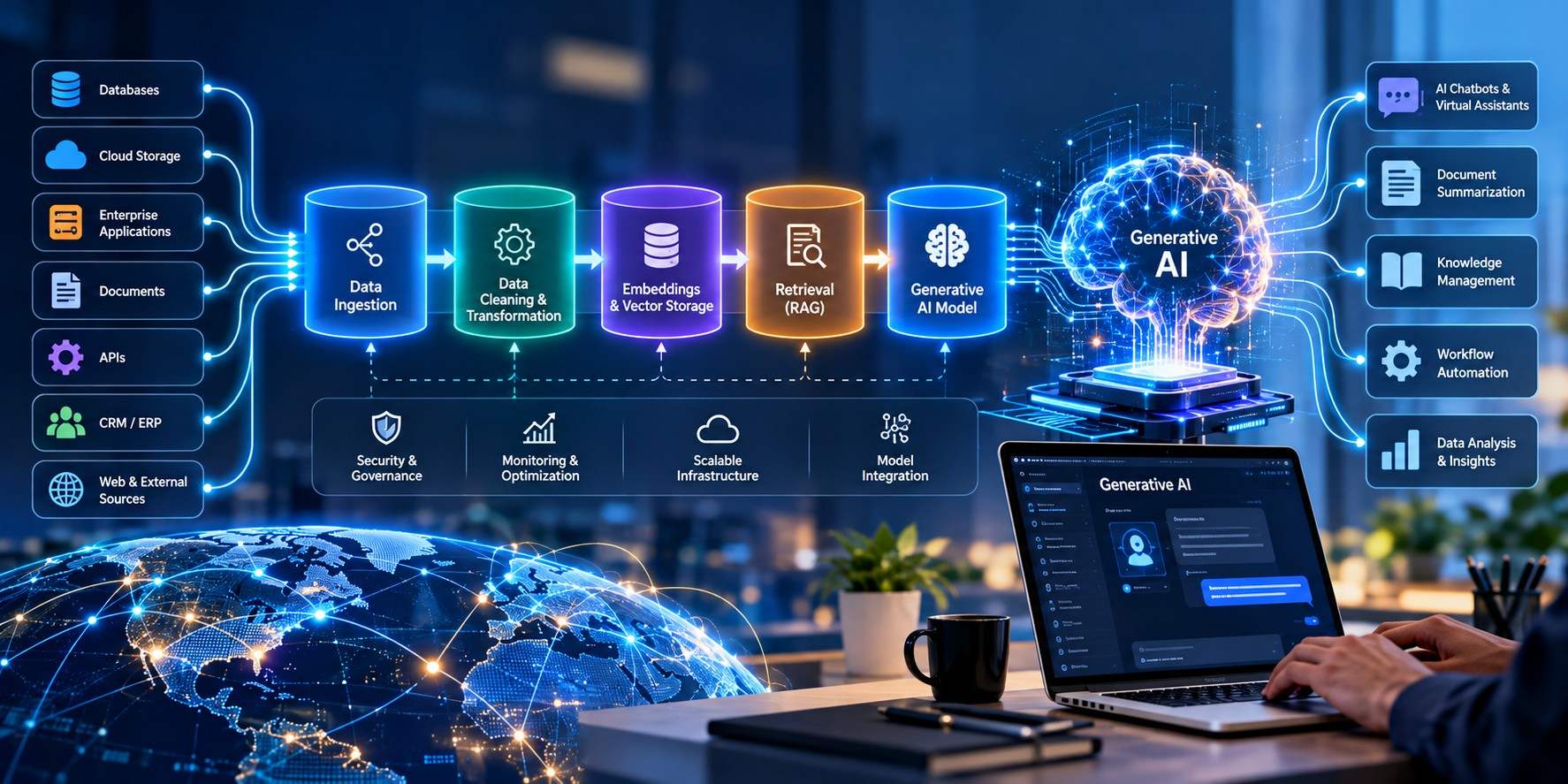
The first stage gathers information from relevant sources, including relational databases, APIs, cloud platforms, enterprise applications, documents, and knowledge repositories.
Businesses may require batch processing for historical information and real-time integrations for frequently changing data. The appropriate approach depends on the use case, source systems, and freshness requirements.
Effective integration helps ensure that the AI application can access the information needed to perform its intended tasks.
2. Data Cleaning and Preparation
Raw data often contains duplicates, formatting inconsistencies, missing values, outdated records, or irrelevant content. These issues can affect the quality of downstream AI applications.
Data preparation may include validation, normalization, deduplication, metadata enrichment, document parsing, and removal of unnecessary information.
For document-based AI applications, the preparation process may also involve splitting documents into meaningful sections while preserving context and metadata.
3. Embeddings and Vector Storage
For many retrieval-based AI applications, prepared text is converted into numerical representations called embeddings. These representations help systems identify content that is semantically relevant to a user's query.
The embeddings and associated metadata can be stored in a vector database or another suitable retrieval system. When a user asks a question, the application retrieves relevant information and provides it as context for the language model.
The best storage and retrieval architecture depends on data volume, search requirements, security controls, and the broader enterprise environment.
4. Retrieval-Augmented Generation (RAG)
Retrieval-augmented generation connects a language model with relevant external information. Instead of relying only on information learned during training, the application retrieves suitable context from approved data sources before generating a response.
A typical RAG workflow includes query processing, retrieval, relevance ranking, context construction, and response generation.
This approach is useful for enterprise knowledge assistants, technical documentation search, customer support, internal policy queries, and document analysis.
However, RAG does not automatically guarantee factual accuracy. Organizations should evaluate retrieval quality, validate generated responses, and monitor system performance.
5. AI Model Integration
Once data is prepared and retrieved, it can be passed to a suitable generative AI model through an application interface or API.
Model integration includes prompt design, context management, output validation, error handling, and response formatting. Depending on the application, the system may also connect with enterprise APIs, business applications, and workflow automation tools.
This integration allows AI applications to support practical business activities rather than operate as isolated chat interfaces.
Security and Governance in Generative AI Pipelines
Enterprise AI systems frequently process confidential business information. Security and governance must therefore be considered throughout the pipeline.
Organizations should implement role-based access controls, encryption, secure API connections, data retention policies, and appropriate monitoring. Access permissions should be enforced during retrieval so that users cannot obtain information they are not authorized to view.
Businesses should also consider sensitive-data detection, audit logging, model output validation, and human approval for high-impact actions.
Governance requirements vary by industry and use case. Organizations should evaluate applicable privacy, security, and regulatory obligations before deploying an AI pipeline in production.
Monitoring and Optimizing Pipeline Performance
A Generative AI Data Pipeline requires ongoing monitoring to remain dependable as data sources, applications, and business requirements change.
Important metrics may include data freshness, processing failures, retrieval relevance, response latency, model usage, infrastructure consumption, and cost per request.
Organizations should also evaluate answer quality, groundedness, and the frequency of incorrect or unsupported responses. These measurements help teams identify bottlenecks and improve the overall AI experience.
Version control, automated testing, pipeline orchestration, and structured deployment practices can further improve maintainability and reliability.
Business Applications of Generative AI Data Pipelines
Generative AI data pipelines can support several enterprise use cases.
Customer support: Connect approved product information, support documentation, and service policies to AI assistants.
Enterprise knowledge management: Help employees find relevant information across internal documents and knowledge repositories.
Document processing: Extract, organize, and summarize information from contracts, reports, invoices, and other business documents.
Data analysis: Enable natural-language interaction with approved datasets and generate contextual summaries for business users.
Workflow automation: Combine enterprise information with AI models and business APIs to support multistep processes, with appropriate controls and human oversight.
The value of each application depends on data quality, integration design, security, and measurable business objectives.
How Naveera Technology Supports Generative AI Solutions
Naveera Technology provides Generative AI Services focused on building, integrating, and operationalizing enterprise AI solutions. Its approach includes custom AI application development, retrieval-augmented and multimodal solutions, enterprise system integration, cloud-based AI platforms, and model lifecycle management.
These capabilities can support organizations planning to connect proprietary data with AI applications while maintaining appropriate governance, security, monitoring, and cost controls.
Businesses can explore NaveeraTech Generative AI Services to learn more about its approach to enterprise AI consulting, development, integration, and managed services.
Conclusion
A well-designed Generative AI Data Pipeline provides the data foundation required for reliable, scalable, and secure AI applications. By combining data integration, preparation, retrieval, model connectivity, governance, and continuous monitoring, organizations can move beyond experimental AI projects toward practical business solutions.
As generative AI adoption expands, businesses that invest in trusted data foundations and disciplined engineering practices will be better positioned to improve workflows, enhance information access, and support data-driven decision-making.
The key is to build a pipeline around clear business goals, suitable architecture, measurable performance, and responsible AI practices.