Why Geometry Dash’s Simple Controls Deliver a Surprisingly Tough Challenge
-

- March 08th, 2026
- 193 views
Geometry Dash gameplay mechanics prove that extreme simplicity in controls can produce one of the most demanding reflex tests in casual gaming. This article breaks down the core systems—timing, pattern recognition, and audio-synced inputs—and explains why a game with a single input can feel like a mastery-based challenge.
Detected intent: Informational
How simple controls become complex: the mechanics behind Geometry Dash
Geometry Dash gameplay mechanics center on a few repeatable, deterministic systems: jump input, gravity variants, portals that change movement, spike and obstacle timing, and audio-synced cues. With one primary input—tap or click—challenge emerges from sequencing those systems, not from input complexity. Core elements include timing windows, level pacing, and predictable physics, all designed to reward pattern recognition and split-second execution.
Key systems that create difficulty
Timing windows and input precision
A tight timing window reduces the margin for error. Geometry Dash levels often require precision within a few frames; that constraint converts small timing errors into immediate failure. The perceived difficulty scales with how narrow the acceptable timing is and how frequently precise timing is demanded.
Audio-synced level design (rhythm-based precision gameplay)
Rhythm-based precision gameplay is central: music cues are mapped to obstacle patterns, allowing auditory prediction to support visual input. That coupling gives levels a musical logic—players can internalize beats and anticipate jumps, but only after many repetitions.
Minimalist platformer design and pattern recognition
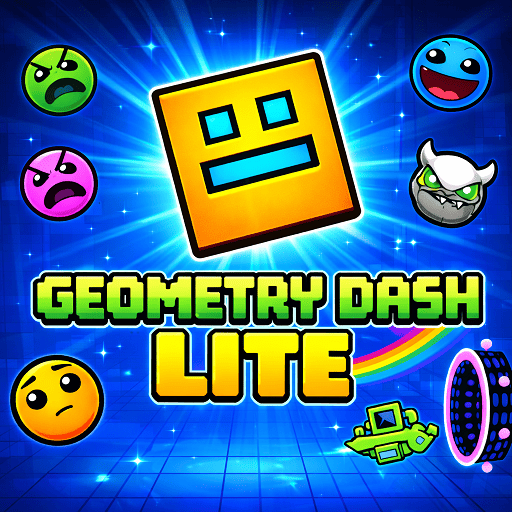
Minimalist platformer design reduces visual clutter so pattern recognition and timing are foregrounded. Simple shapes and contrasting colors make obstacles easy to parse, which shifts the challenge to execution rather than perception. This minimalism is what makes a single mis-timed tap fatal and practice highly repeatable.
SIMPLE checklist: a named framework for players and designers
Use the SIMPLE checklist to evaluate or build sections of a level and to structure practice sessions. SIMPLE stands for:
- Sensing: Are audio and visual cues clear and unambiguous?
- Input Timing: How narrow is the success window for each action?
- Momentum: Does movement feel consistent and learnable?
- Patterns: Are obstacle sequences logical and repeatable?
- Learnability: Does the design allow incremental skill building?
- Execution Feedback: Is failure immediate and informative?
Apply this checklist to a level segment or a daily practice routine to isolate what needs tuning—either for better design or faster skill gains.
Practical scenario: tuning a challenging segment
Example scenario: A creator tests a 10-second gauntlet where the player must jump across a series of three moving spikes timed to a drum beat. Using the SIMPLE checklist reveals that the audio cue is slightly delayed relative to the visual motion (Sensing), and the success window is a single frame (Input Timing). Adjusting the beat alignment to the obstacle start and widening the timing window to 2–3 frames increases fairness while preserving difficulty. Players practicing that segment should isolate the three-jump combo and repeat it in short looped runs until timing becomes automatic.
Practical tips to improve performance or level design
- Break sequences into micro-sections: Practice short chains repeatedly rather than full runs to build muscle memory faster.
- Use audio as a scaffold: Tap along with the beat at slower playback speed (or lower game audio volume and metronome) to internalize timing before restoring normal speed.
- Record runs and inspect consistent failure frames: Video makes it easier to spot whether failures are perception or input-related.
- Balance repetition with rest: Short, frequent practice sessions (10–20 minutes) reduce plateaus and fatigue.
Trade-offs and common mistakes
Trade-offs when designing or tuning difficulty
Making timing windows wider improves accessibility but can reduce the satisfaction of perfect runs. Adding visual indicators helps new players but may clutter the minimalist aesthetic. Designers must choose: prioritize approachability or elite-level challenge. A recommended approach is to layer difficulty—starter sections with forgiving timing that progressively narrow into precision segments.
Common mistakes
- Relying solely on visual cues without matching audio can confuse players who learn by rhythm.
- Overcomplicating patterns: adding too many rule changes in a short span breaks learnability.
- Ignoring immediate feedback: delayed or obscured failure states make it hard to learn from mistakes.
Related concepts, entities, and best practices
Relevant terms include frame-perfect timing, muscle memory, procedural difficulty curve, level pacing, and input latency. Designers and players should consult community and industry resources for best practices; for general game design and accessibility guidance, see the International Game Developers Association resource page: IGDA.
Core cluster questions
- How do simple controls increase difficulty in Geometry Dash?
- What mechanics define Geometry Dash’s challenge curve?
- How can players improve timing and muscle memory for rhythm-based platformers?
- What level design techniques support minimalist platformer design while staying fair?
- How should creators balance predictability and novelty in obstacle sequences?
Final thoughts: why simplicity scales challenge
When control inputs are minimal, every other design decision—timing windows, audio alignment, visual clarity, and level pacing—becomes the lever for difficulty. This focus leads to a high skill ceiling and a rewarding learning loop: repeated failure with immediate feedback reinforces precise timing and pattern recognition. Applying the SIMPLE checklist and the practical tips above helps both players refine performance and designers craft levels that feel fair yet demanding.
FAQ
How do Geometry Dash gameplay mechanics create high difficulty?
Geometry Dash gameplay mechanics create high difficulty through narrow timing windows, audio-synced obstacles, and deterministic physics that expose even tiny input errors. The single-input model magnifies the importance of sequencing and timing rather than complex control schemes.
Can audio cues make levels easier to learn?
Yes. Audio cues support anticipation and chunk sequencing, turning visual patterns into rhythm-based templates. Properly aligned music allows players to predict obstacle timing and reduces cognitive load.
What is a good practice routine for improving precision?
Focus on repeating micro-segments, slow down practice runs if possible, analyze failure frames from recordings, and use short, frequent sessions to build muscle memory without fatigue.
Should designers prioritize minimalism or clarity?
Clarity should be prioritized within minimalism. Minimalist platformer design works best when visual and audio cues are unambiguous. Aim for clean visuals and consistent feedback; add decorative elements only if they do not interfere with obstacle readability.
How can creators test fairness in challenging levels?
Use the SIMPLE checklist to evaluate sensing, input timing, momentum, patterns, learnability, and execution feedback. Playtesting with a range of skill levels and recording runs to inspect failure points will reveal whether challenge is fair or arbitrary.