Gumasta vs Trade License in Raipur: Key Differences, Rules & Requirements
-

- Published Updated
- 52 views
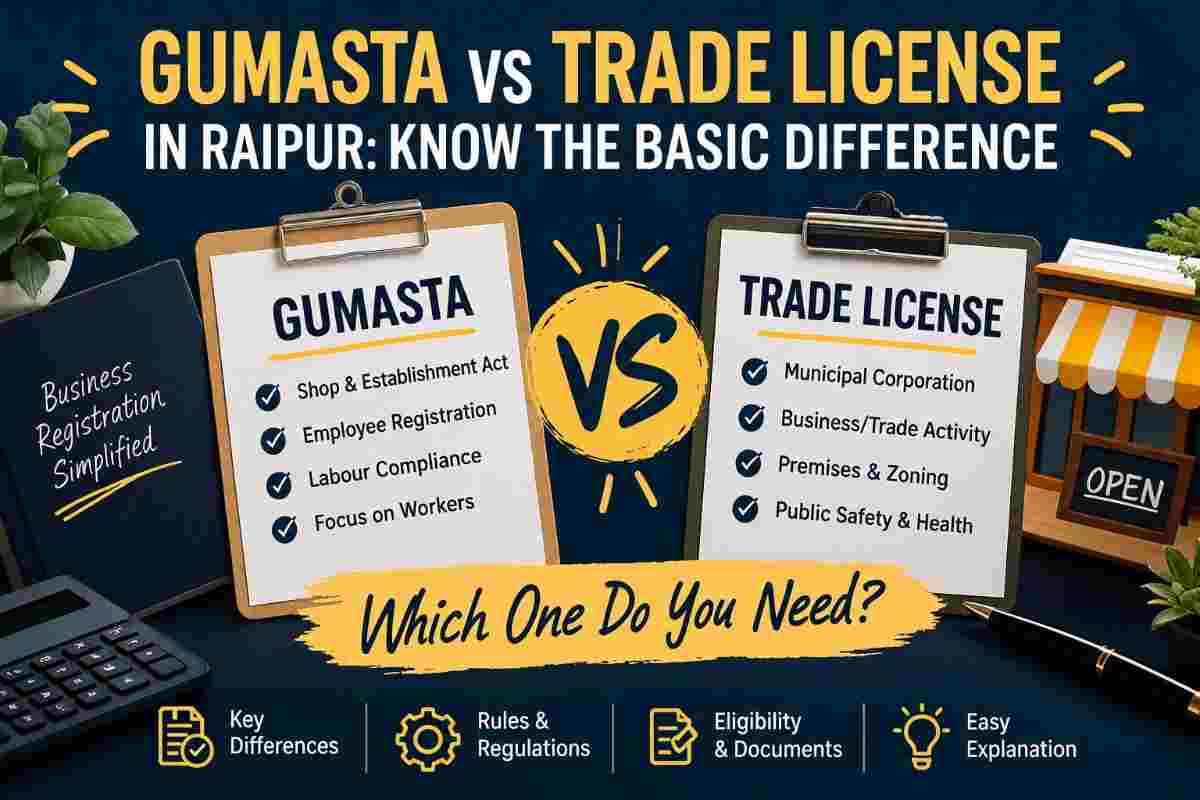
Starting a new business in Raipur involves more than choosing a location and beginning operations. Business owners may need to complete different registrations, licences and approvals depending on the nature of their business, premises and activities. Two terms that are frequently confused are Gumasta Registration and Trade License. Although both are related to business compliance, they serve different purposes and are governed through different regulatory frameworks.
Understanding the difference between Gumasta and Trade License can help entrepreneurs identify the registrations that may apply to their business and avoid treating one approval as a replacement for another.
What Is Gumasta Registration?
In common business terminology, Gumasta generally refers to registration under the Shops and Establishments framework. It is associated with the registration and regulation of shops, commercial establishments and employment-related conditions.
In Chhattisgarh, the government provides an online system for Shops and Establishments registration. The Labour Department's current portal provides registration applications under the Chhattisgarh Shops and Establishments framework.
The main purpose is to establish that a covered shop or establishment is registered and follows applicable requirements concerning employees and workplace operations. Depending on the business, relevant matters can include working conditions, working hours, leave, holidays and other employment-related compliance.
For example, a clothing store, office, salon or other commercial establishment may need to consider the applicable Shops and Establishments requirements.
What Is a Trade License?
A Trade License is different from Gumasta registration. It generally relates to permission from the competent local municipal authority to conduct a particular trade or business activity at a specific premises.
The purpose of municipal trade licensing is to regulate applicable commercial activities from a local perspective, including considerations connected with public health, safety, sanitation and other municipal requirements.
Chhattisgarh's Single Window System separately lists Shop & Establishment License, Trade License and Renewal Trade License as different services, demonstrating that these are separate compliance processes.
For a business operating within the relevant municipal jurisdiction of Raipur, the applicable municipal requirements should therefore be checked based on the exact nature of the business and premises.
Gumasta vs Trade License: Key Difference
The simplest way to understand the difference is:
Gumasta = Registration of the Shop or Establishment
Trade License = Permission for an Applicable Trade or Business Activity
Gumasta primarily focuses on the establishment and employment-related compliance, while a Trade License focuses on whether a particular commercial activity can be conducted under applicable municipal regulations.
They are therefore not automatically interchangeable.
Major Differences
1. Purpose
Gumasta registration is primarily connected with shops, establishments and employment-related requirements. A Trade License is primarily concerned with regulating applicable business or trade activities under municipal rules.
2. Regulatory Authority
Gumasta or Shops and Establishments matters are associated with the Labour Department. Trade License matters are generally handled by the relevant municipal authority.
3. Regulatory Focus
Gumasta focuses more on the establishment and applicable employee-related requirements. Trade License focuses more on the business activity, premises and municipal requirements.
4. Nature of Approval
Gumasta is generally a registration under the applicable Shops and Establishments framework. A Trade License is a licence or permission for an applicable business activity.
5. Applicability
The exact requirement depends on the nature of the establishment, business activity, location and applicable rules. Therefore, business owners should not assume that every business automatically needs the same set of registrations.
Do You Need Both Gumasta and Trade License?
This is one of the most important questions for new business owners.
The answer depends on the business and applicable regulations. In some cases, a business may need Shops and Establishments registration as well as a municipal Trade License. In other cases, the requirements may differ depending on the activity, location and applicable exemptions or rules.
For example, consider a restaurant in Raipur. The owner may have to consider Shops and Establishments compliance for the establishment and employees. At the same time, the restaurant may need to check municipal Trade License requirements applicable to its business activity. It may also need additional approvals such as food-related, fire or other sector-specific permissions.
Similarly, a retail shop should independently check both its establishment-related obligations and whether its particular business activity requires a municipal licence.
Documents Commonly Required
The exact documentation can vary according to the type of registration, business structure and application requirements. Common documents may include:
- PAN card or other identity proof
- Applicant's address proof
- Business address or premises proof
- Rent agreement or ownership documents, where applicable
- Details of the business activity
- Business constitution documents
- Partnership deed, LLP or company documents, where applicable
- Relevant NOCs or supporting licences, if applicable
- Applicant's contact details
Applicants should verify the current document requirements before submitting an application because requirements can change according to applicable rules and the nature of the business.
How the Registration Process Generally Works
A business owner can follow a basic compliance approach:
Step 1: Identify the business activity
Clearly determine what the business does, where it operates and whether employees are involved.
Step 2: Identify applicable registrations
Check whether Shops and Establishments registration, Trade License or both are applicable.
Step 3: Prepare documents
Keep identity, address, premises and business-related documents ready.
Step 4: Apply to the appropriate authority
The relevant Labour and municipal systems are used for their respective registrations and licences. Chhattisgarh provides online government services for Shops and Establishments registration.
Step 5: Complete verification and payment
The application may be reviewed by the concerned authority, and applicable fees or charges may need to be paid.
Step 6: Maintain compliance
After receiving the required registration or licence, the business should keep records updated and monitor renewal or other compliance requirements.
Common Mistakes to Avoid
One of the biggest mistakes is assuming that Gumasta and Trade License are the same document. They generally address different regulatory requirements.
Another common mistake is believing that one registration automatically covers all business compliances. Depending on the business, separate requirements such as GST, FSSAI, fire safety, pollution-related approvals or other sector-specific licences may apply.
Business owners should also avoid using outdated information. Chhattisgarh has introduced updated trade licensing provisions, and current requirements should be checked before making an application.
Why Professional Assistance Can Help
Understanding which registration applies to a business can sometimes be difficult, particularly when several licences and approvals are involved. Professional assistance can help business owners identify applicable requirements, prepare documents correctly and complete the relevant application process.
CorpBuddy provides business and compliance assistance in Raipur, including support related to Trade License requirements and business registrations. The company can help entrepreneurs understand the documentation and application process before submitting their applications.
CorpBuddy
Conclusion
Gumasta and Trade License are important but different aspects of business compliance. Gumasta generally relates to Shop and Establishment registration and employment-related requirements, while a Trade License relates to permission for applicable business activities under municipal regulations.
Neither should automatically be considered a replacement for the other. The correct requirements depend on the business activity, establishment, premises and applicable laws.
If you are starting or operating a business in Raipur and are unsure whether you need Gumasta registration, a Trade License, or both, getting professional guidance can make the process easier and help you approach the correct authority with the required documents.
CorpBuddy Private Limited, Raipur
📞 +91 6261971810
✉️ [email protected]