Healthcare Contract Research Outsourcing Market: Growth Opportunities and Industry Forecast Through 2036
-

- Published Updated
- 61 views
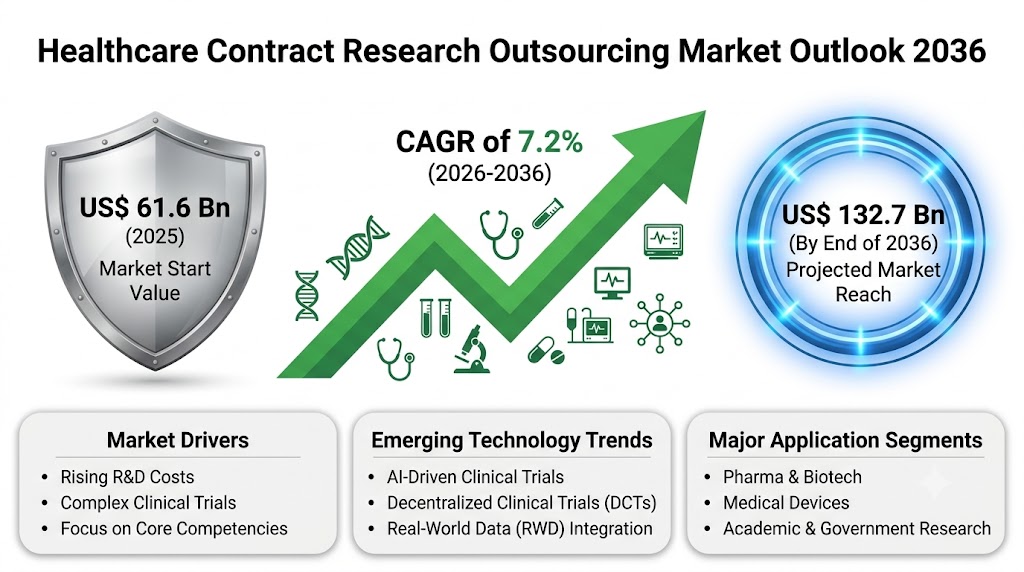
The global Healthcare Contract Research Outsourcing Market was valued at US$ 61.6 billion in 2025 and is projected to reach US$ 132.7 billion by 2036, expanding at a compound annual growth rate (CAGR) of 7.2% from 2026 to 2036. The market is gaining momentum as pharmaceutical, biotechnology, and medical device companies increasingly outsource research and development activities to specialized contract research organizations (CROs). Rising drug development costs, increasingly complex clinical trials, and the need to accelerate time to market are creating strong demand for outsourced research services.
CROs help healthcare companies access specialized scientific expertise, advanced technologies, experienced clinical teams, and established research infrastructure. These capabilities enable sponsors to manage complex development programs while improving operational efficiency. Growing investments in biologics, personalized medicine, cell and gene therapies, and treatments for rare diseases are further expanding the need for specialized research services.
Market Overview
Healthcare contract research outsourcing involves delegating research and development activities to external service providers that support the development, testing, and evaluation of pharmaceutical products, biologics, and medical devices. Services cover several stages of the development process, including early-phase development, preclinical research, clinical trials, regulatory affairs, clinical data management, laboratory testing, toxicology testing, and medical documentation.
Outsourcing enables companies to reduce the need for extensive internal infrastructure and access specialized capabilities according to project requirements. It is particularly valuable for biotechnology startups and smaller pharmaceutical developers that may have limited financial and operational resources.
The market is segmented by type into early-phase development, preclinical research, and clinical research. Clinical research accounted for the largest share of 42.7% in 2025, reflecting the extensive resources and expertise required to conduct clinical trials. Service types include clinical supply and project management, regulatory services, clinical data management and biometrics, medical communications and documentation, consulting, site management, quality assurance, laboratory testing, toxicology testing, and other services.
Key Market Growth Drivers
Increasing Complexity of Clinical Trials
The growing complexity of clinical trials is a major factor supporting market expansion. Modern clinical studies often involve multiple countries, diverse patient populations, strict eligibility criteria, extensive documentation, and sophisticated data management requirements. Trials involving oncology, neurology, immunology, and rare diseases can be particularly challenging because they frequently require specialized protocols and access to specific patient groups.
CROs provide experienced research professionals, established clinical site networks, and dedicated project management capabilities to help sponsors address these requirements. Their expertise can improve trial coordination, support regulatory compliance, and enhance the quality of clinical data.
Digital tools such as electronic data capture, remote monitoring, artificial intelligence-based analytics, and decentralized clinical trial platforms are also improving research operations. These technologies can support patient recruitment, streamline data collection, and provide better visibility into study progress.
Rising Research and Development Investments
Increasing investment in drug discovery, biologics, and advanced therapies is creating additional demand for contract research outsourcing. Innovative treatments often require specialized preclinical testing, safety assessments, biomarker analysis, and carefully designed clinical trials.
Pharmaceutical and biotechnology companies increasingly collaborate with CROs to access the scientific expertise and infrastructure required for these programs. Outsourcing can help companies manage costs, scale research activities, and concentrate internal resources on core innovation priorities.
The expansion of personalized medicine is further increasing the need for patient stratification, molecular testing, and data-intensive clinical research. CROs with specialized capabilities in precision medicine, cell and gene therapies, and complex therapeutic areas may benefit from these evolving requirements.
Emerging Trends and Market Opportunities
Artificial Intelligence and Digital Transformation
Artificial intelligence and digital technologies are becoming important tools in clinical research. AI-enabled analytics can help identify suitable trial participants, analyze large datasets, and support operational planning. Digital platforms can also improve data accessibility and coordination among investigators, sponsors, laboratories, and research teams.
Decentralized and hybrid clinical trials are creating additional opportunities by incorporating telemedicine, remote patient monitoring, electronic consent, and digital engagement tools. These approaches can make participation more convenient for eligible patients and potentially improve recruitment and retention.
CROs that invest in secure and reliable digital platforms may strengthen their competitive position. However, effective implementation requires high-quality data, cybersecurity measures, system validation, and compliance with applicable privacy and regulatory requirements.
Strategic Partnerships Between Pharmaceutical Companies and CROs
Long-term partnerships represent an important growth opportunity for the healthcare contract research outsourcing industry. These collaborations provide pharmaceutical and biotechnology companies with continuing access to specialized research services while allowing CROs to understand their clients' development pipelines and operational priorities.
Strategic partnerships can improve planning, streamline workflows, reduce administrative complexity, and support more consistent resource allocation. They may also encourage the adoption of integrated data management systems and advanced clinical trial technologies.
For CROs, long-term contracts can provide greater demand visibility and support investment in specialized facilities, technology platforms, and skilled personnel. Providers that deliver consistent quality, transparent reporting, and reliable project execution may be better positioned to secure repeat business.
Expansion in Emerging Markets
Emerging markets offer opportunities through growing healthcare infrastructure, skilled scientific workforces, and access to diverse patient populations. Countries such as India and China are attracting attention as sponsors seek to expand clinical research networks and improve operational flexibility.
CROs can capitalize on these opportunities by developing local partnerships, strengthening clinical site networks, and investing in regulatory expertise. However, successful expansion requires adherence to local regulations, ethical research standards, data protection requirements, and internationally accepted quality practices.
Regional Market Outlook
North America dominated the Healthcare Contract Research Outsourcing Market in 2025, accounting for 41.6% of global revenue. Its leadership is supported by a strong pharmaceutical and biotechnology sector, advanced research infrastructure, extensive clinical trial activity, and substantial investment in drug development.
The United States is a major center for outsourced research services, supported by pharmaceutical companies, medical device manufacturers, academic institutions, and established CROs. Demand for clinical research in oncology, cardiovascular diseases, neurology, and rare diseases contributes to the region's strong market position.
Europe remains an important market because of its established pharmaceutical industry, scientific research capabilities, and demand for specialized clinical and regulatory services. Meanwhile, Asia Pacific offers significant growth potential as clinical research infrastructure expands and international sponsors seek access to additional patient populations.
Latin America and the Middle East and Africa also present opportunities as healthcare systems and research capabilities develop. Continued investment in infrastructure, professional training, and regulatory systems will be important for expanding outsourcing activity across these regions.
Competitive Landscape and Key Players
The healthcare contract research outsourcing industry includes global service providers and specialized research organizations competing through scientific expertise, geographic reach, service quality, and technological innovation.
Major companies include IQVIA Inc., Allucent, Charles River Laboratories, Parexel, ICON, Medpace Inc., Thermo Fisher Scientific Inc., SGS Société Générale de Surveillance SA, WuXi AppTec, Pharmaron, Aragen Life Sciences Ltd., Ergomed Group, TFS HealthScience, and CTI Clinical Trial & Consulting.
Market participants are focusing on strategic collaborations, digital technology investments, service portfolio expansion, and specialized capabilities in complex therapeutic areas. Companies are also strengthening clinical data management, patient recruitment, laboratory testing, and regulatory support to deliver more integrated research solutions.
Providers that combine advanced technology with strong compliance practices and reliable project management are likely to be well positioned to capture future opportunities.
Market Challenges and Investment Outlook
Despite strong growth prospects, the market faces challenges involving data privacy, intellectual property protection, regulatory differences, vendor dependency, and inconsistent service delivery. Clinical trial delays, recruitment difficulties, and complex approval processes can also increase project costs and affect development timelines.
Sponsors must carefully evaluate CRO partners based on scientific capabilities, quality systems, data security, regulatory experience, and operational transparency. Service providers must continually invest in skilled personnel, validated technology platforms, and robust compliance processes.
Investment opportunities are emerging in clinical data management, biometrics, laboratory testing, toxicology, regulatory consulting, decentralized clinical trials, and research supporting advanced therapies. AI-enabled research tools and specialized services for rare diseases and personalized medicine may offer additional growth potential.