Healthcare IT Market Outlook, Key Trends, Growth Catalysts, and Emerging Opportunities
-
- Published Updated
- 6,481 views
Healthcare IT Market Size
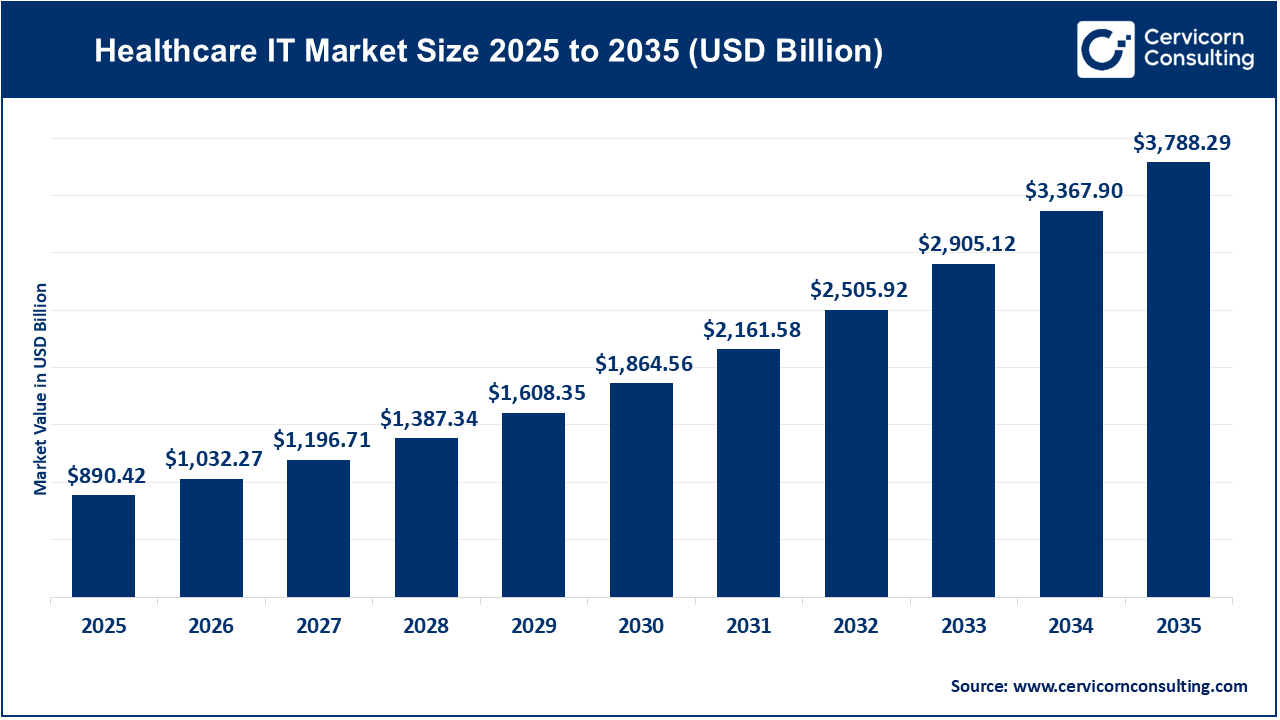
The global Healthcare IT Market was valued at approximately USD 890.42 billion in 2025 and is expected to reach nearly USD 3,788.29 billion by 2035, registering a robust CAGR of 15.58% between 2026 and 2035. Market growth is being fueled by the rapid digital transformation of healthcare systems, increasing adoption of advanced technologies, growing reliance on data-driven clinical decision-making, and the expansion of integrated healthcare ecosystems across the world.
Read a Full Report: https://www.cervicornconsulting.com/healthcare-it-market
Understanding the Healthcare IT Market
The healthcare IT market encompasses a diverse range of technologies and digital solutions designed to enhance healthcare delivery, administrative operations, and clinical efficiency. It includes software platforms, hardware systems, cloud infrastructure, networking technologies, analytics tools, and digital healthcare services that support providers in delivering high-quality patient care.
Core segments within the market include electronic health records (EHRs), telehealth and virtual care platforms, healthcare analytics solutions, hospital information systems, revenue cycle management software, clinical decision support tools, patient engagement applications, cybersecurity platforms, and artificial intelligence-powered healthcare technologies.
As hospitals, healthcare providers, insurers, pharmaceutical companies, and government agencies accelerate their digital transformation initiatives, healthcare IT has become a vital pillar supporting operational excellence, patient-centered care, clinical innovation, and healthcare modernization.
Key Drivers Accelerating Healthcare IT Market Growth
Several factors are contributing to the rapid expansion of the healthcare IT industry. Widespread adoption of electronic health records and increasing utilization of telemedicine and remote patient monitoring technologies continue to be major growth drivers. Healthcare organizations are also integrating artificial intelligence and machine learning into clinical workflows and administrative functions to improve productivity and patient outcomes.
Additionally, the exponential growth of healthcare data is increasing demand for sophisticated analytics platforms capable of supporting real-time decision-making. Other significant contributors include rising healthcare expenditures, increasing focus on personalized healthcare delivery, broader adoption of cloud-based healthcare infrastructure, growing cybersecurity requirements, demand for seamless interoperability among healthcare systems, government-backed digital health programs, expansion of mobile health applications, and substantial investments in healthcare infrastructure modernization across both developed and emerging economies.
Importance of Healthcare IT in Today's Healthcare Environment
Healthcare IT has become indispensable to modern healthcare systems by improving patient outcomes, streamlining operations, and helping organizations control costs. Digital healthcare solutions enable healthcare professionals to access patient records instantly, minimize medical errors, support evidence-based clinical decisions, and improve communication among multidisciplinary care teams.
Beyond direct patient care, healthcare IT plays a crucial role in population health management. Advanced analytics, predictive modeling, and AI-powered tools help healthcare organizations identify disease trends, assess patient risks, and implement preventive care initiatives more effectively.
Healthcare IT also improves access to healthcare services through telemedicine and remote monitoring technologies, particularly in rural and underserved communities. Its importance became especially evident during the COVID-19 pandemic, when virtual care solutions enabled healthcare providers to maintain continuity of care while limiting physical interactions.
Get a Free Sample Report: https://www.cervicornconsulting.com/sample/2592
Major Participants in the Healthcare IT Market
| Company | Core Competency | Strategic Focus Areas | Key Differentiators | 2025 Revenue | Market Position | Global Reach |
|---|---|---|---|---|---|---|
| Accenture | Healthcare consulting and digital transformation | AI, analytics, cloud healthcare, interoperability | Extensive digital transformation expertise | Approx. USD 69.7 Billion | Leading healthcare IT services provider | 120+ countries |
| Agfa-Gevaert Group | Healthcare imaging and information management | Enterprise imaging and hospital IT solutions | Advanced imaging informatics portfolio | Approx. €1.09 Billion | Strong imaging IT specialist | Worldwide operations |
| Athenahealth, Inc. | Cloud-based EHR and practice management | Revenue cycle management, patient engagement, EHRs | Cloud-native healthcare ecosystem | Estimated above USD 2 Billion | Strong ambulatory care provider | Primarily North America |
| Carestream Health | Medical imaging and healthcare software | Digital radiology and imaging workflow optimization | Comprehensive imaging technology portfolio | Privately held | Established imaging solutions provider | Presence in 150+ countries |
| eMDs, Inc. | Ambulatory healthcare software solutions | Practice management and clinical documentation | Physician-centric healthcare technologies | Privately held | Specialized healthcare IT vendor | North America |
Company Profiles
Accenture
Accenture continues to be a dominant force in healthcare consulting and technology services. The company assists healthcare providers, payers, and life sciences organizations in adopting cloud technologies, artificial intelligence, analytics, cybersecurity solutions, and large-scale digital transformation initiatives. Continuous investments in AI-powered healthcare capabilities have strengthened its leadership position within the healthcare IT sector.
Agfa-Gevaert Group
Agfa-Gevaert has established itself as a recognized provider of enterprise imaging solutions, radiology information systems, and healthcare information management technologies. The company continues to enhance its healthcare IT portfolio through investments in cloud-enabled imaging platforms and interoperability solutions.
Athenahealth
Athenahealth is a leading provider of cloud-based EHR systems, patient engagement technologies, and revenue cycle management solutions. Its software-as-a-service (SaaS) model enables healthcare organizations to streamline workflows, improve operational efficiency, and enhance patient experiences.
Carestream Health
Carestream Health specializes in advanced medical imaging systems, enterprise imaging platforms, and healthcare workflow technologies. Its innovative diagnostic imaging software and digital radiography solutions support healthcare providers across global markets.
eMDs, Inc.
eMDs focuses on ambulatory healthcare software, delivering EHR solutions, revenue cycle management tools, and practice management applications tailored to physician practices and outpatient healthcare facilities.
Major Trends Reshaping the Healthcare IT Industry
Artificial Intelligence and Machine Learning Integration
Artificial intelligence is rapidly transforming healthcare by enabling predictive diagnostics, automated clinical documentation, workflow automation, and personalized treatment planning. AI-driven platforms analyze vast volumes of healthcare data to generate valuable clinical insights, improving diagnostic accuracy and treatment effectiveness.
Impact
Accelerated diagnosis and treatment planning
Improved clinical decision-making
Reduced administrative burden
Enhanced patient outcomes
Expansion of Telehealth and Virtual Care
Telehealth has evolved into a mainstream healthcare delivery model. Virtual consultations, remote monitoring technologies, and digital engagement platforms allow healthcare providers to deliver services beyond traditional healthcare facilities.
Impact
Improved healthcare accessibility
Enhanced chronic disease management
Lower hospitalization rates
Reduced healthcare delivery costs
Growth of Cloud-Based Healthcare Infrastructure
Healthcare organizations are increasingly transitioning to cloud environments to improve scalability, flexibility, interoperability, and accessibility. Cloud platforms support more efficient data management and accelerate the deployment of digital health applications.
Impact
Reduced infrastructure expenditures
Improved information accessibility
Enhanced disaster recovery capabilities
Faster technology implementation
Rising Investments in Healthcare Cybersecurity
As healthcare systems become increasingly digitized, safeguarding patient information has become a strategic priority. Healthcare organizations are investing heavily in cybersecurity technologies to protect sensitive data and ensure compliance with regulatory requirements.
Impact
Stronger data protection measures
Improved regulatory compliance
Increased patient confidence
Lower cybersecurity risks
Interoperability and Health Information Exchange
Healthcare organizations are prioritizing interoperability standards to enable seamless and secure sharing of healthcare information among hospitals, laboratories, pharmacies, insurers, and public health agencies.
Impact
Better care coordination
Improved patient experiences
Reduced duplicate testing and procedures
Enhanced population health management
Successful Healthcare IT Deployments Around the World
Estonia's National Digital Health Platform
Estonia has developed one of the world's most advanced digital healthcare ecosystems, where nearly all patient records are digitized and accessible through a secure national infrastructure supported by blockchain-enabled security technologies.
Key Results
Near-universal EHR adoption
Streamlined healthcare administration
Strong patient data protection
NHS Digital Transformation – United Kingdom
The UK's National Health Service has implemented extensive digital healthcare initiatives, including electronic prescribing, telemedicine services, and integrated patient record systems.
Key Results
Reduced administrative costs
Improved care coordination
Expanded healthcare accessibility
Singapore's National Electronic Health Record System
Singapore has established a nationwide electronic health record platform connecting hospitals, clinics, and healthcare providers through an integrated digital framework.
Key Results
Seamless information exchange
Better clinical decision-making
Enhanced healthcare efficiency
Telehealth Expansion Across the United States
The widespread adoption of telemedicine services in the United States has transformed healthcare delivery, especially following the pandemic-driven acceleration of virtual care.
Key Results
Increased healthcare access
Higher patient engagement
Improved chronic disease management
Ayushman Bharat Digital Mission (ABDM) – India
India's ABDM initiative aims to build a connected national digital health ecosystem through unique health IDs, interoperable health records, and integrated healthcare services.
Key Results
Improved healthcare accessibility
Digitized patient health records
Greater healthcare transparency
Regional Market Overview
North America
North America remains the largest healthcare IT market, supported by advanced healthcare infrastructure, substantial healthcare spending, and high adoption of digital technologies.
Key Growth Drivers
Strong EHR adoption rates
Advanced AI implementation
Significant healthcare IT investments
Supportive regulatory environment
Government Initiatives
HITECH Act
CMS interoperability mandates
Federal EHR incentive programs
Expanded telehealth reimbursement policies
Europe
Europe continues to represent a mature healthcare IT market supported by comprehensive healthcare systems, ongoing digital transformation efforts, and stringent regulatory standards.
Government Programs
European Health Data Space (EHDS)
Digital Europe Programme
AI Act implementation
GDPR-based healthcare data governance
Asia-Pacific
Asia-Pacific is expected to register the fastest market growth due to healthcare modernization initiatives, expanding healthcare expenditures, and increased investment in digital health technologies.
Government Programs
Healthy China 2030
Ayushman Bharat Digital Mission
Japan's Society 5.0 healthcare initiatives
Australia's My Health Record Program
Latin America
Healthcare IT adoption is increasing across Latin America as governments and private healthcare providers invest in healthcare modernization, digitization, and health information systems.
Middle East & Africa
The Middle East and Africa region is emerging as a promising healthcare IT market, driven by healthcare infrastructure development and government-led digital transformation strategies.
Government Programs
Saudi Vision 2030 healthcare initiatives
UAE smart healthcare strategies
South Africa's National Digital Health Strategy
Future Outlook
The healthcare IT market is expected to maintain strong momentum throughout the forecast period as healthcare organizations increasingly leverage digital technologies to improve efficiency, enhance patient outcomes, and reduce operational costs. Innovations in artificial intelligence, blockchain, cloud computing, predictive analytics, precision medicine, and digital therapeutics are expected to transform the healthcare technology landscape.
Ongoing government support for healthcare digitization, combined with rising demand for connected healthcare ecosystems, will continue to create substantial opportunities for healthcare IT vendors and healthcare organizations worldwide.
For Detailed Market Insights and Customized Research Services: https://www.cervicornconsulting.com/contact-us