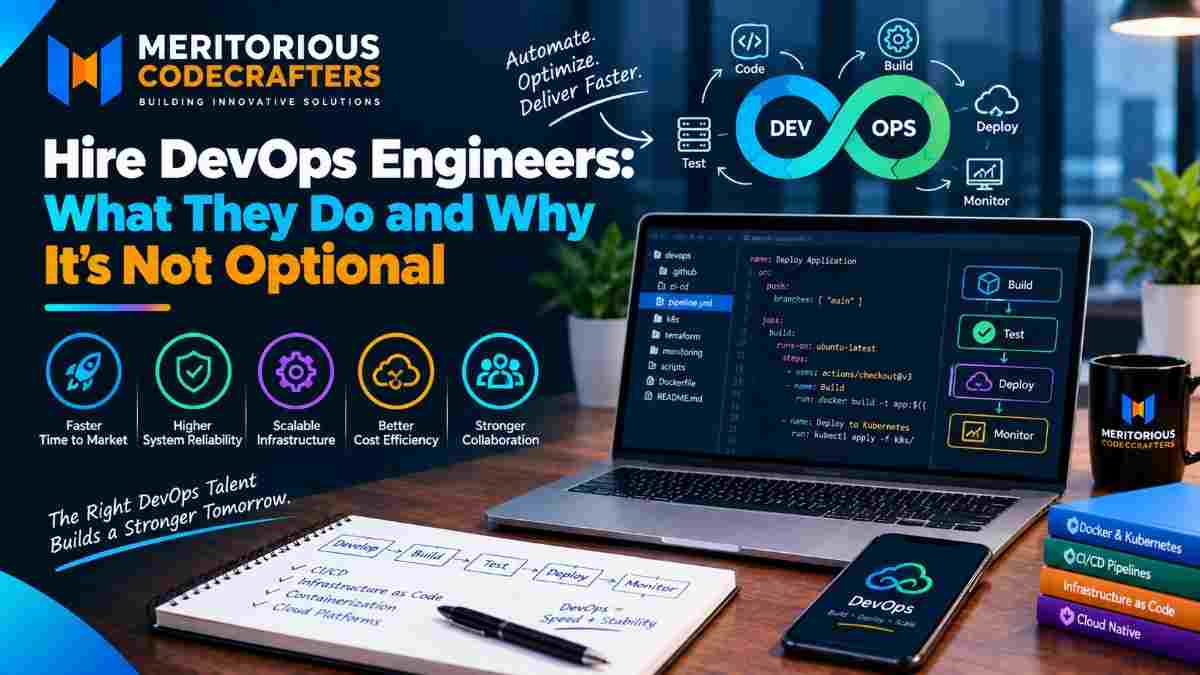
Hire DevOps Engineers: What They Do and Why It's Not Optional
-

- September 23rd, 2026
- 87 views
Quick answer: Businesses hire DevOps engineers to automate deployments, manage infrastructure, and catch problems (downtime, security gaps, scaling failures) before they reach users. DevOps failures tend to stay invisible until a deployment breaks in production, at which point the cost — in downtime, lost revenue, and engineering time — is significantly higher than the cost of preventing it in the first place.
What Does a DevOps Engineer Actually Do?
Function |
What It Covers |
What Happens Without It |
CI/CD pipelines |
Automated testing and deployment of code changes |
Manual, error-prone deployments |
Infrastructure management |
Provisioning and maintaining servers and cloud resources |
Undocumented, inconsistent setups |
Monitoring and alerting |
Detecting issues before users report them |
Problems discovered via customer complaints |
Security and compliance |
Configuring infrastructure securely, maintaining posture |
Misconfigurations going unnoticed until exploited |
Scalability planning |
Infrastructure that handles growth automatically |
Manual scrambling during traffic spikes |
Why Can't Developers Just Handle Deployment Themselves?
Manual deployment processes work for small, low-stakes applications but don't scale reliably. As an application grows, the person who understands the infrastructure best is usually also the person busiest building features — and manual pushes without automated testing or rollback plans tend to fail at inconvenient times, turning a routine deployment into an emergency incident.
How Much Does Downtime Actually Cost a Business?
Downtime cost scales with how dependent the business is on the application being available:
- E-commerce: direct lost sales for every hour offline
- SaaS products: eroded customer trust that takes longer to rebuild than the outage itself lasted
- Any business: engineering time spent firefighting instead of shipping new features
Proper DevOps practice — automated deployments, monitoring, and a tested rollback strategy — doesn't eliminate every incident, but it reduces both the frequency and severity of outages, and shortens recovery time when something does go wrong.
Is DevOps the Same as QA?
No. QA and DevOps solve related but different problems. Hire QA Engineers covers verifying that an application's logic actually works as intended before release. DevOps covers what happens to that verified code afterward — deployment, infrastructure health, and how fast problems get detected and resolved. A well-tested application can still go down due to a bad deployment or infrastructure failure unrelated to code correctness, which is why both functions matter independently.
What Does Good DevOps Practice Actually Look Like?
- Automated CI/CD pipelines testing every code change before production
- Infrastructure as code — version-controlled, reproducible server and cloud configuration
- Proactive monitoring and alerting that flags problems before users notice
- A tested rollback strategy for reversing bad deployments quickly
- Scalability planning built in from the start, not scrambled together during a traffic spike
When Should a Business Bring in DevOps Support?
DevOps works best integrated closely with development from early on, not added after an application is already struggling in production. It's especially valuable for teams that Hire Full-Stack Developers to move quickly across frontend and backend, since fast-moving teams need infrastructure and deployment processes that keep pace without becoming the bottleneck. The same applies to teams using broader Web & CMS Development Services, where infrastructure needs to match how the site is actually built — CMS-driven or custom.
What Should a Business Check Before Hiring a DevOps Engineer?
- Real experience with CI/CD tooling relevant to the project's stack
- Comfort with cloud infrastructure (AWS, GCP, or Azure) and infrastructure-as-code practices
- A track record of reducing downtime or deployment incidents, not just maintaining existing systems
- Security built into infrastructure decisions from the start, not treated as a separate later concern
- Clear communication and close collaboration with the development team
Frequently Asked Questions
What's the difference between DevOps and QA? QA verifies that an application's code works correctly before release. DevOps manages what happens after — how code gets deployed, how infrastructure stays healthy, and how quickly issues are detected and resolved. Both are needed; neither replaces the other.
Why do startups often skip dedicated DevOps early on? Manual deployment processes work fine at small scale, so the cost of skipping DevOps stays invisible until a deployment fails or traffic grows beyond what manual processes can handle — at which point the cost of not having it becomes very visible, very quickly.
How much does downtime cost a business? It varies by business model, but downtime typically costs direct revenue (for e-commerce and transactional platforms), customer trust (for SaaS products), and engineering time diverted from building new features toward firefighting.
What is CI/CD and why does it matter? CI/CD (Continuous Integration/Continuous Deployment) is an automated system for testing and deploying code changes reliably. It replaces manual deployment processes that are more prone to error and harder to roll back when something goes wrong.
Does a small startup need a dedicated DevOps engineer? Not always immediately, but the need typically arrives sooner than expected — as soon as manual deployment processes start causing incidents or the team can't reliably scale infrastructure to match growing traffic.
The Bottom Line
DevOps failures are expensive because they stay invisible until they aren't — a business can run for months on manual, informal processes before one bad deployment or infrastructure failure causes real, visible damage. Investing in dedicated DevOps practice before that happens is consistently cheaper than the alternative.
For businesses that want to build reliable deployment and infrastructure practices proactively, working with a team like Meritorious CodeCrafter to hire DevOps engineers is a practical way to prevent an incident rather than react to one.