Homework Help UK for Improving Academic Writing and Presentation
-

- Published Updated
- 39 views
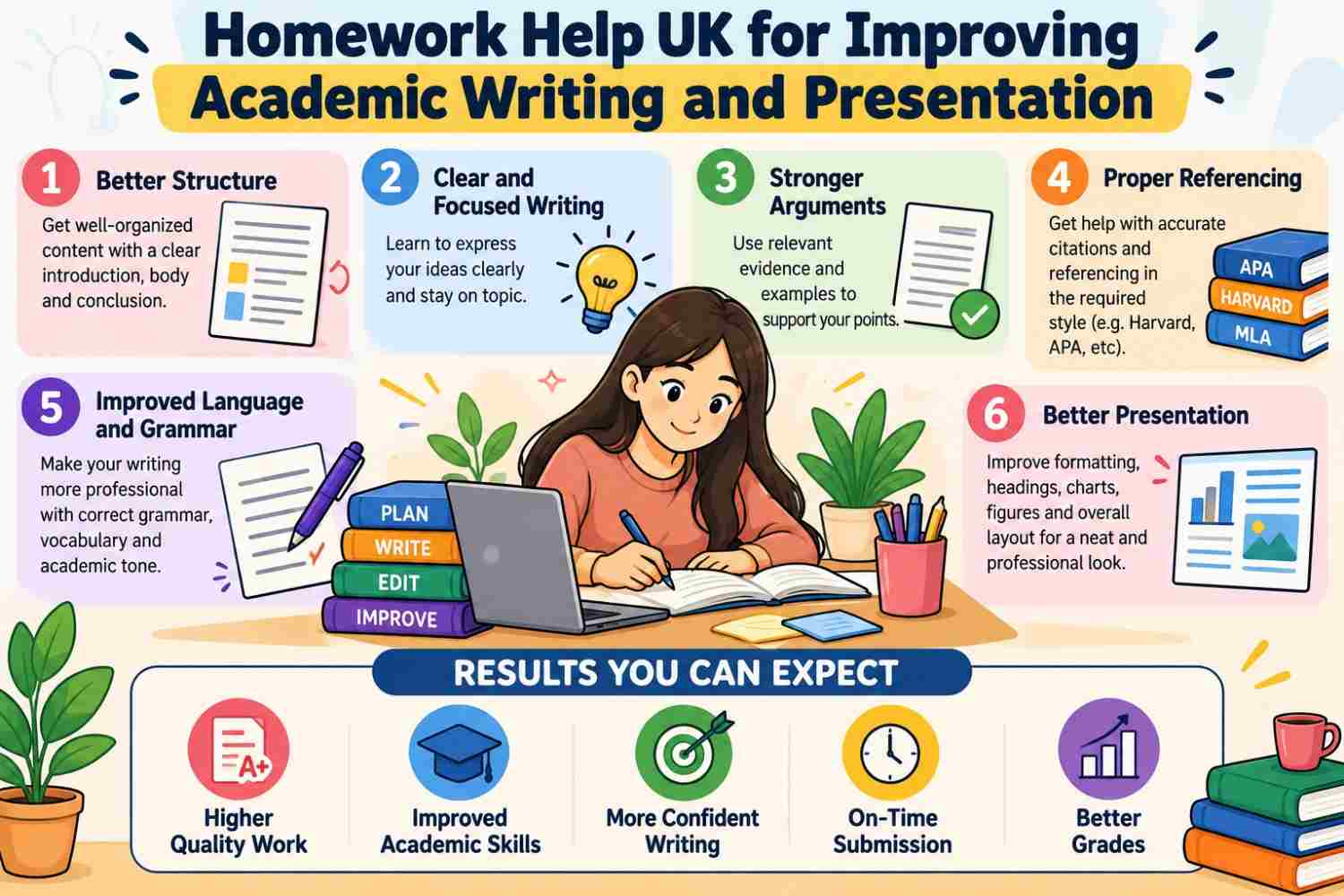
Academic writing requires more than correct grammar. Students also need to present their ideas in a clear structure, use appropriate evidence, maintain a suitable academic tone, and make sure every section connects with the assignment question. These requirements can become difficult when students are managing several subjects and deadlines at the same time.
Homework Help UK provides support with academic writing, editing, proofreading, structure, research, and referencing for students working on different types of university assignments. The support can focus on a complete assignment or specific areas that need more attention.
Clear Ideas Before Complex Language
Academic writing does not need unnecessarily complicated vocabulary. A clear explanation is often more effective than a sentence filled with difficult words. Students should focus on communicating their ideas accurately and directly.
Using simple language does not mean making the writing less academic. The goal is to explain concepts clearly while using subject-specific terminology where it is appropriate.
For example, instead of adding several difficult words to one sentence, students can use shorter sentences that explain the same idea more clearly. This can make the overall discussion easier for the reader to follow.
Stronger Sentence Structure
Long or complicated sentences can make an argument difficult to understand. During editing, students can divide lengthy sentences and remove unnecessary wording.
Sentence structure also affects the flow of an assignment. If every sentence follows the same pattern, the writing may feel repetitive. Combining different sentence lengths can create a more natural academic style.
Students should also look for incomplete sentences, unnecessary phrases, repeated words, and unclear references. Small improvements across the document can make the writing much easier to read.
A Consistent Academic Tone
University writing generally requires a formal and appropriate tone. Students should review informal expressions, conversational wording, vague statements, and language that may not suit an academic assignment.
The exact expectations may vary between subjects and courses, so students should follow their academic guidelines.
A suitable academic tone should also remain consistent throughout the assignment. Switching between formal academic language and casual expressions can make the writing feel uneven.
Homework Help UK can provide guidance with wording, sentence structure, and academic tone while students work on their existing assignments.
Better Paragraph Organisation
Paragraphs should have a clear purpose. When several unrelated ideas appear in the same paragraph, the discussion can become difficult to follow.
A focused paragraph can begin with a main idea, followed by supporting evidence and an explanation. The final part can connect the discussion to the wider argument when appropriate.
Students should also avoid making every paragraph unnecessarily long. If a paragraph contains several different ideas, separating them can improve both structure and readability.
Good paragraph organisation helps readers understand the direction of the discussion without having to search for the main point.
Smooth Connections Between Sections
An assignment should feel like one connected piece of writing rather than a collection of unrelated paragraphs.
Students can improve connections by making sure each section follows logically from the previous one. Headings can also help organise longer assignments by showing the reader what each section covers.
Transitions should support the relationship between ideas rather than simply being added to make the writing appear more academic.
For example, a section discussing a theory may naturally lead into a section examining its practical application. Making this relationship clear helps the assignment maintain a logical flow.
Evidence and Explanation
Academic claims often need supporting evidence. However, evidence should be explained rather than simply inserted into the assignment.
Students should show how the source relates to the point being discussed. A quotation or research finding becomes more useful when the writer explains its relevance to the argument.
A useful academic paragraph may contain a claim, supporting evidence, explanation, and a connection to the wider discussion.
This approach prevents assignments from becoming a collection of quotations and summaries. It also gives students more space to demonstrate their own understanding of the topic.
Research and Source Selection
Good academic writing usually depends on good research. Students may need to use books, journal articles, research papers, university resources, and other suitable academic sources.
However, finding a large number of sources is not the main goal. Students should focus on sources that are relevant to the assignment and appropriate for their subject.
Research should also be organised before the writing stage. Keeping notes under separate topics can make it easier to find evidence later.
Homework Help UK can provide guidance with research planning, source organisation, academic writing, and referencing.
Developing a Clear Argument
An assignment should have a clear direction. Students need to understand the main question and make sure their discussion remains connected to it.
A strong argument does not mean making unsupported claims. Instead, students can use relevant evidence, compare different viewpoints, explain their reasoning, and connect each section to the central topic.
During the editing stage, students can ask whether each major paragraph contributes something useful to the overall discussion. Information that does not support the assignment may need to be shortened or removed.
Avoiding Repetition
Repetition is common in academic writing, especially when students are trying to meet a specific word count.
Repeating the same idea with slightly different wording does not necessarily improve an assignment. It can make the discussion feel longer without adding useful information.
Students should review repeated explanations, similar examples, and points that appear in several sections. Removing unnecessary repetition can make room for more relevant analysis and evidence.
Editing Existing Work
Students often discover writing problems after completing their first draft. Editing provides an opportunity to improve sentence structure, remove repetition, strengthen explanations, and correct unclear wording.
Editing should focus on the content as well as the language. Students can check whether their arguments are developed properly, whether sections are in the right order, and whether the evidence supports the discussion.
Homework Help UK can provide guidance during this stage without requiring students to start their work again. Reviewing an existing draft can often be more useful than immediately rewriting everything from the beginning.
Proofreading for Language Errors
Proofreading is different from general editing. Editing focuses on improving ideas, structure, and clarity, while proofreading looks more closely at smaller language and presentation issues.
Students can check for:
- Spelling mistakes
- Grammar errors
- Punctuation problems
- Repeated words
- Missing words
- Incorrect capitalisation
- Inconsistent formatting
- Unclear sentences
Reading the document slowly can help students notice errors that are easy to overlook during normal reading.
Referencing and Citations
Referencing is an important part of academic presentation. Students should give appropriate credit to the sources they use and follow the referencing system required by their university or course.
Common referencing systems include Harvard, APA, MLA, and other styles. Requirements can vary, so students should check their course guidelines rather than assuming that one format applies everywhere.
A final reference check should compare in-text citations with the reference list. Students can also check whether the formatting is consistent throughout the document.
Improving the Introduction
The introduction gives readers their first understanding of the assignment. It should establish the topic and provide a clear sense of the discussion that follows.
A useful introduction does not need to explain every detail. It should provide enough context and establish the direction of the assignment.
Students can review their introduction after completing the main body. This makes it easier to ensure that the opening accurately reflects what the assignment actually discusses.
Strengthening the Conclusion
The conclusion should bring the main discussion together. It can summarise the key points and present the overall outcome of the discussion.
Students should avoid adding completely new arguments or evidence in the conclusion unless the assignment requirements specifically call for it.
A well-structured conclusion gives the reader a clear sense of closure and connects back to the main purpose of the assignment.
Final Presentation Checks
Before submission, students should check headings, spacing, citations, references, formatting, spelling, and grammar.
A final review can also confirm that the assignment follows the instructions provided by the university. Students should check the required word count, file format, submission method, and any specific formatting requirements.
It is useful to leave some time between finishing the draft and completing the final review. A short break can make it easier to notice problems that were missed during the writing process.
Support for Different Academic Subjects
Academic writing requirements can differ between subjects. An English Literature assignment may focus heavily on textual analysis, while a business assignment may require case studies, data, and theoretical discussion.
Similarly, science and technical subjects may require specific methods, evidence, calculations, or reporting formats.
Homework Help UK provides flexible academic support across different subjects and assignment types. Students can seek guidance based on their academic level, subject requirements, and the areas where they need additional support.
Building Better Writing Habits
Improving academic writing is not only about correcting one assignment. Students can also use each writing project as an opportunity to develop better habits.
Keeping organised research notes, planning before writing, reviewing paragraphs, checking references, and proofreading carefully can become part of a regular academic routine.
Over time, these habits can make the writing process more structured and reduce the amount of last-minute editing required.
Final Thoughts
Strong academic presentation comes from clear ideas, organised paragraphs, suitable evidence, careful language, accurate referencing, and thorough editing. Grammar is important, but it is only one part of effective academic writing.
Students should also focus on answering the assignment question, developing their arguments, connecting evidence with ideas, and presenting information in a logical order.
Homework Help UK provides flexible academic support for students who want guidance with improving their written assignments and presenting their ideas more clearly. Support can cover research, planning, academic writing, editing, proofreading, structure, and referencing, allowing students to focus on the areas that require the most attention while following their university's academic requirements.