In-Store Retail Media in India: Advertising Robots vs Fixed Screens
-

- Published Updated
- 78 views
Blog Summary
In-store retail media in India is creating opportunities for autonomous advertising robots in retail. This blog explores how advertising robots compare with fixed digital screens, their applications in retail stores, and how retailers can use robotic advertising to improve promotional reach, assist shoppers, measure interactions, and develop advertising revenue streams. By bringing promotions directly to shoppers across different store locations, advertising robots also help brands reach audiences that traditional advertising channels may have missed.
Key Takeaways
- Autonomous advertising robots combine digital advertising, intelligent navigation, and shopper assistance in one platform.
- Fixed digital screens deliver campaigns at permanent locations, while advertising robots can move through multiple store zones.
- Advertising robots offer interactive promotions, wayfinding, and centralized campaign management.
- Robotic advertising can create additional retail media inventory for brands without installing permanent screens across every aisle.
- Retailers should measure advertising performance through impressions, shopper interactions, QR scans, and sales attribution.
- Hypermarkets can combine fixed signage with autonomous advertising robots to support different advertising objectives.
Introduction
Supermarkets invest heavily in attracting shoppers, yet brands face a persistent challenge once customers enter the store: reaching them at the right moment. A digital advertisement displayed near the entrance may capture attention, but its influence becomes limited as shoppers move between aisles, explore products, and make purchasing decisions.
This creates an important opportunity for in-store retail media in India, where retailers are exploring ways to connect advertising with actual shopper movement rather than relying entirely on fixed display locations. Autonomous advertising robots offer a different approach. Equipped with interactive displays and intelligent navigation, these robots can move across mapped shopping areas, present promotional campaigns, and assist customers in finding departments or destinations.
For supermarkets, hypermarkets, and consumer brands, robotic advertising introduces possibilities beyond traditional digital signage. It brings together advertising mobility, customer engagement, and shopper assistance within a single platform.
How Is India's Growing Digital Advertising Market Shaping In-Store Retail Media?
In-store retail media allows retailers to generate advertising revenue from their physical shopping environments. Brands can promote products through digital displays, sponsored placements, interactive kiosks, and emerging robotic advertising platforms.
The broader advertising industry provides a useful indication of market direction.
According to the 2026 FICCI-EY Media and Entertainment Report, India's digital advertising revenue reached INR 947 billion in 2025, accounting for 63% of total advertising revenue. The report projects India's overall media and entertainment sector to reach INR 3.3 trillion by 2028.
These figures describe the broader advertising market rather than advertising robots specifically. However, growing investment in digital advertising provides relevant context for retailers evaluating new media formats.
For 2026 and 2027, supermarkets can consider whether autonomous robotics could make existing advertising inventory more flexible and interactive.
Companies such as Kody Robots, an AI robotics company in India, are developing autonomous systems for advertising, navigation, and visitor assistance across commercial environments.
How Do Fixed Digital Screens Advertise Products Inside Supermarkets?
Fixed digital screens display promotional content at permanent locations, including entrances, checkout counters, product aisles, and promotional sections.
For digital advertising in supermarkets, fixed signage offers consistent placement and straightforward content scheduling.
However, fixed advertising has limitations:
- Advertisements reach shoppers who enter the screen's viewing area.
- Campaign placement remains unchanged unless equipment is relocated.
- Traditional digital displays can show store maps and product locations, but they cannot physically guide shoppers to the advertised products.
- Installing screens across additional aisles requires more physical infrastructure.
Fixed screens remain valuable for predictable customer touchpoints. Their limitations become more noticeable in large supermarkets with multiple shopping routes.
How Are Advertising Robots Different From Fixed Digital Screens?
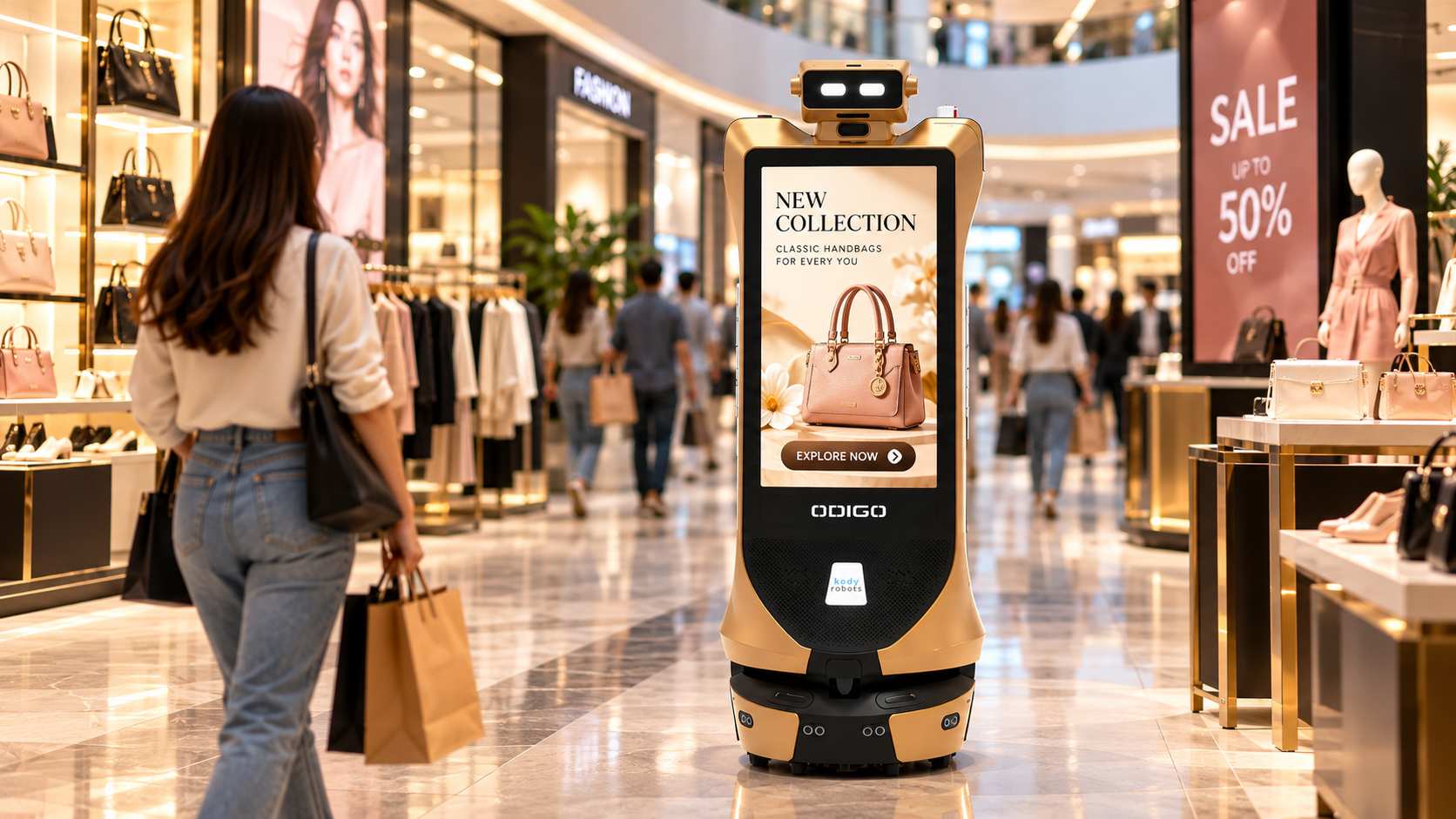
An autonomous advertising robot is a self-navigating robotic platform equipped with digital displays, sensors, software, and interactive customer assistance capabilities.
While mobile digital advertising screens primarily describe movable display equipment, autonomous advertising robots can independently navigate mapped environments and respond to visitors.
The Autonomous Advertising Robots vs fixed screens in retail stores comparison becomes more useful when the moving format is understood as a robotic advertising platform.
Comparison Factor |
Fixed Digital Screens |
Autonomous Advertising Robots |
Advertising placement |
Permanent installation |
Multiple mapped store zones |
Mobility |
Stationary |
Autonomous navigation |
Customer interaction |
Passive or touchscreen |
Touchscreen, voice, and guided assistance |
Product discovery |
Displays promotions |
Can combine promotions with wayfinding |
Campaign management |
Digital signage software |
Centralized advertising and robot management |
Operations |
Power, network, maintenance |
Navigation, charging, connectivity, maintenance |
Primary value |
Consistent advertising visibility |
Advertising, mobility, and shopper engagement |
The key distinction is the ability to connect advertising with physical actions and assistance, rather than simply changing where a screen is positioned.
What Are the Benefits of Autonomous Advertising Robots in Supermarkets?
1. Bring Advertising Closer to Product Categories
Advertising robots can move along approved store routes while displaying campaigns for different brands.
A supermarket could use robotic advertising to promote packaged foods near grocery departments and household products in another shopping zone.
2. Help Shoppers Discover Products and Departments
A shopper searching for a product category may need assistance while employees are occupied.
An advertising robot with wayfinding capabilities can help visitors find relevant departments, adding a practical service to the advertising experience.
3. Support Interactive Brand Campaigns
Touchscreens, voice assistance, QR-based offers, and promotional content allow customers to interact with advertising instead of viewing it passively.
Brands can use these features for product launches, seasonal promotions, and customer engagement campaigns.
4. Create Flexible Advertising Inventory
Retailers can create additional advertising revenue opportunities by offering brands promotional placements through autonomous advertising robots. Campaigns can be scheduled for specific periods and delivered across approved store routes, allowing brands to reach shoppers in different sections of the supermarket.
By combining autonomous navigation, digital advertising, and interactive customer engagement, these robots provide retailers with a more flexible way to manage in-store promotions and expand their retail media offerings.
How Does Odigo Bring Autonomous Advertising Into Retail Stores?
Autonomous advertising robots offer retailers more than just the ability to display promotions across different store locations. By combining digital advertising with intelligent navigation and interactive customer assistance, they can help brands reach shoppers while supporting their in-store journey.
One example is Odigo by Kody Robots, an AI-powered advertising robot designed for supermarkets, hypermarkets, shopping malls, airports, and other high-footfall commercial environments. Odigo brings these capabilities together in a single platform, allowing retailers to promote brands, engage shoppers, and assist visitors with navigation.
Odigo offers the following capabilities:
- Dual 32-inch interactive displays: Showcase brand campaigns, product promotions, and digital offers.
- Intelligent navigation: Uses Laser and Visual SLAM technology with obstacle avoidance to move through mapped environments.
- Interactive wayfinding: Helps shoppers locate stores, departments, and destinations.
- Centralized advertising management: Supports campaign scheduling, content updates, and management across multiple robots.
- Audience and campaign analytics: Provides information about advertising activity, visitor interactions, and engagement.
- Autonomous charging: Supports operational continuity through automatic docking when charging is required.
These capabilities position Odigo as a robotic retail media platform rather than conventional mobile signage.
Real-World Example: Odigo at LuLu Group UAE
The commercial application of robotic advertising is reflected in Kody Technolab's collaboration with LuLu Group International.
In November 2025, Kody Technolab announced that its joint venture company, Falcon Tech Robotics, had entered an agreement to deploy 290 Odigo AI-powered advertising robots across 60 LuLu Group locations in the UAE, including 43 hypermarkets and 17 malls.
The agreement outlines a two-phase deployment supported by an advertising revenue-sharing arrangement.
For retail operators, the initiative illustrates how robotic advertising can be planned as a multi-location media network rather than an isolated promotional installation.
How Can Retailers Measure the Performance of Advertising Robots?
Retailers evaluating advertising robots should assess both advertising delivery and meaningful shopper actions.
Useful measurements include:
- Advertising impressions: Estimated audience exposure based on a defined measurement method.
- Campaign delivery: Advertising plays completed across assigned routes or locations.
- Customer interactions: Touchscreen engagement, navigation requests, and promotional activities.
- QR code scans: Responses to specific brand offers.
- Incremental sales: Sales differences assessed through comparable campaign and control periods.
Retailers should also monitor route coverage, operating availability, and charging requirements. Robot interactions can indicate engagement, but controlled sales comparisons are necessary before attributing revenue growth to advertising campaigns.
Should Supermarkets Invest in Advertising Robots or Fixed Digital Screens?
The choice depends on what retailers expect from their advertising infrastructure. Fixed digital screens work well where customer traffic is predictable. Autonomous advertising robots are more relevant when a store needs promotional mobility, interactive navigation, and flexible advertising coverage.
Large supermarkets may benefit from combining both approaches. Fixed signage can serve permanent advertising zones, while robots introduce brand campaigns and customer assistance into approved shopping routes.
Before deployment, retailers should assess aisle widths, pedestrian safety, store traffic, connectivity, advertiser demand, and operational costs.
A controlled pilot can help determine whether robotic advertising provides enough additional commercial value to justify expansion.
Conclusion
The future of in-store retail media in India is not just about installing more digital screens but about creating advertising opportunities that connect with shoppers throughout their purchasing journey. While fixed screens provide consistent visibility at selected locations, autonomous advertising robots offer additional advantages through mobility, interactive promotions, and customer assistance. For supermarkets and hypermarkets, combining both technologies can help brands reach shoppers across different store sections while creating new advertising revenue opportunities. With Odigo, Kody Robots brings autonomous navigation, digital advertising, and interactive wayfinding together, helping retailers explore a more flexible approach to in-store advertising.