Industrial Packaging Machines: 7 Ways They Improve Manufacturing Efficiency
-

- Published Updated
- 2,406 views
Sometimes, a few seconds don’t feel like much—until they happen thousands of times.
In a busy manufacturing environment, packaging is much more than the final step before a product reaches the customer. Filling, sealing, wrapping, coding, and handling all have a direct impact on production speed, product quality, material usage, and operating costs.
This is where industrial packaging machines can make a significant difference. By automating repetitive packaging tasks and improving process consistency, modern packaging equipment helps manufacturers build faster, more reliable, and scalable production processes.
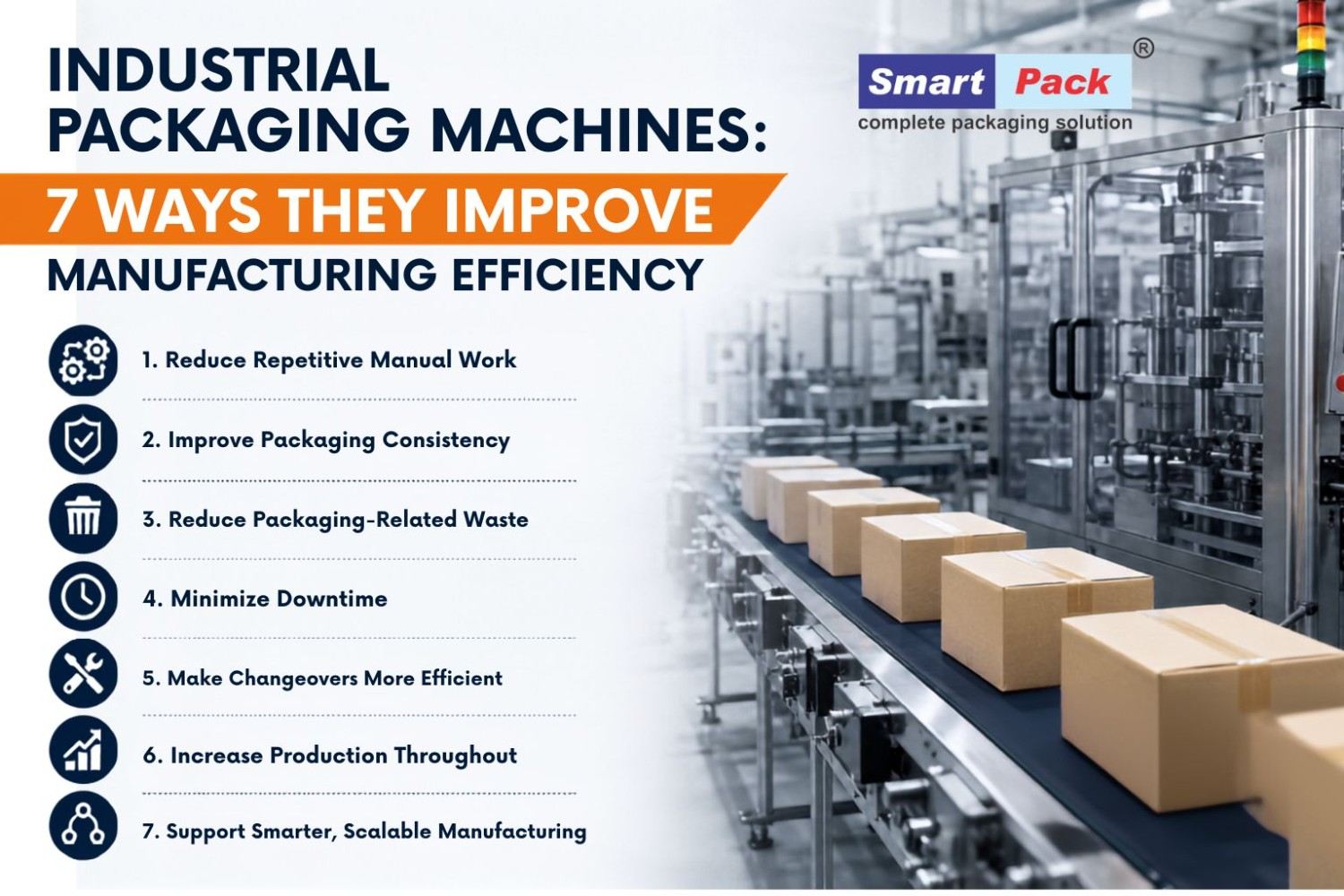
Here are 7 ways industrial packaging machines can improve manufacturing efficiency.
1. Reduce Repetitive Manual Work
Manually filling, sealing, or packing hundreds or thousands of products can consume a considerable amount of labour time.
Industrial packaging machines automate repetitive processes such as filling, sealing, wrapping, coding, and packing. This reduces routine manual work and allows operators to focus on machine supervision, quality inspection, material handling, and other productive activities.
Even a few seconds saved on each package can create a meaningful improvement when multiplied across an entire production shift.
Small time savings, repeated at scale, can create a big productivity gain.
2. Improve Packaging Consistency
Consistency is critical in manufacturing.
Consider ten identical products on a shelf. If one package has a different fill level, an uneven seal, or damaged packaging, the difference is immediately noticeable.
Automated packaging equipment helps maintain repeatable operations. Depending on the machine and application, it can provide more consistent filling quantities, sealing results, packaging dimensions, and production cycles.
This can help manufacturers reduce variations, rework, and packaging-related rejections.
The objective isn't simply to produce faster -it is to produce consistently.
3. Reduce Packaging-Related Waste
Small amounts of product or packaging material wasted during every cycle may seem insignificant.
However, when production reaches thousands of units per day, those small losses can become substantial.
Problems such as overfilling, product spillage, incorrect sealing, damaged packaging, and inconsistent operations can contribute to unnecessary waste. Properly selected packaging machinery can improve process control and help manufacturers use materials more efficiently.
Actual savings depend on the product, packaging material, machine configuration, and production conditions, but reducing repeated losses is an important part of improving manufacturing efficiency.
4. Minimize Production Downtime
A packaging line may be capable of high-speed production, but frequent stoppages can significantly reduce actual output.
Downtime can occur because of machine adjustments, material problems, maintenance requirements, incorrect settings, or equipment faults.
Modern packaging machines with suitable controls, monitoring features, and maintenance practices can help manufacturers identify recurring issues and maintain better equipment availability.
The key is to look beyond maximum machine speed and consider how consistently the equipment can operate during real production.
A machine that runs reliably can be more valuable than one that only looks fast on paper.
5. Make Changeovers More Efficient
Manufacturers producing multiple products or package sizes often need to change machine settings throughout the day.
Every changeover can involve adjustments, cleaning, material replacement, tooling changes, and testing.
Packaging machines designed with practical changeover features can help reduce setup time and make production scheduling easier.
This is particularly useful for businesses handling different product sizes, pouch formats, bottles, cartons, or packaging materials.
Reducing changeover time means more time can be spent on actual production.
6. Increase Production Throughput
Higher machine speed does not automatically mean higher overall production.
For example, if a packaging machine can operate at a high speed but the upstream filling process cannot supply products quickly enough, the packaging machine's maximum capacity may never be achieved.
Manufacturers should therefore evaluate packaging equipment as part of the complete production line.
Filling, conveying, sealing, coding, wrapping, inspection, and final handling should work together. When these processes are properly coordinated, manufacturers can improve overall throughput and make better use of available production capacity.
7. Support Smarter and Scalable Manufacturing
As businesses grow, production managers need better visibility into their operations.
Modern packaging systems can incorporate digital controls, monitoring, automation, and connectivity to provide useful information about production performance.
Data related to output, downtime, machine status, and recurring operational issues can help manufacturers make more informed decisions.
This becomes particularly valuable when expanding production capacity. Instead of simply adding more manual processes, businesses can build packaging operations that are easier to control, standardize, and scale.
Beyond Machine Speed
Manufacturing efficiency rarely comes from one major improvement.
It is usually the result of many smaller improvements working together—fewer manual tasks, less waste, better consistency, shorter changeovers, reduced downtime, and improved throughput.