Interstate Property Investment: What to Know Before Buying Outside Your Home Market
-

- Published Updated
- 1,640 views
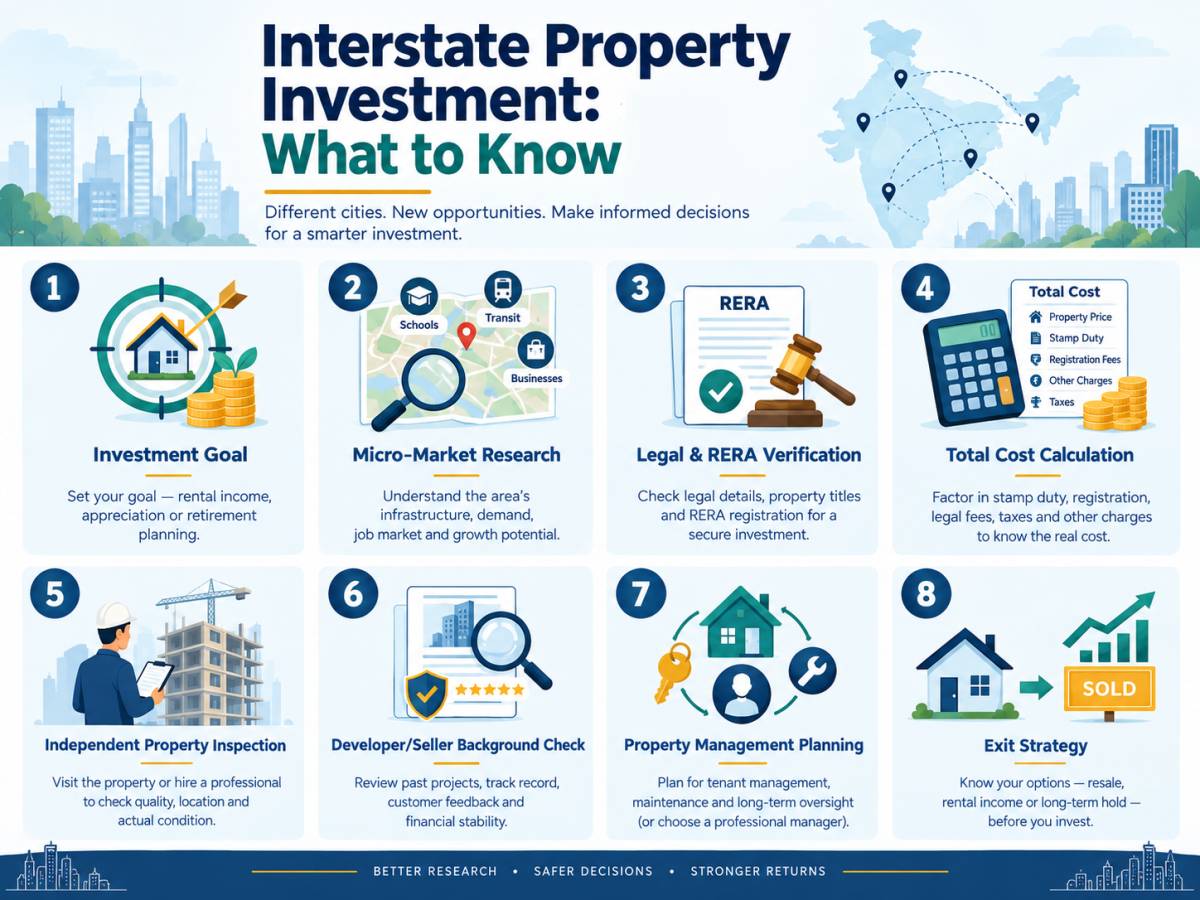
When making a real estate investment in another state, there are several important things to consider before making your purchase. Here are a few things to keep in mind before buying interstate property.
There are increased risks inherent in investing in another market, including new regulations, market dynamics, building codes, and property management regulations. Decide what you want to purchase, narrow down your search to a specific area, check legal and RERA information, add up the down payment and closing costs, and see the property, and ensure you plan to manage the property and that you can sell it.
1. Identify Your Investment Goal
First, you need to determine the reasons for investing. It can be used to generate rental income, long-term appreciation, future use, retirement planning, or as part of a portfolio.
You need to select the property and area you want to buy based on the objective. Certain areas that are close to offices, educational facilities, transport, and everyday use facilities may be preferred by rental investors. Industrial corridors with better infrastructure, employment, and planned development are a place to look if you're looking for appreciation.
Don't just select a market because it is cheap. Lower prices can be due to poor demand or excess stocks/low resale value. Evaluate all opportunities in light of your financial objectives and risk tolerance.
2. Research the Exact Micro-Market
Do not use the market of an entire city or state to gauge the market of a smaller city or state. The performance of property may differ significantly in different neighbourhoods.
Study:
- Current prices and available inventory
- Rental demand, vacancy levels, and achievable rents
- Nearby employment and business hubs
- Road, metro, rail, and public transport connectivity
- Schools, hospitals, and essential services
- Existing and upcoming residential supply
- The neighbourhood’s stage of development
Be sure to scrutinize infrastructure claims. Identify the difference between operational projects, under-construction projects, and approved and proposed projects. New infrastructure could help, but there is no guarantee of such benefits if the announcements are made without confirmation.
3. Verify Laws, Regulations and RERA Details
Purchasing a home in another state involves various other registration requirements, stamp duty rates, and local laws. Know these expenses and needs prior to investing money.
In the case of under-construction projects, refer to the RERA websites of the respective states/UT. Check the project registration, the promoter information, the declared completion timeframe, and the documents that have been declared for disclosure.
There is no replacement for independent legal verification with RERA registration. Engage a registered property lawyer who is knowledgeable about the jurisdiction to review ownership documents, land usage, approvals, agreements, and other such records. This is especially crucial when acting in situations where there is a lack of familiarity with local property practices.
4. Calculate the Complete Cost
The quoted price represents just part of the investment. Get a detailed cost sheet, which includes stamp duty, registration fees, taxes, parking fees, maintenance deposits, club/facility fees, and project expenses.
If the purchase is financed, include the interest on the home loan, processing fees, and banking charges. Additional travel, inspection, legal, and property-management costs may apply to buyers from out of state.
Focus on total acquisition costs, realistically expected returns, and recurring costs rather than the quoted price per SF.
5. Inspect the Property Independently
A marketing brochure, video, or virtual tour may not contain all of the information about the property or its surroundings. If possible, visit the location frequently. If you are not able to, designate a trusted representative or independent inspector.
Examine the actual site, access roads, development, construction quality, connectivity, and access to services. If the property is on the market, check it out for any physical damage and look for discrepancies with the seller or developer.
Get a sense of the progress of under-construction projects by visiting the site and making official announcements. Don't make a big investment just because of an advertisement.
6. Assess the Developer or Seller
Check out the developer's past works, track record, construction, and maintenance quality. Don't assume that all projects made by a well-known developer will perform the same.
If the property is being used for resale, check the legal and ownership history of the seller. Watch out for the promise of guaranteed appreciation, high rental income, or steady resale profits. Actual returns are subject to demand, supply, interest, location, and property quality.
Local brokers provide valuable information; their recommendations should be contrasted and verified.
7. Plan Property Management
A property that is far away needs constant monitoring. It could require tenant screening, rent collection, maintenance, repairs, and regular inspections if it's rented.
Determine if you will be in charge of the property yourself, trust someone who lives in the area, or put the job up to a professional manager. When you are doing rental investment calculations, compute your net income after you subtract management fees, maintenance, vacancies, and other expenses. Make projections for base rent based on existing local demand, not the best-case scenario.
8. Consider the Exit Strategy
Plan your exit before purchasing. Forecast potential buyers, competitive supply, and end-user demand in the area.
If the market becomes saturated or the demand decreases, a property could take longer to sell. Therefore, assess liquidity, holding capacity and resale prospects, not only expected appreciation.
The Bottom Line
While expanding your opportunities with interstate investment, distance comes with its own set of challenges: Diligence is key in ensuring you do your due diligence on the exact micro-market, confirm legal and RERA details, determine the total cost, conduct an independent property check, evaluate real demand, and secure proper management. An exit strategy is also crucial. The best investments come from facts and expectations, not low prices, gimmicks, or projections of growth.