The New iOS Stack: AI, Intent, Vision and Spatial Computing
-

- Published Updated
- 4,013 views
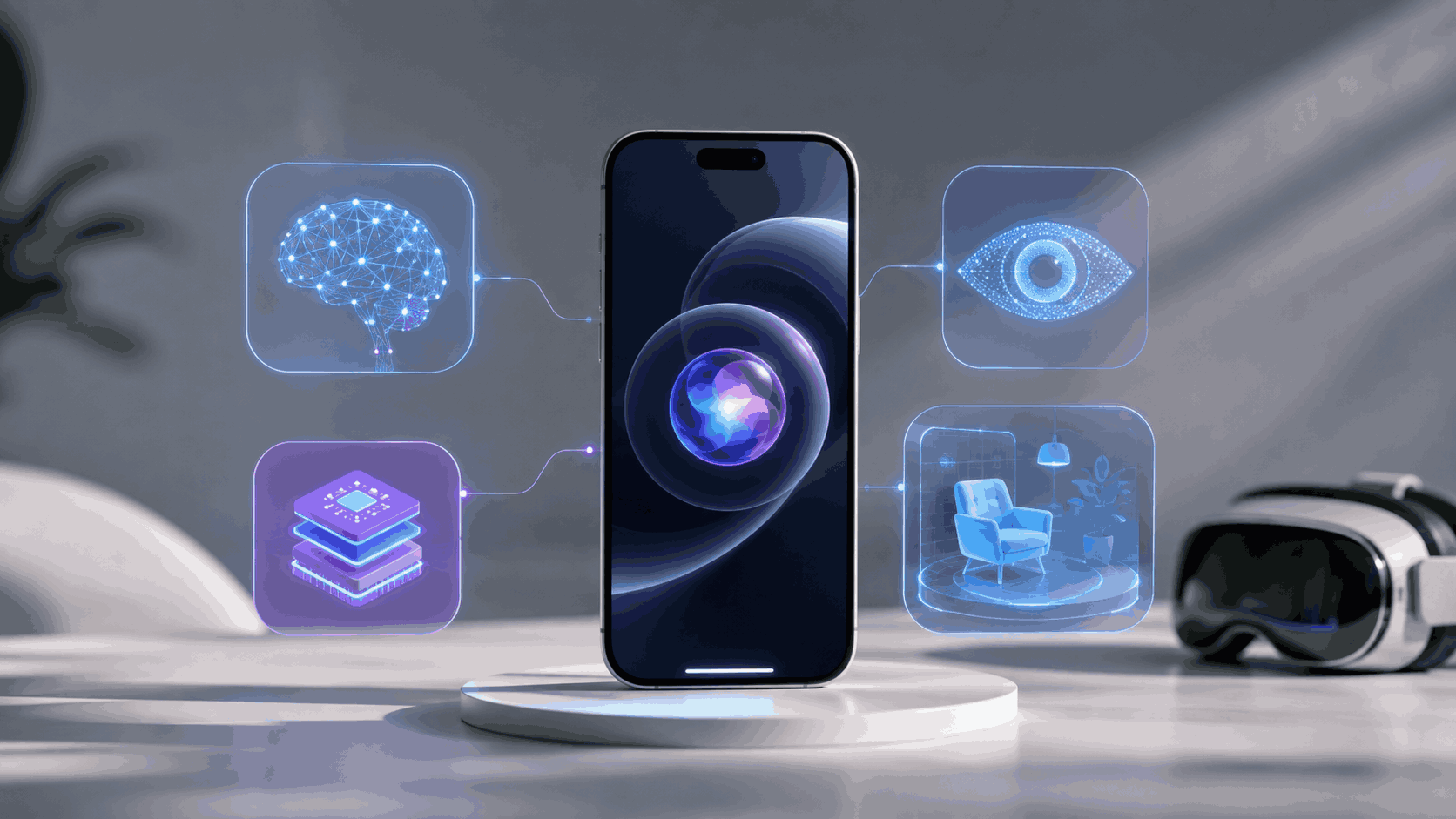
The modern iOS AI development stack is becoming broader than SwiftUI, UIKit, networking, and databases. AI models, App Intents, Vision, on-device machine learning, and spatial technologies are becoming important parts of Apple's development ecosystem.
For businesses planning future mobile products, understanding this stack is becoming essential.
Layer 1: The Application Experience
SwiftUI remains an important foundation for modern Apple interface development.
Developers can use familiar Apple technologies while extending applications toward new experiences, including visionOS. Apple explains that existing iOS and iPadOS applications can be brought to visionOS, while developers can add platform-specific features for richer spatial experiences.
The UI layer is therefore no longer limited to flat screens.
Layer 2: Artificial Intelligence
The Foundation Models framework provides a native Swift API for Apple's on-device foundation models and supports compatible third-party language models.
Applications can use these capabilities for:
- Summarization
- Classification
- Extraction
- Text generation
- Image understanding
- Structured output
- Tool calling
This gives developers a native path for integrating language intelligence into application workflows.
Layer 3: Intent
AI needs to understand what an application can actually do.
This is where App Intents becomes important.
Apple describes App Intents as a way to make app content and actions discoverable by Apple Intelligence, Siri, Spotlight, Shortcuts, widgets, and other system experiences.
For developers, this means application architecture should expose meaningful operations.
For example:
- Create appointment
- Find invoice
- Start workout
- Save article
- Generate report
- Add item to list
These operations can become building blocks for natural-language interaction.
Layer 4: Vision
Vision adds visual intelligence.
Applications can use image analysis and recognition capabilities to understand visual information.
Apple's latest Foundation Models capabilities can combine image input with text and allow models to work with Vision tools such as OCR and barcode readers.
This creates possibilities in:
- Healthcare workflows
- Retail
- Manufacturing
- Education
- Logistics
- Document management
- Accessibility
The camera becomes more than a capture device. It can become an input to an intelligent workflow.
Layer 5: Spatial Computing
The stack is also expanding beyond the iPhone.
Apple's visionOS platform allows developers to create windows, volumes, and immersive spaces. It uses technologies including SwiftUI, RealityKit, and ARKit.
This matters because applications can increasingly share data and business logic across Apple's ecosystem while presenting platform-specific experiences.
A product might begin as an iPhone application and later offer:
- A conventional mobile interface
- A larger iPad experience
- A spatial interface
- AI-assisted workflows across devices
Why These Layers Work Better Together
The real opportunity is not each technology individually.
It is the combination.
Imagine a field-service application.
AI understands a technician's request.
Vision reads a machine label or document.
App Intents expose actions such as creating a service report.
Cloud services synchronize business information.
Spatial computing could later provide an immersive training or visualization experience.
This creates an ecosystem rather than a collection of disconnected features.
Architecture Needs to Become More Modular
A modern development team should separate:
- User interface
- Business logic
- AI orchestration
- Tool definitions
- Data access
- Security
- Platform-specific capabilities
This makes it easier to replace or improve individual components.
For example, the AI layer may evolve faster than the rest of the application. A modular architecture reduces the cost of that change.
Privacy Must Be Built Into the Stack
AI introduces new questions about data.
Developers need to decide:
- What data the model can access
- What information stays on device
- Which tasks require cloud processing
- Which actions require confirmation
- How user permissions are handled
Apple provides both on-device and Private Cloud Compute approaches within its current AI technologies.
What Businesses Should Prioritize
Companies do not need every technology in every application.
Instead, select the layers that solve real problems.
A strong iOS App Development Company should help determine whether a product actually benefits from AI, Vision, App Intents, spatial computing, or a combination.
The best stack is not the one with the most technologies.
It is the one that creates the best user experience with the least unnecessary complexity.
The New Definition of iOS Development
The shift also changes how teams should think about product development. Instead of designing an app first and adding AI features later, businesses can consider intelligence, automation, and contextual interaction from the beginning. This approach helps developers identify which tasks should remain traditional UI interactions and which could be handled through natural language, visual input, system actions, or intelligent automation. As a result, product teams can build iOS applications that feel more adaptive and useful without making the user experience unnecessarily complicated.
Modern iOS development is moving toward a multidisciplinary model.
Developers need to understand interfaces, AI, structured actions, data, privacy, automation, and potentially spatial interaction.
That makes the Apple platform more powerful—but also makes architecture and product strategy more important.
The next generation of iOS products will be built not around one framework, but around a connected stack of intelligence, intent, perception, and experience.