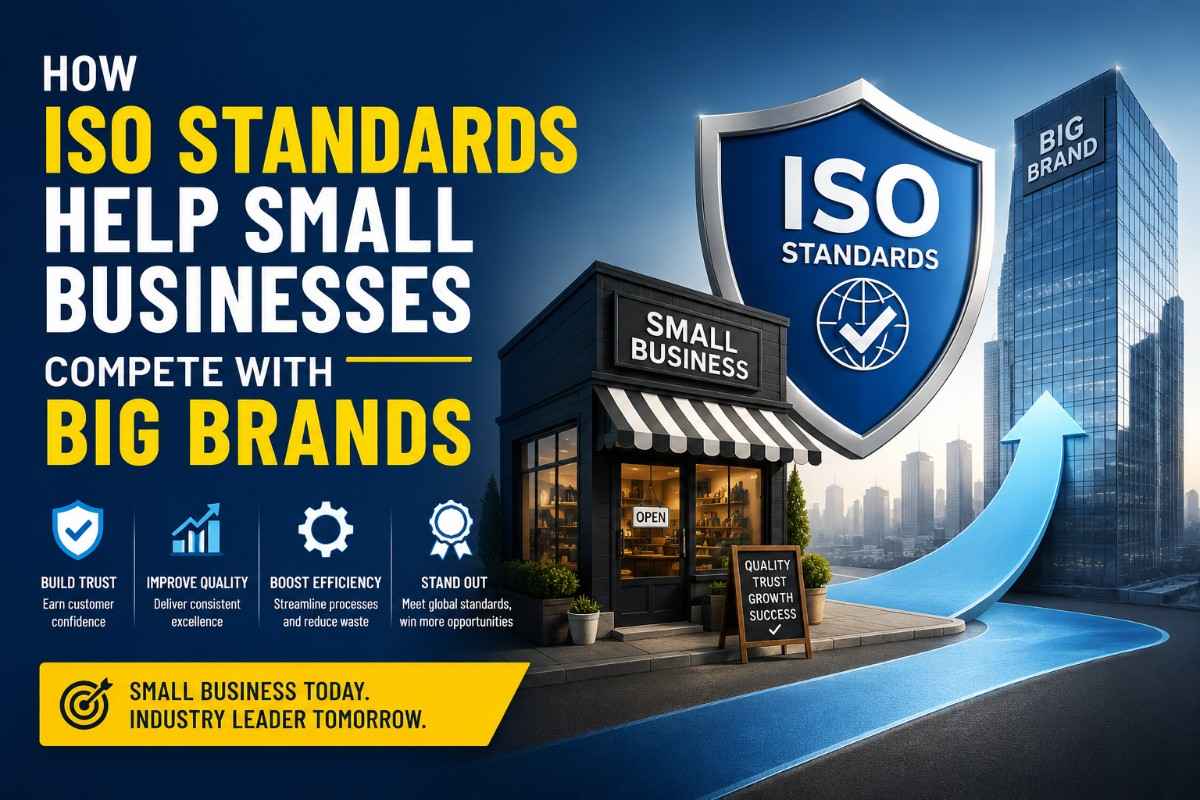
How ISO Standards Help Small Businesses Compete with Big Brands
-

- May 08th, 2026
- 7,758 views
Picture two vendors side by side at a government tender evaluation. One is a 500-person corporation with a glossy brand. The other is a 40-person manufacturing unit from Pune. On paper, the small firm has no chance, except for one detail on their bid: an ISO 9001 quality management certificate. The evaluator ticks the qualifying box, the SME enters the final round, and the playing field suddenly looks a great deal less tilted. This is not a hypothetical. It happens every day across India, and it explains why ISO Certification in India has moved from a nice-to-have to a genuine competitive weapon for small and medium enterprises.
Why Big Brands Win by Default: and How ISO Changes That
Large corporations enjoy structural advantages that no startup can replicate overnight: decades of brand trust, deep procurement relationships, and marketing budgets that dwarf entire SME balance sheets. Buyers, especially corporate and government buyers, use these signals as proxies for quality and reliability. When they cannot quickly evaluate a vendor's actual capabilities, brand reputation fills the gap.
ISO standards exist precisely to solve this information asymmetry. An ISO certificate from an accredited certification body is a globally recognised, third-party-verified signal that your processes, safety systems, or information security practices meet a defined international benchmark. In other words, it converts your operational competence into a credential that any buyer — anywhere — can understand and trust.
An ISO certificate does not just open doors — it tells the buyer exactly how well-oiled your operations are, without them ever setting foot in your facility. |
For small businesses in India, this matters enormously. Government tenders, export contracts, large-retailer vendor panels, and hospital supply chains increasingly list ISO certification as a mandatory qualifying criterion. Without it, your bid is disqualified before it is even read. With it, you compete on merit.
The Four Certifications That Move the Needle Most
ISO 9001 — Quality Management System
The foundational standard. ISO 9001 focuses on consistent product and service quality, customer satisfaction, and process documentation. For a small business, going through the 9001 audit process is often the first time leadership gets a clear, structured picture of where they are efficient and where they are haemorrhaging resources. The discipline of process documentation alone routinely reduces defect rates and customer complaints — delivering ROI independent of any contract won.
ISO 45001 Certification: Occupational Health & Safety
Published in 2018 as the international successor to OHSAS 18001, ISO 45001 Certification sets the global benchmark for workplace health and safety management. For small businesses in construction, manufacturing, logistics, chemicals, and food processing, this standard is particularly powerful for three reasons.
First, it demonstrates to employees and labour inspectors that safety is managed systematically — not reactively. Second, it is increasingly required by large contractors and OEMs before onboarding sub-vendors. Third, and often underestimated: a documented occupational health and safety management system directly lowers the risk of accidents that result in costly downtime, legal liability, and reputational damage. In a sector where a single incident can shutter a small business, this is not a compliance checkbox — it is risk management.
India Context: The Factories Act and state-level Labour Laws impose significant obligations on employers. ISO 45001 Certification does not replace legal compliance, but it provides a structured framework that makes compliance more systematic and auditable — reducing the likelihood of surprise inspections becoming penalties. |
ISO 27001: Information Security Management
As Indian SMEs increasingly handle customer data, run e-commerce platforms, or integrate with enterprise IT systems, data security is no longer an enterprise-only concern. ISO 27001 sets the international standard for information security management systems (ISMS). Holding this certificate signals to clients — particularly in IT services, BPO, fintech, and healthcare — that their data is protected by documented, audited controls.
More practically, the ISO 27001 certification process forces small businesses to inventory their data assets, identify vulnerabilities, and close them — reducing the real risk of a breach that could destroy client relationships and attract regulatory scrutiny under India's Digital Personal Data Protection Act, 2023.
ISO 22000: Food Safety Management
For food manufacturers, processors, and packagers targeting retail chains or export markets, ISO 22000 is the passport. Modern retail procurement teams in India routinely require it before listing any new supplier, making it essentially a market-access requirement rather than a differentiator.
ISO 27001 Certification Cost in India: A Realistic Breakdown
One of the most common questions from SME owners is: What does ISO 27001 Certification actually cost? The honest answer is that ISO 27001 Certification Cost varies widely depending on company size, existing security infrastructure, and the certification body chosen. For small businesses in India, here is a practical framework:
Cost Component |
Typical Range (INR) |
Notes |
Gap Assessment / Consultant Fee |
₹50,000 – ₹2,00,000 |
One-time; depends on scope and consultant expertise |
ISMS Implementation & Documentation |
₹30,000 – ₹1,50,000 |
Often bundled with consulting |
Internal Audit & Training |
₹20,000 – ₹80,000 |
Staff time is the hidden cost here |
Certification Body Audit Fee |
₹80,000 – ₹3,00,000 |
Varies by accredited body (BSI, TÜV, Bureau Veritas, etc.) |
Annual Surveillance Audit |
₹40,000 – ₹1,20,000/year |
Mandatory to maintain certification |
For a small IT or services company with 20–50 employees, a realistic total first-year investment for ISO 27001 Certification in India typically falls in the range of ₹2,00,000 – ₹5,00,000. This sounds significant until you weigh it against a single lost contract for which ISO 27001 was a prerequisite — or a single data breach that triggers client attrition and regulatory penalties.
|
QUICK FACTS ◆ India ranks among the top five countries globally for ISO 9001 certificates issued, reflecting strong SME adoption. ◆ ISO 45001 Certification replaced OHSAS 18001 in 2021 as the global occupational health benchmark. ◆ The ISO 27001 Certification Cost for micro-enterprises (under 10 employees) can be significantly lower with MSME-focused certification consultants. ◆ NABCB (National Accreditation Board for Certification Bodies) accredits ISO certification bodies in India — always verify your certifier's NABCB accreditation. ◆ Many state governments and central schemes offer partial subsidy on ISO certification costs for registered MSMEs. |
The Real ROI: Beyond the Certificate on the Wall
The tangible benefits of ISO Certification in India for small businesses break down into three categories that collectively justify the cost many times over.
Market Access: Winning tenders, export contracts, and large-buyer vendor approvals that were previously inaccessible. A single such contract, which may be worth tens of lakhs — dwarfs the certification investment entirely.
Operational Efficiency: The certification process mandates process documentation, root-cause analysis, and corrective action systems. Most businesses that implement these rigorously find themselves running more efficiently within 12 months, reducing waste, rework, and customer complaints in measurable ways.
Risk Reduction: Whether it is a workplace accident under an ISO 45001 framework or a data breach under ISO 27001, systematic risk management prevents the kind of catastrophic events that can permanently damage a small business. The insurance analogy is apt: you hope never to claim, but you are profoundly grateful the policy exists when you need it.
Conclusion
The path to ISO Certification in India follows a consistent sequence, regardless of which standard you pursue. Begin with an honest gap assessment, either self-conducted using the standard's requirements or with the help of a consultant, to understand where your current practices fall short. Next, implement and document the required processes, controls, and records. Run at least one full cycle of internal audits to identify weaknesses before the external auditor does. Finally, engage an accredited certification body for the Stage 1 (documentation review) and Stage 2 (on-site audit) assessments.
MSME Subsidy Alert: Under the MSME Competitiveness Scheme and several state-level industrial policies, registered MSMEs can claim reimbursement of 50–75% of ISO certification costs. Check with your District Industries Centre (DIC) or the MSME Ministry portal for current scheme details before budgeting your certification spend. |