The Parent's Guide to Buying a Kids' Off-Road UTV
-

- Published Updated
- 4,735 views
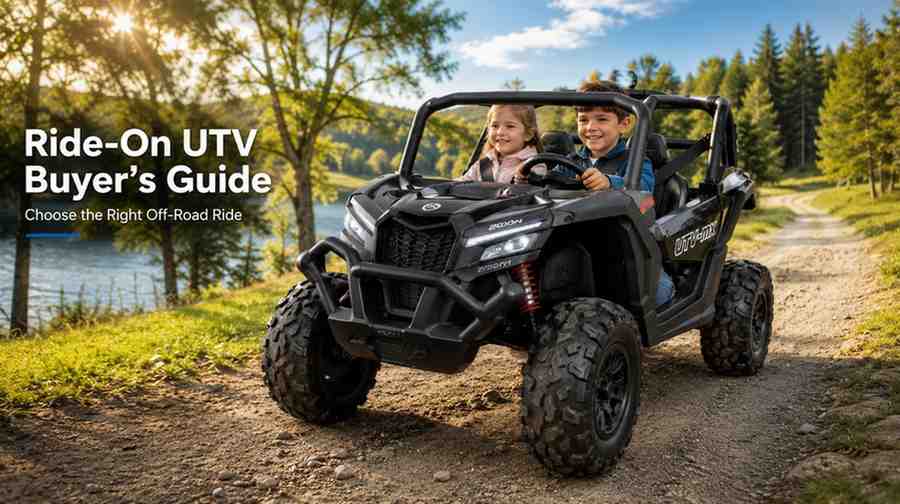
Somewhere between a basic ride-on car and a full-size off-roader sits the kids' UTV — a side-by-side, two-seat vehicle built to handle real backyard terrain rather than just a flat driveway. If your child has outgrown their first ride-on and is asking for something bigger, faster, and genuinely capable outdoors, here's what actually matters when comparing UTVs, ATVs, and Jeep-style trucks.
What Is a Ride-On UTV?
A ride-on UTV is modeled after real side-by-side off-roaders — the kind of vehicle used on ranches and trails — scaled down and speed-limited for kids. The defining features are a wider, more stable frame, a cab that's at least partially enclosed, side-by-side two-seat capacity, and a motor built for uneven ground rather than smooth pavement. Many of the "Jeep-style" ride-ons sold today share this exact layout, which explains why the terminology tends to blur together across product listings.
UTV vs. ATV vs. Jeep-Style Truck
Before comparing individual models, it helps to separate the three categories clearly:
- Ride-On UTV – side-by-side, two-seat, enclosed or semi-enclosed cab. Best for siblings who want to ride together over rougher terrain.
- Ride-On ATV – single rider, open, quad-bike-style design. Best for a child who wants a solo, sportier experience.
- Jeep-Style Ride-On Truck – one or two riders depending on the model, open-top or soft-top body. Best for families who want the classic off-road look without a fully enclosed cab.
If you're deciding between a solo quad and a shared side-by-side, that comparison is worth researching on its own before you narrow things down further. This guide focuses specifically on choosing well within the UTV category once you've already leaned toward the side-by-side format.
Battery Voltage: The Feature That Matters Most
Voltage is the single biggest factor in how a UTV actually performs. A 12V motor works well for a younger or first-time rider sticking to flat, forgiving ground. Stepping up to 24V delivers real torque, noticeably better hill performance, and enough power to carry two kids across bumpy yard terrain — which is what most families are actually buying a UTV to do. If you're on the fence between the two, it's worth digging into the voltage comparison in more depth before deciding, since it affects almost every other part of the ride experience.
Cab Design: Doors, Roof, and Frame
This is where UTVs genuinely separate themselves from open-body ATVs. Look for doors that actually lock — a real safety feature, not just styling — a roof or soft-top for sun and light rain coverage, and a roll-bar-style frame that adds structural rigidity even at kid-safe speeds. Not every "enclosed cab" listing delivers the same level of protection, so it's worth checking these details individually rather than assuming they're standard across every model.
Suspension and Tires
Four-wheel independent suspension handles bumps and ruts noticeably better than two-wheel or no suspension at all, which matters a lot if your yard isn't perfectly flat. Wider, deeper-tread tires grip grass and light gravel well; narrow, smooth tires are really only suited to driveways and patios. Ground clearance is also worth checking — a UTV that scrapes on every root or rock in the yard tends to get parked and forgotten quickly.
Seating and Weight Capacity
Side-by-side seating means two riders share one combined weight limit rather than each getting a separate full allowance. Check the listed capacity against both riders together, or against one rider with room to grow, rather than assuming the number doubles automatically because there are two seats.
Parental Remote Control
A 2.4GHz remote with forward, reverse, and steering override, plus a one-click emergency brake, is close to standard in this category now and worth treating as a genuine requirement rather than an optional extra — especially with two kids riding together and less direct hands-on control than a single-rider ATV offers.
Entertainment Features
LED headlights, engine sound effects, and Bluetooth speakers show up across most models in this category and genuinely extend how long kids stay interested. None of these are safety-critical, but they're a reasonable way to break a tie between two otherwise similar UTVs.
Matching Age to Setup
| Age Range | Recommended Setup | Notes |
|---|---|---|
| 2–4 years | 12V, remote as primary control | Independent steering usually isn't realistic yet |
| 4–6 years | 12V or entry-level 24V, remote as backup | Good window for transitioning to manual driving |
| 6–8 years | Full 24V, manual driving capability | Most kids this age want, and can handle, real independence |
Two Real Family Examples
A family with a 4-year-old and a 7-year-old chose a 24V UTV specifically to avoid buying two separate ride-ons — the locking doors and seatbelts gave them enough confidence to let the older child drive the younger one around the yard under supervision. Another family with a sloped, root-covered backyard upgraded from a 12V ride-on car that kept getting stuck to a 24V UTV with full suspension, and described the difference in usable yard space as dramatic — territory that had previously been off-limits became part of the regular riding route almost immediately.
Pre-Purchase Checklist
- Combined weight capacity comfortably covers both riders, with some room to grow
- 24V for two riders, hills, or rough terrain; 12V works fine for flat, solo, younger-rider use
- Four-wheel suspension if your yard has any bumps or uneven ground
- Doors and a frame that provide real structure, not just a decorative shell
- Parental remote with an emergency brake, especially for a family's first off-road ride-on
Frequently Asked Questions
What's the difference between a ride-on UTV and a ride-on Jeep? They overlap significantly. "UTV" specifically means a side-by-side, two-seat, enclosed-cab design. "Ride-on Jeep" is often used more loosely to describe any off-road-styled ride-on, including models that are structurally identical to a UTV.
Is a 24V UTV too fast for a young child? Not usually — nearly all 24V UTVs in this category include speed-lock settings and a parental remote, so you can cap the top speed for a younger rider and raise it gradually as they gain confidence.
Can two kids ride a UTV safely at the same time? Yes, as long as the model's combined weight limit covers both riders and both wear their seatbelts. The side-by-side design is built specifically for this.
Do UTVs work on grass and dirt, or only on pavement? Most models with four-wheel suspension and wider tires handle short grass and packed dirt reasonably well. Loose gravel, mud, and steep slopes are more limited.
How is a UTV different from a Jeep-style ride-on truck? A UTV always means side-by-side seating in an enclosed or semi-enclosed cab. A Jeep-style truck may have front-and-back seating or a more open body, even though both get marketed under the same "off-road" umbrella.
What voltage should I choose for a first off-road ride-on? 12V is a safe, controllable starting point for a younger or first-time rider on flatter ground. 24V is the better choice if two kids will ride together or your terrain includes hills or bumps.
Final Thoughts
Choosing the right UTV comes down to matching voltage, cab design, suspension, and weight capacity to your specific family — not just picking whichever model has the most attractive photos. Taking the time to compare these details before checkout makes it far more likely the vehicle becomes a genuinely well-used part of outdoor play rather than something that gets outgrown or abandoned after the first few rides.
Originally published on:
https://toysporter.com/2026/07/13/kids-ride-on-utv-buyers-guide/