How Managed Billing Service Supports Automated Billing and Revenue Management
-
- Published Updated
- 1,647 views
Billing is one of the most important operational processes for any telecom provider. It connects the services a business delivers with the revenue it collects. However, as telecom businesses expand their customer base, products, plans, usage-based services, and payment options, billing can become increasingly complex.
Manual billing processes can require significant time and coordination. Teams may need to collect usage data, apply pricing rules, prepare invoices, send billing communications, monitor payments, and follow up on overdue accounts. Even a small error can create additional work for the billing team and affect the customer experience.
This is where a Managed Billing Service can support telecom providers.
A managed billing approach combines billing technology, structured processes, automation, and ongoing management to help businesses handle billing operations more efficiently. It can reduce repetitive administrative work while providing better visibility into revenue-related activities.
What Is a Managed Billing Service?
A Managed Billing Service is a billing solution where billing operations, technology, or selected billing processes are managed through a dedicated platform or service rather than being handled entirely through internal manual processes.
For telecom providers, managed billing can cover different activities depending on the solution and business requirements.
These may include:
Customer account management
Usage data processing
Recurring billing
Usage-based billing
Invoice generation
Payment processing
Payment reminders
Revenue tracking
Account reconciliation
Billing reports
Customer statements
Billing system management
The main objective is to create a more organised and automated billing environment that can support the provider's day-to-day operations.
Why Automated Billing Matters for Telecom Providers
Telecom billing is rarely as simple as charging customers a fixed amount every month.
Providers may offer multiple plans, add-ons, usage-based services, recurring subscriptions, discounts, packages, and other commercial models.
As the number of customers and services increases, managing these billing scenarios manually becomes more difficult.
Automated billing helps address this challenge by using predefined rules and workflows to process billing activities.
Instead of employees manually calculating every customer's charges, a billing system can process relevant data based on configured pricing and billing rules.
This can help reduce repetitive work and make the overall billing cycle more consistent.
How Managed Billing Service Supports Automated Billing
1. Automating the Billing Cycle
One of the main advantages of a Managed Billing Service is the ability to automate recurring billing activities.
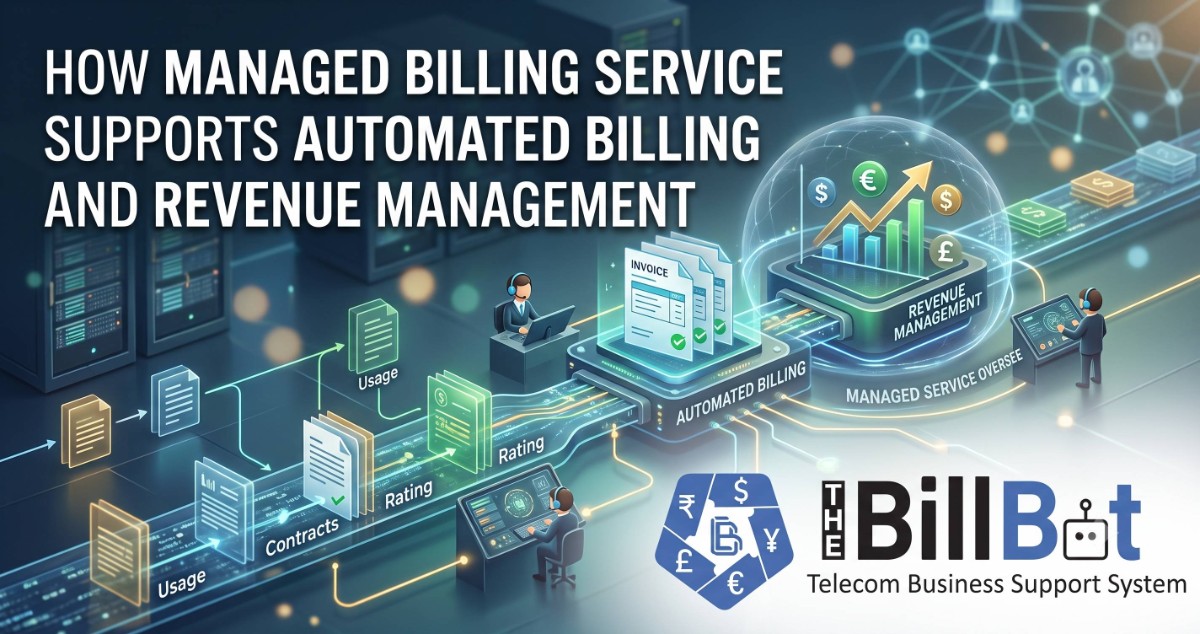
A typical automated billing cycle may involve:
Collecting customer and service information
Processing usage data
Applying pricing rules
Calculating charges
Generating invoices
Sending invoices
Recording payments
Sending payment reminders
Updating account status
Producing billing reports
Once the workflow is configured, many of these steps can happen automatically.
This allows billing teams to spend less time performing repetitive tasks and more time handling exceptions and reviewing billing operations.
2. Processing Usage Data
Telecom providers often need to bill customers based on service usage.
Depending on the business model, this may include call duration, data usage, messages, or other service metrics.
A Managed Billing Service can connect with relevant telecom systems to collect and process usage information.
For example, call detail records (CDRs) can be imported or integrated into the billing workflow. The system can then apply configured rates and billing rules to calculate the applicable charges.
Automating this process can reduce the amount of manual data handling required from billing teams.
3. Generating Accurate Invoices
Invoice generation is another area where automation can make a significant difference.
A managed billing platform can use customer information, products, services, usage data, pricing, taxes, discounts, and other configured rules to generate invoices.
Instead of creating invoices manually, the system can generate them according to the billing schedule.
Automated invoice generation can help businesses maintain consistent invoice formats and reduce repetitive administrative work.
4. Automating Payment Reminders
Generating an invoice does not guarantee that it will be paid on time.
Telecom providers also need to monitor outstanding invoices and communicate with customers about upcoming or overdue payments.
A Managed Billing Service can support automated payment reminders based on configured rules.
For example, a system may send a reminder before an invoice reaches its due date and additional notifications when an invoice becomes overdue.
This reduces the need for staff to manually track every outstanding invoice.
The Role of Managed Billing in Revenue Management
Billing and revenue management are closely connected.
A telecom provider needs to know not only what it has billed but also what it has collected, what remains outstanding, and where revenue may be delayed.
A managed billing platform can provide visibility into these areas.
Tracking Revenue
Businesses can use billing reports and dashboards to monitor revenue-related information.
Depending on the platform, this may include:
Total billed amount
Payments received
Outstanding invoices
Recurring revenue
Customer balances
Collections
Payment status
This information can give management a clearer view of the financial side of day-to-day operations.
Monitoring Outstanding Receivables
Unpaid invoices can affect cash flow.
A managed billing system can help teams monitor accounts with outstanding balances and identify overdue invoices.
Automated reminders and collection workflows can reduce the amount of manual tracking required.
This can create a more structured approach to receivables management.
Reducing Billing Errors
Manual billing creates opportunities for mistakes.
Employees may enter incorrect customer information, apply the wrong price, miss a usage record, or make calculation errors.
Automation does not eliminate every possible billing issue, but it can reduce repetitive manual data entry and standardise how billing rules are applied.
A well-configured Managed Billing Service can consistently apply predefined pricing and billing rules across customer accounts.
This can help create greater consistency throughout the billing process.
Improving Customer Experience
Billing is also part of the customer experience.
Customers expect invoices to be clear, accurate, and delivered on time. They also want convenient payment options and timely communication about their accounts.
Automated billing can support a more consistent customer experience by helping providers:
Generate invoices on schedule
Send billing notifications automatically
Provide clear customer statements
Track payment status
Send reminders when required
Keep account information updated
A smoother billing process can reduce unnecessary billing-related queries and make account management easier for customers.
Supporting Telecom Business Growth
As a telecom business grows, its billing requirements usually become more complex.
A provider may add more customers, introduce new products, expand service offerings, or adopt new pricing models.
A Managed Billing Service can provide a structured billing environment that can support increasing transaction volumes.
Automation is particularly useful when businesses want to grow without increasing manual billing work at the same rate.
Instead of relying on additional employees for every increase in billing activity, businesses can use automated workflows to handle routine processes.
Integration With Other Business Systems
Billing rarely operates independently.
Telecom providers may use CRM systems, PBX platforms, payment gateways, accounting systems, customer portals, and other applications.
Integrating billing with these systems can help information move between different business processes.
For example:
CRM → Customer Account → Services → Usage → Billing → Invoice → Payment → Reporting
A connected workflow can reduce duplicate data entry and help teams maintain more consistent information across systems.
The available integrations will depend on the specific managed billing platform, but integration is an important consideration for telecom providers evaluating billing technology.
Key Benefits of Managed Billing Service
For telecom providers, the main benefits can include:
Reduced Manual Work
Automating repetitive billing activities can reduce administrative workload.
Better Billing Consistency
Predefined rules can help standardise billing processes.
Faster Invoice Generation
Automated workflows can generate invoices according to configured schedules.
Improved Payment Follow-Up
Automated reminders can help teams manage outstanding invoices.
Better Revenue Visibility
Reports and dashboards can provide information about billing and collections.
Easier Scalability
Automated billing workflows can support increasing customer and transaction volumes.
Improved Customer Experience
Consistent invoices, notifications, and payment processes can make billing easier for customers.
What Should Telecom Providers Look for in a Managed Billing Service?
Before selecting a solution, telecom providers should consider their specific billing requirements.
Important capabilities may include:
Automated billing cycles
Usage-based billing
Recurring billing
CDR processing
Invoice automation
Payment gateway integration
Automated reminders
Customer account management
Revenue reporting
Payment reconciliation
API and system integrations
Scalable architecture
Security and access controls
The right solution should fit the provider's products, customers, billing models, and existing technology environment.
Conclusion
Billing is at the centre of telecom revenue operations, but managing it manually can become increasingly difficult as a business grows.
A Managed Billing Service can help telecom providers automate important billing activities, from usage processing and invoice generation to payment reminders and revenue reporting.
By reducing repetitive work and connecting billing with other business systems, managed billing can create a more structured and scalable operational environment.
For telecom providers, ITSPs, and MSPs, the goal is not simply to automate invoice creation. It is to build a connected billing process that improves operational efficiency, provides better revenue visibility, and supports sustainable business growth.
As telecom services continue to evolve, automated and well-managed billing processes will remain an important part of modern telecom business management.
Frequently Asked Questions
1. What is a Managed Billing Service?
A Managed Billing Service is a technology or service-based approach that helps businesses manage billing operations through structured processes, automation, integrations, and billing management tools.
2. How does a Managed Billing Service automate billing?
It can automate activities such as usage processing, charge calculation, invoice generation, invoice delivery, payment tracking, payment reminders, and billing reporting based on configured rules.
3. Can Managed Billing Service process telecom usage data?
Yes. Depending on the platform, a Managed Billing Service can integrate with telecom systems and process usage information such as call detail records for usage-based billing.
4. Can managed billing improve revenue management?
It can provide greater visibility into invoices, payments, outstanding balances, collections, and other revenue-related information, helping businesses manage billing and receivables more systematically.
5. Does a Managed Billing Service reduce manual work?
Yes. Automation can reduce repetitive tasks such as invoice creation, payment reminders, billing calculations, and routine reporting.
6. Is Managed Billing Service suitable for growing telecom providers?
It can be particularly useful for growing providers because automated workflows can help manage increasing customer and transaction volumes without relying entirely on manual billing processes.
7. Can Managed Billing Service integrate with CRM and payment systems?
Many platforms support integrations with CRM systems, payment gateways, accounting platforms, telecom systems, and other business applications. Available integrations depend on the specific solution.
8. How does managed billing improve customer experience?
Automated billing can help customers receive invoices and payment notifications on time, access consistent billing information, and use convenient payment processes, depending on the capabilities of the service.
Visit this link: https://thebillbot.com/services