Marginal vs. Effective Tax Rates: Stop Overpaying the IRS
-

- June 23rd, 2026
- 5,177 views
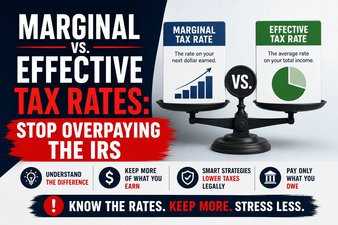
It's a common misconception among business owners that they are aware of their tax rate. They do see a 22% or 24% and they think that's the amount that they pay. They are wrong. And that misconception is costing them a bundle each and every year.
There are two numbers that reflect your actual tax situation. Your marginal rate. And your effective rate. One of the costliest errors a business owner can make can be confusing them. Whether it is the first or the second, it is a place where true tax savings start.
What Is a Marginal Tax Rate?
Marginal tax rate is the rate that is applied to the last dollar of income. It is not the rate that is charged on all dollars earned. This is the primary point to keep in mind.
The United States has a progressive tax system. Income is taxed in a graduated manner. The rates are different for each layer. For 2025, those layers go from 10% to 37%, at the bottom and at the top, respectively.
Here are some examples of its use in action. One man makes $85,000 from his income, which is all taxable to him. The first $11,925 is taxed at 10%. Income from $11,926 to $48,475 is taxed at 12%. Income from $48,476 to $85,000 is taxed at 22%. The marginal rate is 22% of the tax rate. However, the taxpayer does not pay 22% of the $85,000.
This is the bracket legend. A significant portion of people get concerned about entering the next bracket. They are afraid that their whole earnings will be subject to the higher rate. That is not the way it is. The income within brackets only receives the brackets rate. Nothing more.
What is an Effective Tax Rate?
Effective Tax Rate is your actual tax rate. It is equal to the amount of tax divided by the amount of income. It will reveal the percentage of your income that actually went to the IRS.
With the same example. If an individual with $85,000 in taxable income is single, they could be liable for around $13,300 in federal income taxes. Divide that by $85,000. The effective rate is about 15.6%. That is quite low compared with the 22% marginal rate.
The challenge is between the marginal rate and the effective rate, that's where opportunity resides. With careful tax planning, that disparity grows. It contracts, and you get more overpaid, when you ignore it.
Why Business Owners Overpay
There are three primary reasons why business owners are overpaying.
The first reason is because you mix up the marginal rate with actual liability. They use their highest income tax rate for all income. So they don't plan. They skip deductions. They pay off more than they owe.
The second reason is to fail to exclude necessary deductions. All deductions lower your taxable income. The lower the taxable income, the lower the tax brackets that are hit. The lower brackets indicate lower effective rates. Any business-related costs, retirement contributions, health insurance premiums, or home office costs can lower the amount the IRS considers to be taxable income.
The third is bad timing. Deductions and income can be deferred. For a business owner, the ability to accelerate deductions into a year with a high income, and defer income into a year with a lower income, can make a significant difference in the effective rate. This is a careless part of the thought, most of the time, of an owner. The fact is they have no idea how to file. Not what might have been organized.
The Real Math Behind Lowering Your Effective Rate
Deductions aren't simply a way to lower your taxable income. They may bump you down to a lower marginal bracket completely. That doesn't help matters.
Let's assume a man is a business owner with $210,000 of taxable income. They have a marginal rate of 32%. However, a $15,000 SEP-IRA contribution reduces income by $195,000. This helps to keep them under 32%. They get a lower marginal rate of 24%. And their working rate declines as well. The savings from a single contribution decision can easily be more than $4000.
Tax credits are even more effective. A Deduction is a subtraction from taxable income. A credit is an amount subtracted directly from the tax owed. Dollar for dollar. Owners of qualifying businesses may experience a dramatic reduction in their effective rate, with credits such as the Work Opportunity Tax Credit, research and development, and others available.
That's where tax return filing service professionals come in. Correct filing is not all that it is about. It's all about smart filing. The difference in a basic and strategically prepared return is thousands of dollars.
Entity Structure Changes Everything
The way your business is organized influences both your marginal and effective rates. It is one of the most forgotten tax planning tools.
Sole trader tax is levied on the total net profit. This represents an additional 15.3% over income taxes. An S corporation enables the owner to divide the income between salary and distributions. The portion of salary is what will cause self-employment tax. The distributions don't. This business structure change can save or result in a savings of $8,000 and up per year for a company with a $150,000 profit.
A C corporation will be taxed at a flat 21% federal rate. That's lower than a lot of personal marginal rates. The OBBBA adopted this rate as their permanent rate. While the math was not always in the favor of the high earning business owner, the numbers do now make sense for them to structure their business as a C corporation, particularly when the profits are reinvested into the business and not paid out to shareholders.
These decisions are not one-size fits all. They are decisions that add up over the years, though. If you get them wrong, it will cost you. Doing them right creates wealth.
Now that's a message worth listening to.This is a message you can't not hear.
Compliance Is Not Optional
The following is a reality that many business owners are unaware of. Reducing taxes and full compliance don't have to be mutually exclusive. They go together.
Some owners attempt to lower their taxes by under-reporting income or over-stating expenses. It's not a strategy. That is a risk. The IRS is equipped with far more data-matching capabilities than ever before. Audits follow patterns. The costs of not complying with this regulation are greater than any short-term savings.
The key to real tax reduction is to utilize the code as it is written. Deductions, credits, timing and structure. All legal. All documented. All defensible.
This is what expert business compliance services offer. They make sure that all of the deductions claimed are substantiated. All credits are documented. All filings are timely and accurate. Compliance is not a cost center. It is protection.
What to Do Right Now
The first step is to know your effective rate (not your marginal rate). This number is available from your accountant. If they cannot generate it in a timely fashion, this is a red flag.
Next, check your deductions. Have you reached the limits of your retirement contributions? Are you documenting all of your allowable business costs? Have you got credits that you have not cashed in?
Next check your structure. Still the correct entity type for your income and objectives?
Finally, plan ahead. Tax return filing services are most useful if they are all year long and aren't just a filing process in April. The actual savings are in the months leading up to the return. Not after.
Revive Business helps business owners get caught up between what they feel they owe and what they actually owe, legally, strategically and even with full compliance. That is a space that can be greater than they realize.
Cease paying marginal rate. Begin to control your effective rate. This is where a lot of the money is.
Revive Business provides expert tax planning, tax return filing services, and business compliance services for small and mid-sized businesses across the US. Learn more at revive-business.com.