Getting Your Marriage Certificate Apostilled for Use Abroad
-

- Published Updated
- 85 views
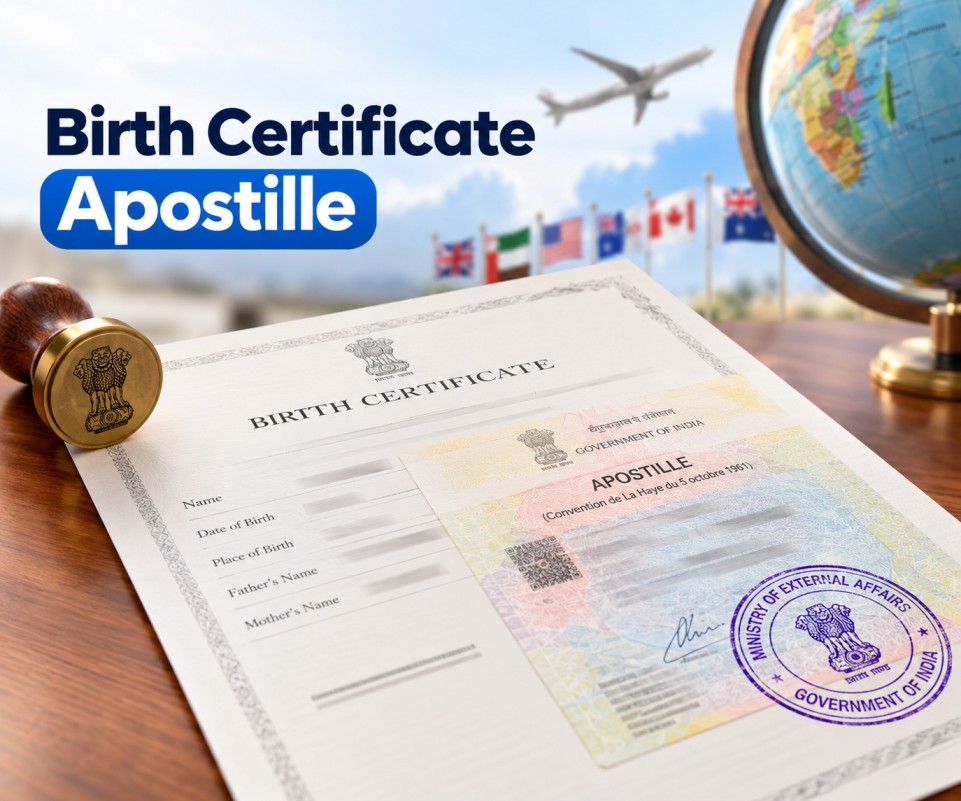
Most couples hear about this at the worst possible time. The visa appointment is booked, the folder is almost ready, and then someone mentions that the foreign office wants an apostilled marriage certificate. The plain copy you collected from the registrar's office won't do. The process isn't hard once you know the order of things, so here is how it usually goes.
What a Marriage Certificate Apostille is
An apostille is a certificate attached to a public document. It confirms that the signature, seal and designation of the official who issued that document are genuine. The idea comes from the Hague Convention of 1961, and India has been a member since 2005. Countries in the convention accept an apostilled document without asking for embassy legalisation. A Marriage Certificate Apostille doesn't prove your marriage all over again. It only tells the foreign authority that the certificate in your hand is a real Indian public document.
Why you might need one
A foreign office has no easy way to check the stamp of an Indian sub-registrar, so the apostille gives them something standard to rely on. It usually comes up for spouse or dependent visas, residence permits, name changes on foreign records, joint property or bank matters, and a child's immigration papers when proof of the parents' marriage is needed. Some countries also ask for it if you want to register your marriage there.
What to keep ready
The list changes a little from state to state, but most people need these:
- The original marriage certificate from the registrar
- Passport copies of both spouses
- ID proof and address proof
- Passport size photographs
- A signed application or covering letter
Check how your names are spelled on every paper. If something doesn't match your passport, sort that out before you apply, because fixing it later costs far more time.
How the process works
Step 1, confirm the marriage is registered. Only a certificate from a government registrar can be apostilled. One from a temple, a priest or a community hall can't. If your marriage was never registered, do that first under the Hindu Marriage Act, the Special Marriage Act or whatever your state follows.
Step 2, state attestation. The certificate first goes to the designated state authority, usually the Home Department, which verifies the registrar's signature.
Step 3, apostille from the MEA. Once the state has attested it, the Ministry of External Affairs issues the apostille. You apply through the MEA's online system, and the apostille carries a unique number.
Step 4, check the final document. Read the names, the dates and the apostille number. A small mistake is much easier to correct now than after you land in another country.
Step 5, ask about translation. If the certificate isn't in English, or the destination country works in another language, ask the receiving authority whether a certified translation is needed and whether that translation must be apostilled too.
Validity and timing
An apostille has no expiry date. Even so, many foreign authorities prefer a recent one, often apostilled within the last three to six months, so check what your destination expects. Processing time depends on the state and on how busy the offices are. It can be a few working days or a couple of weeks, so give yourself more room than you think you need.
Mistakes people often make
- Applying with a photocopy instead of the original
- Skipping the state attestation
- Leaving name or date mismatches between the certificate and the passport
- Assuming the destination country accepts apostilles when it may not be a Hague member
- Starting a week before the visa interview
If the country isn't part of the convention, the document normally needs embassy legalisation after the MEA stage. It's worth confirming this early.
Getting help in Chennai
If you live outside the state or abroad, or you just can't spare the time to stand in queues, Apostille services in Chennai can take a lot of that work off your hands. A decent provider checks your certificate before submitting it, tells you plainly if something needs correcting, and keeps you posted until the document reaches you. Ask for the timeline in writing, and stay away from anyone who promises same-day results or says they have special access to government offices.
In short
A marriage certificate is a simple paper until a foreign office wants proof that it's genuine. Register the marriage, check the details, follow the attestation order and begin early. Do that, and the apostille becomes one of the easier parts of moving abroad.
Marriage Certificate Apostille : https://hrdattestation.in/apostille-marriage-certificate-in-india/
Single Status Certificate Apostille: https://hrdattestation.in/how-to-get-a-single-status-certificate-in-india/
Apostille Services in Chennai: https://hrdattestation.in/apostille-services-in-chennai/