Maximize 2024 ROI with Effective Email Marketing Strategies
-

- Published Updated
- 1,453 views

Effective email marketing remains one of the highest-return digital channels for businesses seeking to boost ROI in 2024. With careful list management, targeted segmentation, and a focus on deliverability and measurement, email programs can drive conversions across customer lifecycle stages while keeping costs relatively low.
- Prioritize segmentation, personalization, and clear calls to action to improve open rates and conversion rates.
- Monitor deliverability, list hygiene, and compliance with regulations such as CAN-SPAM and GDPR.
- Use A/B testing, lifecycle automation, and attribution models to measure and grow ROI.
Effective email marketing: core principles for better ROI
High-performing email programs focus on relevance, timing, and measurement. Relevance is achieved through segmentation and personalization that reflect customer intent and behavior. Timing comes from automation and lifecycle messaging that place offers when recipients are most likely to act. Measurement ties actions to revenue using metrics such as click-through rate (CTR), conversion rate, average order value, and overall campaign ROI.
Why email marketing still delivers strong ROI
Email remains cost-efficient because it leverages owned audiences rather than paid placement, and it supports multiple business goals: retention, reactivation, acquisition follow-up, and cross-sell. Studies in marketing science and industry benchmarks consistently show higher conversion rates from targeted email versus broad display ads when audience intent is considered.
Key metrics and semantic concepts to track
Open rate and click-through rate (CTR)
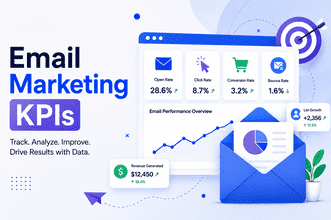
Open rate indicates subject line effectiveness and sender recognition; CTR measures the relevance of content and calls to action. Both should be segmented by audience cohort to reveal performance differences across customer types.
Conversion rate and revenue per email
Conversion rate ties email interactions to business outcomes. Revenue per email and revenue per recipient provide direct ROI visibility when combined with campaign costs and attribution models.
Deliverability and list hygiene
Deliverability affects all downstream metrics. Practices such as removing inactive addresses, authenticating sending domains (SPF, DKIM, DMARC), and monitoring bounce and complaint rates help maintain inbox placement.
Best practices and tactics to boost ROI
Segmentation and personalization
Segment by behavior (purchase history, site activity), demographics, and engagement level. Personalization should go beyond first name insertion to include product recommendations, dynamic content, and offers aligned with lifecycle stage.
Automation and lifecycle campaigns
Implement triggered messages for welcome flows, cart abandonment, post-purchase follow-ups, and win-back series. Automation increases relevance and reduces manual work, supporting steady revenue without constant campaign creation.
A/B testing and iterative optimization
Test subject lines, send times, creative elements, and calls to action. Use statistically sound sample sizes and track results across multiple cohorts before rolling out changes to the full list.
Compliance, privacy, and regulatory considerations
Compliance affects trust and deliverability. Regulations such as the U.S. CAN-SPAM Act and the EU General Data Protection Regulation (GDPR) set requirements for consent, opt-outs, and data handling. Industry guidance from regulators and consumer protection agencies should inform consent collection and retention policies. For a practical compliance guide, consult official resources such as the Federal Trade Commission's CAN-SPAM guide (FTC CAN-SPAM compliance guide).
Measuring and attributing ROI accurately
Attribution can be direct (last-click conversion) or modeled (multi-touch attribution). To estimate ROI, aggregate revenue tied to email campaigns, subtract campaign costs (including platform fees and creative production), and compute return on ad spend equivalent (email revenue divided by cost). Use cohort analysis to assess long-term value and retention uplift rather than only immediate transactions.
Operational considerations for sustainability
Data quality and list management
Maintain accurate preference data and regularly prune inactive subscribers. Proper list hygiene reduces complaint rates and improves engagement signals to mailbox providers.
Infrastructure and security
Authenticate domains, monitor sending reputation, and secure customer data to reduce the risk of fraud and maintain compliance with data protection rules enforced by authorities such as the European Commission.
Conclusion: practical next steps
Prioritize segmentation, automated lifecycle messaging, and ongoing measurement to increase the efficiency of email programs. Combine operational discipline (list hygiene, deliverability) with creative testing and clear attribution to realize sustainable ROI gains.
Further reading and standards
Explore guidance from regulatory bodies and peer-reviewed marketing research on personalization and privacy to align tactics with legal requirements and evidence-based practices.
What is effective email marketing and how does it boost ROI?
Effective email marketing uses segmentation, personalization, and timely automation to deliver relevant messages that increase engagement and conversions, improving ROI by driving repeat purchases and efficient customer communications.
Which metrics matter most for measuring email ROI?
Key metrics include conversion rate, revenue per email, open rate, click-through rate, unsubscribe and complaint rates, and customer lifetime value when attributing long-term impact.
How often should lists be cleaned and inactive users removed?
List cleaning cadence depends on sending frequency and engagement benchmarks; many programs review engagement quarterly and attempt re-engagement campaigns before removing truly inactive addresses to preserve deliverability.
What are basic deliverability checks to perform regularly?
Monitor bounce rates, spam complaints, inbox placement tests, sender reputation, and authentication records (SPF, DKIM, DMARC). Address any sudden changes quickly to avoid broad deliverability decline.
How does privacy regulation affect email marketing?
Regulations like CAN-SPAM and GDPR dictate consent, opt-out procedures, and data handling practices. Compliance reduces legal risk and supports consumer trust, which in turn supports engagement rates and ROI.