Microeconomics vs Macroeconomics: Key Differences Explained
-

- Published Updated
- 68 views
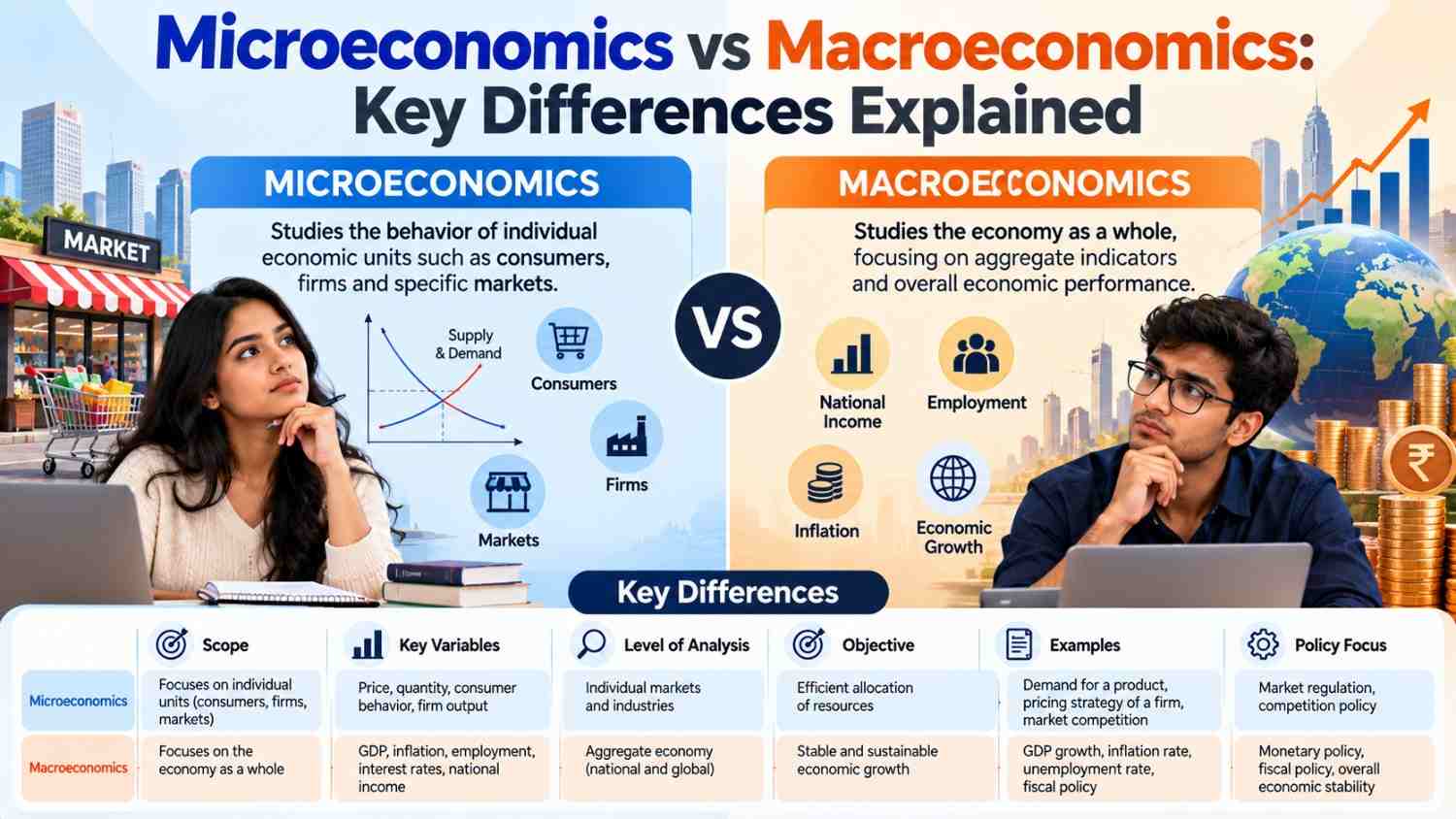
Every introductory economics course begins by drawing a line between microeconomics and macroeconomics — yet many students carry forward a fuzzy, imprecise understanding of exactly where that line falls, and why it matters for how economic problems are actually analysed. Getting this distinction genuinely clear is foundational for any further study of economics, business strategy, or public policy. This blog breaks down the key differences between the two branches clearly.
What Is Microeconomics?
Microeconomics studies the economic behaviour and decision-making of individual units within an economy — specific consumers, individual firms, and particular markets. It examines how these individual actors make choices around resource allocation, pricing, and production, and how their interactions determine outcomes within specific markets.
What Is Macroeconomics?
Macroeconomics studies the economy as a whole — aggregate measures like national income, overall employment levels, inflation, and economic growth, rather than the behaviour of individual consumers or firms. It examines how these aggregate factors interact and how government policy can influence overall economic performance at a national or global level.
Core Differences at a Glance
Scope: Microeconomics focuses on individual economic units (consumers, firms, specific markets); macroeconomics focuses on the economy as a whole (national income, aggregate employment, overall price levels).
Key variables studied: Microeconomics examines individual prices, individual firm output, and specific market supply-demand dynamics; macroeconomics examines GDP, national inflation rates, aggregate unemployment, and overall economic growth.
Approach: Microeconomics generally uses a "bottom-up" approach, building understanding from individual decision-making units; macroeconomics uses a "top-down" approach, analysing the economy through aggregate measures and their interrelationships.
Policy relevance: Microeconomics informs decisions like individual firm pricing strategy or specific market regulation; macroeconomics informs broader government policy decisions like monetary policy (interest rates) and fiscal policy (government spending and taxation).
Key Topics Within Microeconomics
Demand and supply analysis: How individual consumer demand and firm supply interact to determine market prices and quantities.
Consumer behaviour and utility theory: How individual consumers make purchasing decisions to maximise satisfaction given their budget constraints.
Production and cost theory: How individual firms make production decisions to minimise costs and maximise profit.
Market structures: Analysis of different competitive environments — perfect competition, monopoly, oligopoly, and monopolistic competition — and how firm behaviour differs across these structures.
Factor markets: How markets for labour, capital, and other production inputs determine wages, rental rates, and other factor prices.
Key Topics Within Macroeconomics
National income accounting: Measuring and analysing aggregate economic output through metrics like GDP (Gross Domestic Product) and GNP (Gross National Product).
Inflation and price levels: Understanding aggregate price level changes across the entire economy, rather than individual product prices.
Unemployment: Analysing aggregate labour market conditions and the various types of unemployment (frictional, structural, cyclical) at a national level.
Monetary policy: How central banks (like the Reserve Bank of India) use tools like interest rates and money supply management to influence overall economic activity.
Fiscal policy: How government spending and taxation decisions influence aggregate economic activity and national income.
International trade and balance of payments: Analysing a nation's overall trade relationships and financial flows with the rest of the world.
Economic growth and business cycles: Understanding long-term economic growth trends and shorter-term fluctuations between expansion and recession.
How Microeconomics and Macroeconomics Connect
Despite their different focus, microeconomics and macroeconomics are deeply interconnected rather than entirely separate fields. Macroeconomic outcomes are, in an important sense, the aggregate result of countless individual microeconomic decisions — millions of individual consumer and firm choices ultimately aggregate up to determine national income, employment, and overall economic output. Conversely, macroeconomic conditions (like overall inflation or interest rate levels) significantly shape the environment within which individual microeconomic decisions are made — a firm's pricing and investment decisions, for instance, are shaped by the broader macroeconomic backdrop of interest rates and consumer demand conditions.
Practical Examples Illustrating the Difference
Microeconomic question: "How will a specific coffee shop's sales change if it raises its coffee price by ₹20?" — this examines individual firm and consumer behaviour within a specific market.
Macroeconomic question: "How will overall consumer spending across the economy change if the Reserve Bank of India raises interest rates?" — this examines aggregate economic behaviour and policy impact at a national level.
Why Both Branches Matter for Business and Policy
For business strategy: Microeconomic principles inform pricing, competitive positioning, and individual market entry decisions, while macroeconomic understanding helps businesses anticipate broader economic cycles, interest rate trends, and overall demand conditions that affect strategic planning.
For public policy: Macroeconomic analysis directly informs decisions around monetary and fiscal policy aimed at managing inflation, employment, and growth, while microeconomic analysis informs more targeted policy interventions like specific market regulation or competition policy.
For individual career and investment decisions: Understanding both branches helps individuals make more informed decisions — microeconomic principles for personal financial choices and career market positioning, and macroeconomic awareness for broader investment timing and risk assessment.
Final Thoughts
Microeconomics and macroeconomics represent two complementary lenses for understanding economic activity — one zoomed in on individual decision-making units, the other zoomed out to aggregate, economy-wide patterns. Rather than viewing them as entirely separate fields, understanding how they interconnect — individual decisions aggregating into macroeconomic outcomes, and macroeconomic conditions shaping the context for individual decisions — provides a more complete, genuinely useful economic understanding.
To explore more detailed explanations of microeconomic and macroeconomic concepts, refer to the difference between micro and macro economics guide for complete, updated information.
Frequently Asked Questions
What is the main difference between microeconomics and macroeconomics?
Microeconomics studies individual economic units (consumers, firms, specific markets), while macroeconomics studies the economy as a whole through aggregate measures like national income and overall employment.
Can microeconomics and macroeconomics be studied independently of each other?
While they're distinct branches with different focus areas, they're deeply interconnected, since aggregate macroeconomic outcomes are ultimately built from countless individual microeconomic decisions.
Which branch is more relevant for business pricing decisions?
Microeconomics is more directly relevant for specific pricing and competitive strategy decisions, though macroeconomic conditions (like overall demand and interest rates) also shape the broader context for these decisions.
Which branch studies inflation and unemployment?
Macroeconomics studies these as aggregate, economy-wide phenomena, distinct from microeconomics' focus on individual prices and specific labour markets.