Step-by-Step MVP Development Guide for Startups and Product Teams
-

- February 23rd, 2026
- 1,295 views

FREE SEO Topical Map Generator: Find Your Next Content Ideas
MVP development is the practice of creating a Minimum Viable Product to validate assumptions, test demand, and gather user feedback with minimal cost and time. A well-executed MVP helps teams prioritize features, reduce risk, and begin learning from real users before committing significant resources.
- Define a clear problem and target users before building.
- Prioritize core functionality that validates the main hypothesis.
- Use rapid prototypes, gated releases, and user testing to iterate.
- Measure adoption, retention, and engagement to assess product-market fit.
MVP development: Planning and process
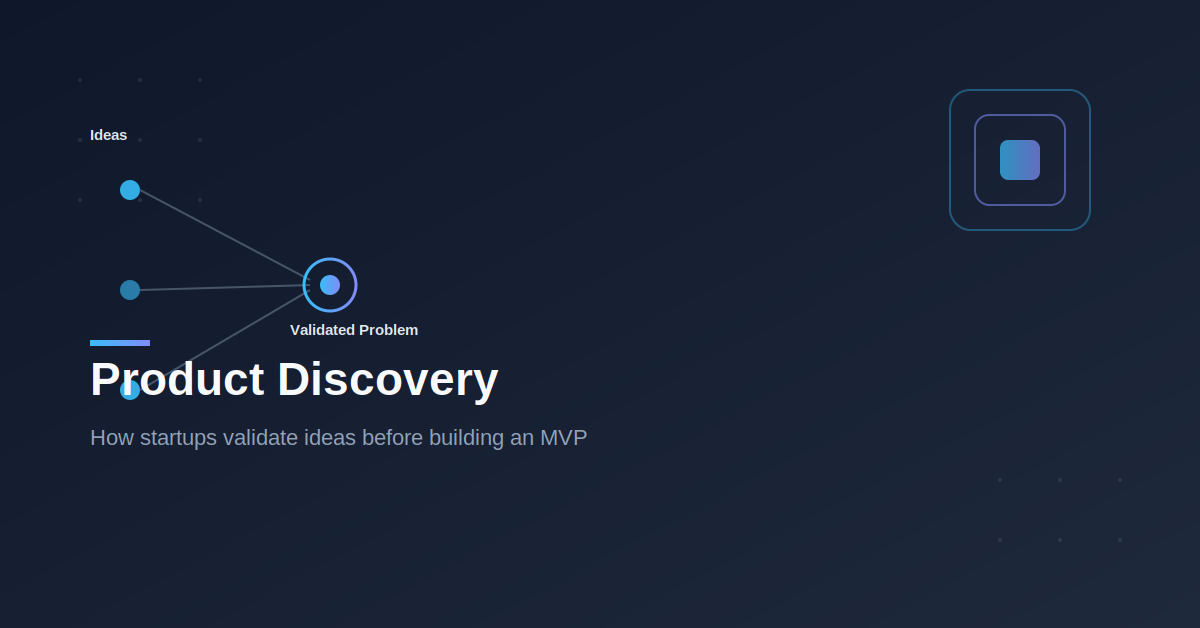
Start by defining the primary hypothesis: what value the product promises and which users will adopt it. Effective planning uses user research, competitive analysis, and a prioritized product backlog. Common frameworks include user personas, job-to-be-done statements, and lean canvases to capture assumptions.
Clarify the problem and hypothesis
Document the user problem, the proposed solution, and the success criteria for validation. Hypotheses should be specific and testable, for example: "If 100 trial users complete onboarding within 5 minutes, interest exists in feature X."
Define the core feature set
Select only the features required to validate the hypothesis. Avoid feature creep by distinguishing between core, supporting, and future features. Techniques such as the MoSCoW method (Must, Should, Could, Won't) help prioritize effectively.
Design, prototyping, and user testing
Design decisions for an MVP emphasize clarity and speed. Low-fidelity prototypes and clickable mockups verify flows without full engineering investment. Early user testing informs usability and helps catch major assumptions.
Prototyping approaches
Options include paper sketches, wireframes, interactive prototypes, or a concierge/manual MVP that simulates service processes behind the scenes. A/B testing and usability sessions reveal which flows convert early adopters.
User testing and feedback loops
Recruit representative users for moderated or unmoderated tests. Collect qualitative feedback on pain points and quantitative metrics such as task completion rate and time on task. Use feedback to update the backlog and iterate quickly.
Build, launch, and measure
Implement the MVP with a lightweight architecture that supports rapid changes. Continuous delivery and basic monitoring systems allow frequent deployments and quick rollback if needed. Track usage data to evaluate hypotheses.
Key metrics to track
Measure acquisition (how users find the product), activation (first successful experience), retention (returning users), engagement (core actions completed), and referral (users recommending the product). These dimensions align with common product metrics frameworks used to assess product-market fit.
Iterate based on evidence
Decisions should be data-informed: keep features that improve key metrics and remove or rework those that do not. Prioritize fixes that reduce friction in onboarding and increase first-time value.
Technical and organizational considerations
Design the MVP to minimize technical debt while allowing scalable enhancements. Maintain a clear product roadmap, documentation, and automated tests for core flows. Cross-functional teams combining product, design, and engineering accelerate validated learning.
Risk management and compliance
Identify regulatory requirements (data protection, accessibility, industry-specific rules) early. In many jurisdictions, standards from regulators and organizations such as national data protection authorities influence implementation choices.
When to scale
Scale only after consistent positive signals across acquisition, activation, and retention metrics. Prepare operational capacity for customer support, infrastructure, and legal compliance before broad rollouts.
Common pitfalls and how to avoid them
Building too much
Expanding the scope beyond the validation goal delays learning and consumes budget. Avoid equating an MVP with a feature-complete product.
Ignoring qualitative feedback
Numbers show what happens; interviews explain why. Combine analytics with customer conversations to uncover root causes and new opportunities.
Confusing MVP with prototype
Prototypes are for design validation; an MVP delivers enough value to real users and collects behavioral data. Choose the approach that matches the learning objective.
Resources and further reading
Government and business support organizations provide guidance for early-stage ventures and market research. For practical guidance on market validation and planning, consult the U.S. Small Business Administration: U.S. Small Business Administration. Academic and industry literature on the Lean Startup methodology and product-market fit can provide additional frameworks for experimentation and scaling.
Conclusion
MVP development is a structured approach to learning quickly and cheaply. By focusing on a testable hypothesis, prioritizing core features, measuring the right metrics, and iterating based on user feedback, product teams can reduce risk and discover sustainable product-market fit.
What is MVP development and why does it matter?
MVP development is the process of building the smallest product version that validates a core hypothesis. It matters because it enables rapid learning, lowers initial investment, and reveals whether a product concept meets user needs before full-scale development.
How long does it take to build an MVP?
Timeframes vary by complexity, team size, and market context. Typical MVPs range from a few weeks for simple prototypes to several months for functional beta products. Focus on the smallest scope that answers the validation question.
How to measure if an MVP is successful?
Success is measured against predefined criteria tied to the hypothesis—user adoption, retention, engagement, and conversion rates. Qualitative feedback and willingness to pay (if applicable) are also strong indicators of success.
When should an MVP be scaled into a full product?
Consider scaling when metrics show consistent user acquisition, meaningful retention, and growth signals, and when operational and regulatory readiness are in place. Scaling should follow repeated validation, not a single positive experiment.