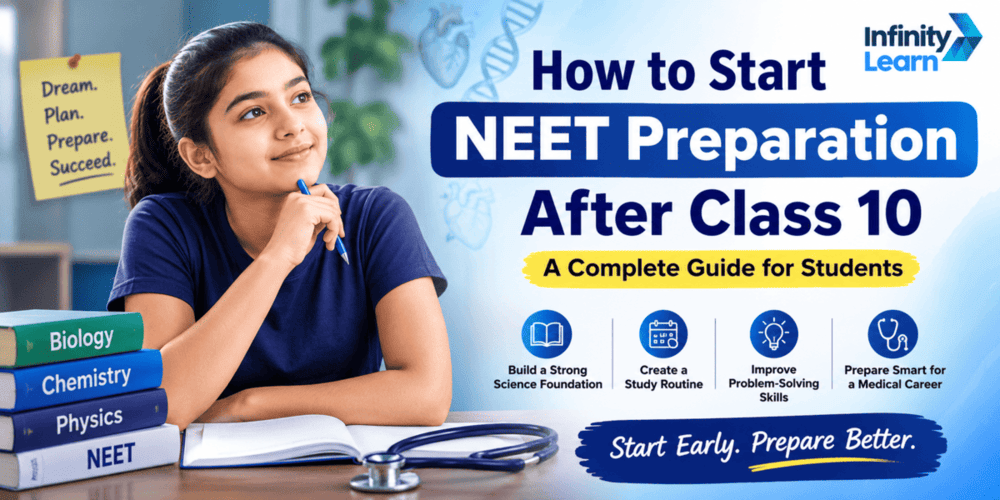
How to Start NEET Preparation After Class 10: A Practical Two-Year Roadmap
-

- Published Updated
- 4,022 views
Finishing Class 10 is an important stage for any student who wants to become a doctor. Until this point, most students focus on board exams, school homework, and basic Science concepts. But after Class 10, the academic journey becomes more focused. Students who choose Biology in Class 11 often start thinking seriously about NEET.
The good news is that NEET preparation does not have to begin with pressure. It should begin with clarity.
A student who starts early has enough time to understand concepts, practise questions, improve accuracy, and build confidence. The aim is not to study all day from the first month. The aim is to build the right habits from the beginning.
Why Class 11 Is the Right Time to Start NEET Preparation
NEET preparation is mainly based on Class 11 and Class 12 Physics, Chemistry, and Biology. So, once a student enters Class 11, every chapter becomes important from both school and entrance exam points of view.
Many students make the mistake of taking Class 11 lightly and then trying to cover everything in Class 12. This usually creates stress because Class 12 also has board exams, practicals, school tests, and revision pressure.
Starting after Class 10 gives students a clear advantage. They get two full academic years to understand the syllabus instead of rushing through it later.
Step 1: Choose the Right Stream and Subjects
The first step is choosing the right academic path. Students aiming for NEET should usually choose Physics, Chemistry, and Biology in Class 11. Mathematics may be optional depending on the school and the student’s interest, but Biology must be taken seriously from day one.
Before selecting the stream, students should ask themselves:
Do I enjoy Biology?
Am I ready to study Physics and Chemistry regularly?
Am I interested in healthcare, medicine, research, or life sciences?
NEET preparation needs consistency. Interest in the subject matters because students will be studying these topics in depth for two years.
Step 2: Understand the NEET Syllabus Early
Students should not wait until the end of Class 11 to look at the NEET syllabus. A simple syllabus overview in the beginning helps them understand what lies ahead.
The syllabus can be divided into three major subjects:
Biology
Biology carries strong scoring potential for NEET aspirants. Students should focus on NCERT line-by-line understanding, diagrams, definitions, processes, and examples.
Important Class 11 areas include cell biology, plant physiology, human physiology, diversity in the living world, and biomolecules.
Chemistry
Chemistry has three parts: Physical Chemistry, Organic Chemistry, and Inorganic Chemistry. Students should build basic clarity in mole concept, atomic structure, chemical bonding, periodic table, and thermodynamics.
These chapters help in both Class 11 and Class 12.
Physics
Physics often feels difficult for many NEET students because it needs concept clarity and numerical practice. Students should start with basics like units, motion, laws of motion, work, energy, power, and gravitation.
The mistake students should avoid is memorising Physics without solving problems.
Step 3: Build NCERT Reading Habits
For NEET, NCERT is not just a school textbook. It is the base material, especially for Biology and Chemistry. Students should learn how to read NCERT properly.
A good method is:
Read the chapter once for understanding.
Underline important definitions and examples.
Make short notes in your own words.
Revise diagrams and tables.
Practise questions after each topic.
In Biology, students should pay attention to small lines, examples, scientific names, and diagrams. Many questions test basic understanding, but the details matter.
Step 4: Do Not Ignore Class 11 Basics
Class 11 is where many students lose confidence. The jump from Class 10 to Class 11 feels big because the subjects become deeper and more application-based.
This is especially true for Physics and Chemistry. A student who does not understand mole concept may struggle in several Chemistry chapters later. A student who skips kinematics may find mechanics difficult.
So, the first goal should be strong basics, not speed.
Students should not think, “I will study seriously in Class 12.” NEET preparation becomes much easier when Class 11 is handled properly.
Step 5: Create a Simple Weekly Study Plan
A complicated timetable is not useful if students cannot follow it. After Class 10, students should begin with a simple weekly plan.
Here is a practical approach:
Study Biology daily for at least 45 to 60 minutes.
Practise Physics numericals 4 to 5 days a week.
Revise Chemistry concepts and formulas regularly.
Take one small test every week.
Keep one day for revision and backlog clearing.
The timetable can change based on school hours and coaching schedule. What matters most is consistency.
Step 6: Start Practice Slowly, Then Increase
In the first few months of Class 11, students do not need to solve very advanced questions immediately. They should first understand the concept and then practise basic to moderate-level questions.
A good practice order is:
NCERT reading
Solved examples
Topic-wise questions
Previous-year NEET questions
Mixed chapter tests
Full-length tests later
This approach helps students avoid confusion. They also learn how questions are framed from each chapter.
Step 7: Learn From Mistakes
Many students take tests but do not analyse them. This is one of the biggest mistakes in NEET preparation.
After every test, students should check:
Which questions were wrong?
Was the mistake due to concept confusion?
Was it a silly mistake?
Did time pressure affect accuracy?
Which chapter needs revision?
A mistake notebook can help. Students can write down wrong formulas, confusing concepts, and repeated errors. This notebook becomes very useful during revision.
Step 8: Balance School and NEET Preparation
Students should not treat school and NEET as two separate worlds. The same Class 11 and Class 12 subjects are important for both.
The smart approach is to study each chapter once properly and then practise it from both school and NEET perspectives.
For example, after learning a Biology chapter in school, students can revise NCERT, practise objective questions, and solve NEET-level questions from that same chapter. This saves time and reduces duplication.
Step 9: Use Guidance When Needed
Self-study is important, but many students need structured guidance, especially for Physics numericals, Chemistry concepts, doubt solving, and regular testing.
This is where the right coaching support can help. A good NEET preparation platform should provide clear concept teaching, regular tests, doubt resolution, performance tracking, and revision support.
Platforms like Infinity Learn can help students follow a more organised NEET preparation path through live classes, practice material, doubt support, and exam-focused learning. For students starting after Class 10, this structure can make the two-year journey more manageable.
Step 10: Avoid These Common Mistakes
Students starting NEET preparation after Class 10 should avoid these mistakes:
Ignoring Class 11 chapters
Only reading theory without practising questions
Depending too much on memorisation
Not revising Biology regularly
Skipping tests because of fear
Studying without a timetable
Collecting too many books and resources
Comparing progress with other students
A calm and steady approach works better than panic-based preparation.
Final Thoughts
Starting NEET preparation after Class 10 is a smart decision, but it should be done with the right mindset. Students do not need to feel pressured from the first day of Class 11. They need a clear plan, strong NCERT habits, regular practice, and proper revision.
The two years after Class 10 can build a strong foundation for NEET if students use them wisely. With the right study routine and guidance, NEET preparation becomes less stressful and more focused.
The goal is simple: understand well, practise regularly, revise often, and keep improving step by step.