Why North India Tour Should Be on Every Wildlife Lover's Bucket List
-

- Published Updated
- 8,621 views
If someone told me a few years ago that I'd be standing at the edge of a jungle in Rajasthan, watching a tiger disappear silently into the golden grass at dusk, I probably wouldn't have believed them. I'd always thought of India's north as a place of forts and palaces, of spice markets and ancient temples. What I didn't realize — until I actually went — was that a north India tour can be one of the most thrilling wildlife experiences on the planet.
And I'm not alone in that discovery.
The Wild Side of North India Nobody Talks About Enough
Most travel blogs will tell you to see the Taj Mahal. Visit Jaipur's pink streets. Catch a camel fair in Pushkar. All of that is absolutely worth doing. But if you stop there, you're only seeing half the picture.
North India is home to some of the most biodiverse landscapes in the entire subcontinent. From the terai grasslands of Uttarakhand to the dry deciduous forests of Rajasthan, the region packs an incredible variety of ecosystems into a relatively compact geography. That's what makes wildlife tours in India focused on the north such a unique proposition — you're not just chasing one species or one habitat. You're moving through an entire tapestry of wild India.
I've met travelers who spent two weeks doing a north India circuit and came back having spotted tigers, leopards, sloth bears, gharials, elephants, and over 400 species of birds. That's not a wildlife documentary. That's just a well-planned itinerary.
Rajasthan: The Desert That Surprised Me Most
When people think of Rajasthan wildlife tours, the first reaction is often skepticism. A desert state? For wildlife? But Rajasthan has been quietly earning its reputation as one of India's premier wildlife destinations, and once you've experienced it firsthand, the skepticism evaporates fast.
Ranthambore — Where Tigers Roam Among Ruins
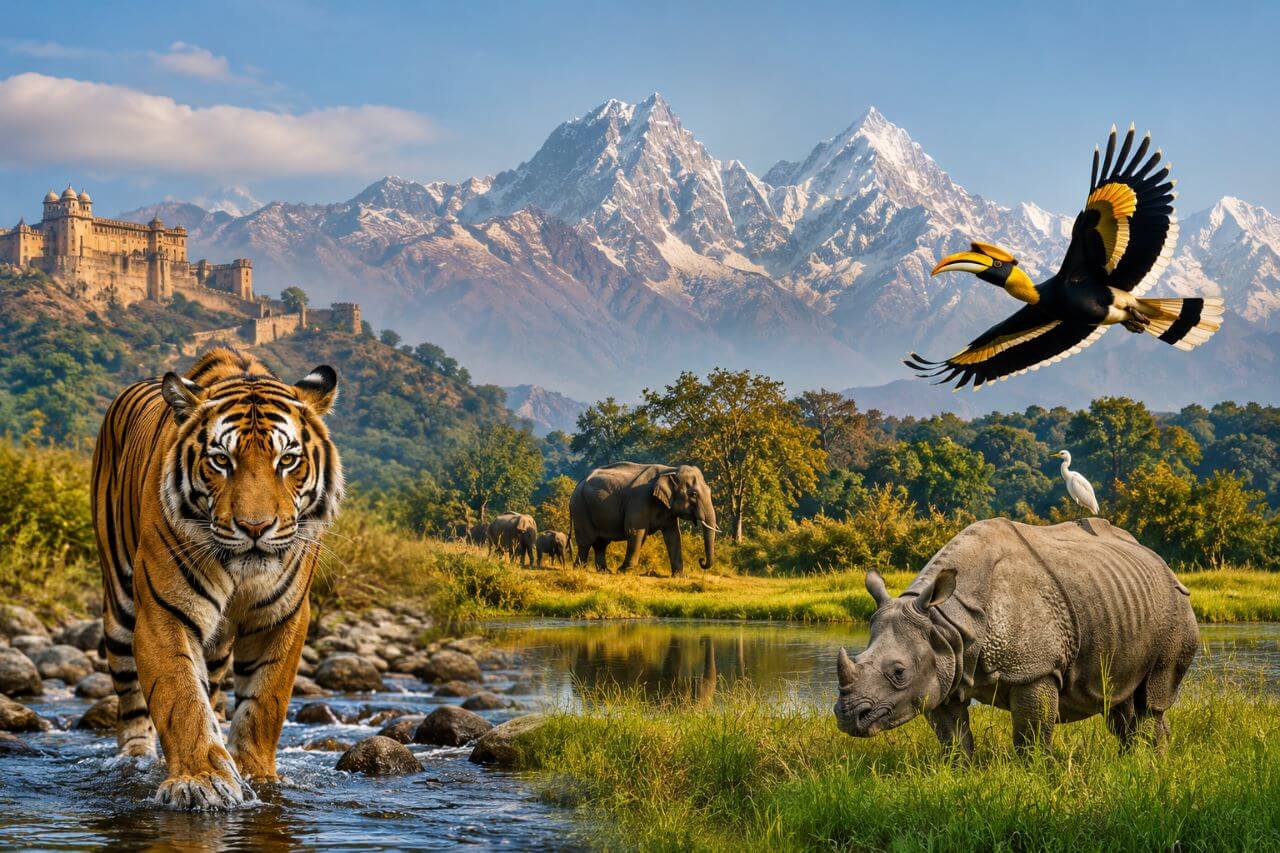
Ranthambore National Park is the crown jewel of any Rajasthan wildlife tour, and for good reason. There's something almost cinematic about seeing a Bengal tiger lounging near a 10th-century fort or reflected in the still surface of a jungle lake. The park's relatively open terrain and habituated tiger population make it one of the best places in the world to actually see a tiger in the wild — not just hope for one.
Early morning safaris here are something you feel in your bones. The air is cool, the light is soft gold, and the jungle is alive with alarm calls that tell you something's moving nearby. When you finally spot a tiger — and the odds are genuinely in your favor at Ranthambore — the silence that falls over the safari jeep is unlike anything I've experienced anywhere else in the world.
Beyond tigers, Ranthambore hosts leopards, striped hyenas, jungle cats, marsh crocodiles, and an extraordinary birdlife including the Indian eagle owl and painted storks.
Sariska — The Comeback Story
Sariska Tiger Reserve, also in Rajasthan, carries a remarkable story of conservation resilience. After its tiger population was wiped out by poaching in the early 2000s, tigers were reintroduced — and they've been thriving. It's now one of India's conservation success stories, and visiting feels like being part of something meaningful.
Sariska also sits closer to Delhi, making it a practical stop on a broader north India circuit.
Keoladeo — A Birdwatcher's Dream
No Rajasthan wildlife tour is complete without a morning at Keoladeo Ghana National Park in Bharatpur. A UNESCO World Heritage Site, this wetland is one of the world's most important bird sanctuaries. During winter, it hosts tens of thousands of migratory birds from Central Asia and Siberia — including the critically endangered Siberian crane when conditions are right. Even outside peak season, the sheer density and variety of birdlife here is staggering.
Beyond Rajasthan: Completing the North India Wildlife Circuit
A well-designed north India wildlife tour doesn't have to stop at the Rajasthan border. The region offers several other remarkable destinations that pair beautifully with a Rajasthan leg.
Jim Corbett — India's Oldest National Park
Nestled in the foothills of the Himalayas in Uttarakhand, Jim Corbett National Park holds the distinction of being India's first national park and a founding reserve under Project Tiger. The landscape here is dramatically different from Rajasthan — dense sal forests, river valleys, and mist-covered hills that feel genuinely wild and remote.
Corbett is famous for tigers, but elephants steal the show just as often. Watching a herd of wild elephants cross a river in the early morning light is a memory that doesn't fade. The park also hosts leopards, gharials, king cobras, and over 600 bird species.
Dudhwa — The Forgotten Gem
Dudhwa National Park in Uttar Pradesh doesn't get the attention it deserves. Bordering Nepal, this terai ecosystem is home to tigers, one-horned rhinos (reintroduced successfully), elephants, barasingha deer, and an incredible array of wetland birds. If you want to experience genuine wilderness without the crowds that come with more famous parks, Dudhwa delivers.
How to Plan Your North India Wildlife Tour
Planning wildlife tours in India requires a bit of strategy, but it's more accessible than people assume.
Best time to visit: October to June covers most parks, with peak wildlife viewing typically between February and May when vegetation thins and animals congregate near water. Ranthambore and most Rajasthan parks close during the monsoon (July–September).
How to get around: Delhi is the natural hub for a north India tour. Most major wildlife destinations — Ranthambore, Corbett, Sariska, Bharatpur — are reachable by road or train within 3–6 hours. A typical circuit of 10–14 days can comfortably cover 3–4 parks.
Safari options: Most parks offer both jeep safaris and, in some cases, canter (open bus) safaris. Booking government-allocated jeep safaris in advance is strongly recommended, especially for Ranthambore, which has limited daily entry slots.
Stay choices: Accommodation near India's top wildlife parks ranges from comfortable forest lodges to surprisingly luxurious eco-resorts. In Rajasthan especially, heritage properties near park boundaries give you the added pleasure of experiencing the region's architectural legacy alongside its wildlife.
What Makes North India Different from Other Wildlife Destinations
I've done wildlife travel in East Africa, Southeast Asia, and South America. Each has its own magic. But north India offers something genuinely distinct: the layering of culture and nature that you don't find anywhere else quite like this.
On a single trip, you can watch a tiger at dawn, visit a 16th-century Mughal monument at noon, and sit under a sky full of stars at a desert camp by evening. The food changes dramatically as you move across states. The languages shift. The architecture evolves. And through it all, the wildlife remains a constant thread connecting the journey.
That's what makes a north India tour so compelling for travelers who want more than a single-note experience. The wildlife is the headline, but the supporting cast — the people, the history, the landscapes — elevates the whole thing into something genuinely unforgettable.
A Few Practical Tips Before You Go
- Book tiger safari permits early. Ranthambore especially fills up weeks in advance during peak season. Don't leave this to the last minute.
- Travel with a naturalist guide. The difference between spotting wildlife and understanding wildlife is enormous. A good naturalist transforms a game drive into an education.
- Pack layers. Early morning safaris in the cooler months can be biting cold, even in Rajasthan. Afternoons warm up quickly, so layers you can peel off are essential.
- Respect the rules. Stay in the vehicle, maintain silence near sightings, never feed animals. These rules exist to protect both you and the wildlife, and India's parks enforce them seriously.
- Give it time. Wildlife doesn't perform on schedule. The best sightings often come to those who sit quietly and wait. Resist the urge to rush through in a day.
Final Thoughts
There's a version of a north India tour that hits the Golden Triangle and calls it done. And there's another version — the one that ventures into the forests at dawn, follows pug marks through tall grass, and comes back with stories that have nothing to do with temples or palaces.
Both versions have their place. But if you ask me which one stays with you longer, I'll always say the one where a tiger looked you directly in the eye across a clearing in Ranthambore and then slipped back into the jungle like it was never there at all.
North India's wildlife is not a footnote to its cultural attractions. It's a destination in its own right — ancient, extraordinary, and more accessible than most people realize. Plan your Rajasthan wildlife tour, build in time for Corbett or Dudhwa, and see for yourself what this part of the world has been quietly offering all along.