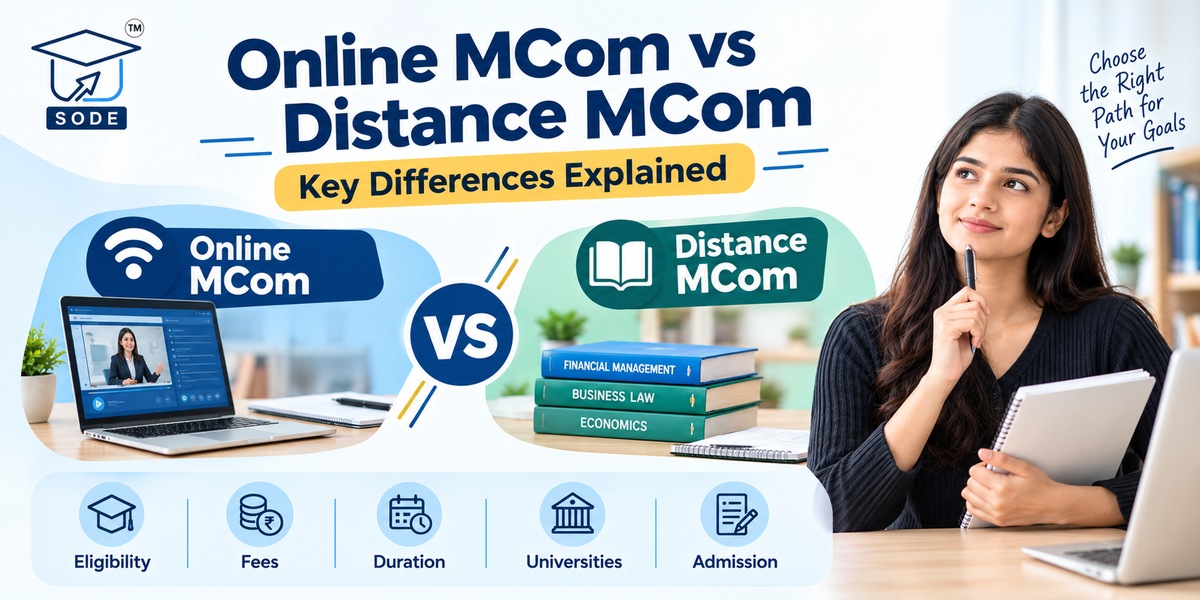
Online MCom vs Distance MCom: Key Differences Explained
-

- Published Updated
- 2,092 views
Choosing between an Online MCom vs Distance MCom can be confusing because both allow students to complete a Master of Commerce without attending a conventional college every day. However, the way classes are delivered, students interact with faculty, study materials are provided, and academic support is offered can differ considerably.
An Online MCom Course primarily uses digital learning platforms, live or recorded sessions, e-learning materials, and online academic interaction. MCom Distance Education, on the other hand, is based more heavily on self-learning, with study materials and learner-support mechanisms determined by the university. Under UGC regulations, recognised postgraduate degrees earned through Online or Open and Distance Learning (ODL) modes are treated as equivalent to the corresponding conventional degree, provided the institution and programme meet the applicable recognition requirements.
Understanding these differences can help students select a learning format that matches their schedule, learning habits, budget, and need for faculty interaction.
Overview of Blog Topic
Here is a quick overview of Online MCom vs Distance MCom before examining each difference in detail.
Particulars |
Online MCom |
Distance MCom |
Course |
Master of Commerce |
Master of Commerce |
Level |
Postgraduate |
Postgraduate |
Learning Mode |
Online |
Open and Distance Learning (ODL) |
Typical Duration |
2 Years |
2 Years minimum; maximum period varies by university |
Learning Resources |
LMS, e-content, recorded/live sessions |
Self-learning material and university-provided learner support |
Faculty Interaction |
Generally more digitally integrated |
Depends on university and learner-support arrangements |
Study Location |
Can generally be accessed remotely |
Primarily self-learning with support as prescribed by the university |
Eligibility |
Graduation requirements vary by university |
Graduation requirements vary by university |
Fees |
University-specific |
University-specific |
Admission |
Generally completed online |
Usually through the university's designated admission system |
Recognition |
Verify programme/university recognition |
Verify programme/university recognition |
Best Suited For |
Learners wanting technology-driven interaction |
Independent learners comfortable with self-study |
What is an Online MCom Course?
An Online MCom Course is a postgraduate commerce programme delivered through a digital learning environment. Students generally receive access to a Learning Management System (LMS), e-learning resources, assignments and other academic activities.
For example, Chandigarh University currently describes its Online MCom as a two-year programme covering areas such as corporate accounting, auditing, finance and strategic cost management. Its published curriculum is spread across four semesters.
UGC regulations define online learning around digital and e-learning materials delivered through a Learning Management System. Recognised online programmes are therefore more than correspondence courses delivered over the internet; they operate within a regulated online-learning framework.
Online MCom Degree Eligibility
There is no single eligibility condition applicable to every university beyond the relevant regulatory and institutional requirements. Applicants should check the exact programme page before applying.
For example, Chandigarh University's current Online MCom page specifies a bachelor's degree in Commerce or equivalent with at least 50% marks from a recognised university/institution.
What is MCom Distance Education?
MCom Distance Education is a postgraduate Master of Commerce programme offered through Open and Distance Learning. It is particularly suitable for learners who are comfortable studying independently and do not require frequent live online interaction.
The university provides the curriculum, self-learning resources and prescribed academic support. The exact delivery structure, examinations and learner-support arrangements vary among institutions.
IGNOU, for example, currently offers its Master of Commerce in ODL mode. Its official programme information lists graduation in any discipline as the eligibility criterion and gives a minimum duration of 24 months and maximum duration of 48 months.
Online MCom vs Distance MCom: Major Differences
Although both lead to a postgraduate commerce qualification when pursued through appropriately recognised programmes, their learning experiences are different.
1. Mode of Learning
The biggest difference between Online MCom vs Distance MCom is how students receive their education.
An Online MCom is built around digital delivery. Students typically use an LMS for course materials, lectures, assignments, announcements and other academic activities.
Distance MCom relies more strongly on structured self-learning. Universities may also provide digital resources and learner support, but students generally need to take greater responsibility for managing their studies.
2. Student and Faculty Interaction
An Online MCom generally suits students who prefer regular technology-enabled academic engagement. Depending on the university, this can include live sessions, discussion forums, recorded lectures and other digital interaction.
In MCom Distance Education, interaction depends on the learner-support model adopted by the university. Students who are comfortable studying independently may find this approach convenient.
3. Flexibility
Both formats provide substantially more location flexibility than conventional classroom education.
UGC regulations specifically state that territorial jurisdiction does not apply to recognised online programmes. They also provide that learners within or outside India may enrol in recognised online programmes, subject to applicable rules. ODL has separate provisions regarding enrolment and institutional territorial jurisdiction.
4. Course Duration
MCom is normally structured as a two-year postgraduate programme, although the permitted completion period can differ by institution.
For example, Chandigarh University's Online MCom is two years. IGNOU's ODL MCom has a minimum duration of 24 months and permits up to 48 months for completion.
Therefore, students comparing m.com course details should check both the normal duration and maximum completion period.
5. Learning Materials
Online MCom students primarily work with digital resources such as:
E-books and e-learning content
Recorded lectures
Live sessions where offered
Online assignments
LMS resources
Discussion platforms
Distance MCom learners generally depend more on self-learning materials provided under the university's ODL framework, although many universities now supplement these resources digitally.
6. Examination and Assessment
Students should not assume that online education means there are no formal examinations.
UGC's ODL and Online regulations prescribe academic and assessment standards. The regulations specify continuous/formative assessment and end-semester or term-end assessment components, with the institution required to notify its assessment tools.
The exact examination method and schedule should therefore be checked on the selected university's official website.
Online MCom Course Fees vs MCom Distance Education Fees
Cost is another important consideration when comparing the two modes.
Online MCom Course Fees vary substantially between universities because institutions may provide different technology platforms, academic services and learner-support facilities.
For a current official example, Chandigarh University lists its Online MCom programme fee at ₹1,30,000 before the displayed early-bird discount and ₹91,000 after that discount, with semester and annual payment options shown on its programme page. Discounts and fees can change, so applicants should verify the amount applicable when they apply.
MCom Distance Education Fees can be significantly lower at some public open universities. IGNOU currently lists its ODL MCom programme fee at ₹10,200 per year and states that examination fees are additional.
These examples demonstrate why students should compare exact university fees rather than relying on a generic national fee range.
MCom Distance Education Universities
Students searching for MCom Distance Education Universities should verify whether the university and the specific MCom programme are recognised for the relevant academic session.
IGNOU is one official example currently offering Master of Commerce through ODL mode.
Recognition should be checked before paying fees because approval can be programme-, institution- and session-specific. UGC's regulations establish a formal recognition process for institutions seeking to offer ODL and online programmes.
Online MCom Degree Recognition and Validity
One of the most common student concerns is whether an Online MCom Degree has the same academic standing as a conventional degree.
UGC states that undergraduate and postgraduate degrees awarded through recognised ODL and Online modes, when offered in conformity with the applicable regulations and degree specifications, are treated as equivalent to corresponding conventional awards.
The important word is recognised. Students should not assume that every programme advertised online automatically meets UGC requirements.
Before admission, verify:
University recognition
Recognition/entitlement for the specific programme and mode
Applicable academic session
Official fee structure
Admission requirements
Online MCom vs Distance MCom: Which Mode Should You Consider?
There is no single learning mode that suits every student.
An Online MCom Course may suit learners who prefer structured digital learning, LMS access, online academic activities and greater technology-enabled interaction.
MCom Distance Education may suit students who prefer independent study, need a highly flexible learning arrangement, or are specifically looking at affordable ODL options such as those offered by public open universities.
The better approach is to compare recognised programmes based on curriculum, total fees, learning format, assessment system, student support and your personal study habits rather than choosing only on the basis of the words "online" or "distance."
FAQs About Online MCom vs Distance MCom
1. What is the main difference between Online MCom vs Distance MCom?
The primary difference is the method of course delivery. Online MCom is designed around digital learning platforms and online academic resources, while Distance MCom follows an ODL model with greater emphasis on self-learning and institution-provided learner support.
2. Is an Online MCom Degree valid in India?
A postgraduate degree obtained through an Online mode from a higher education institution recognised under applicable UGC regulations is treated as equivalent to the corresponding conventional degree. Students should verify the institution, programme and relevant recognition period before admission.
3. Is MCom Distance Education recognised?
It can be, provided the university and programme meet the applicable UGC recognition requirements for ODL education. Recognition should always be checked for the specific programme and academic session rather than assumed from the university's name alone.
4. What is the duration of an Online MCom Course?
Online MCom programmes are generally structured for two years. Chandigarh University's current Online MCom, for example, is a two-year programme divided across four semesters.
5. What are the MCom Distance Education Fees?
Fees differ between universities. IGNOU currently lists ₹10,200 per year for its ODL MCom and states that examination fees are not included in this amount. Students should check the latest official prospectus before applying.
6. What are the Online MCom Course Fees?
Online MCom fees depend on the university. Chandigarh University currently displays ₹1,30,000 as its programme fee and ₹91,000 after the advertised early-bird discount, illustrating how university-specific pricing and discounts can affect the final amount.